



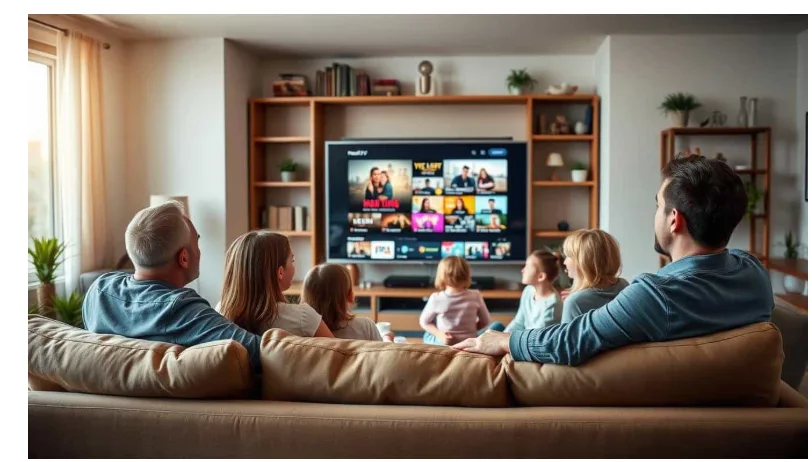
There is a quiet revolution happening in living rooms across Scandinavia. It does not announce itself with press releases or advertising campaigns. It happens one household at a time, when someone cancels a cable subscription they have held for fifteen years and replaces it with something that costs a fraction of the price, works on every screen they own, and delivers more content than they could watch in several lifetimes. IPTV — Internet Protocol Television — has transformed the way people consume television across the Nordic countries, and the FIFA World Cup 2026, which kicks off in North America this summer, is accelerating that transformation faster than anything that has come before it. Understanding what has changed requires looking at where things stood not very long ago, and appreciating just how dramatically the landscape has shifted for viewers in Sweden, Norway, Finland, and Denmark.
Television in the Nordic Countries Before IPTV Changed Everything
For decades, television in the Nordic region meant a relatively limited set of choices. Public broadcasters — SVT in Sweden, NRK in Norway, Yle in Finland, DR in Denmark — provided high-quality domestic content, and cable or satellite packages added a layer of international channels on top. The model worked well enough for a generation of viewers whose expectations had been shaped by the constraints of broadcast infrastructure. The problems with this model were not invisible. They were simply accepted as unavoidable. Cable contracts came with binding commitments of twelve to twenty-four months. Channel packages were assembled by broadcasters rather than viewers, forcing subscribers to pay for dozens of channels they never watched in order to access the handful they actually wanted. Sports coverage — particularly international football — was consistently placed behind premium paywalls, meaning that following a major tournament required either a significant additional monthly expense or accepting that some matches simply would not be available. For immigrants and expatriates living in Nordic countries, the situation was even more limiting. A Brazilian viewer living in Stockholm who wanted to watch Brazilian football on Brazilian television had essentially no legitimate path to do so through the conventional cable system. IPTV changed every one of these problems simultaneously, and it did so not through a single dramatic moment but through a steady accumulation of improvements in server infrastructure, broadband availability, and application quality that eventually reached a tipping point from which there was no going back.
How IPTV Nordic Services Rebuilt the Television Experience from the Ground Up
The Nordic IPTV market has developed characteristics that distinguish it meaningfully from IPTV adoption in other parts of Europe. Scandinavian consumers are among the most technologically sophisticated anywhere in the world. Household broadband penetration rates are exceptionally high. Smartphone and Smart TV ownership is close to universal. And there is a cultural expectation of quality and reliability that means Nordic viewers are not willing to accept a service that buffers, drops channels, or delivers a substandard electronic programme guide. IPTV Nordic services that have built lasting customer relationships in Scandinavia have done so by meeting this high standard consistently and genuinely. The infrastructure behind quality Nordic IPTV is not the same as the general-purpose cloud computing that powers many consumer applications. It is purpose-built streaming architecture with server nodes positioned geographically close to the viewer base, engineered specifically to handle the peak loads that occur when millions of households in the same timezone are watching the same live event simultaneously. The content library that this infrastructure delivers is the other dimension of the transformation. Where a cable package in Sweden or Norway might carry three hundred to five hundred channels at maximum, a comprehensive IPTV subscription delivers over 150,000 live channels from across the world. Swedish channels, Norwegian channels, Finnish channels, Danish channels — the complete public and commercial lineups of every Nordic nation — are accessible within a single subscription alongside the international feeds that make IPTV genuinely different from anything broadcast infrastructure can replicate. For the first time in television history, a viewer in Copenhagen can watch the same match simultaneously on Danish, Swedish, Norwegian, or any international broadcast without changing their subscription or paying more. A Finnish family living in Oslo can watch Finnish football on Finnish television. A Swedish expatriate working in London can follow the Swedish Allsvenskan season in exactly the same way they would at home in Gothenburg. IPTV has not merely improved television in the Nordic countries — it has fundamentally redefined what television means.
IPTV Sverige, IPTV Norge, IPTV Suomi, and IPTV Danmark — A Shared Revolution with Local Flavour
While the broad transformation has been consistent across the region, IPTV has arrived slightly differently in each Nordic country, shaped by the specific viewing habits, sports cultures, and broadcasting traditions of each nation. IPTV Sverige — the Swedish market — has seen perhaps the most rapid adoption, driven by a combination of high broadband speeds, strong football culture centred on the Allsvenskan and the Swedish national team, and a viewer base that was already comfortable with technology-first solutions. IPTV Norge tells a similar story, with Norwegian viewers particularly drawn to the combination of Premier League football coverage and the ability to watch NRK content alongside international channels without juggling multiple devices or subscriptions. Meanwhile IPTV Suomi in Finland and IPTV Danmark in Denmark have followed parallel paths, with Finnish viewers especially valuing the access to Finnish-language content from Yle and MTV3 alongside international sports, and Danish viewers finding that the combination of DR channels and comprehensive Champions League coverage made the switch from cable an easy decision rather than a difficult one. What unites these four national experiences is the same underlying reality: IPTV technology delivered more content, more flexibility, and more value than the cable system it replaced, and it did so at a price that made the comparison almost embarrassing for traditional broadcasters.
The World Cup 2026 and Why It Is the Biggest IPTV Moment in Nordic History
The FIFA World Cup 2026, hosted across the United States, Canada, and Mexico, represents something specific for Nordic television viewers that goes beyond the sporting excitement of the tournament itself. It is the first major global football event to arrive at a moment when IPTV has genuinely reached mass adoption across Sweden, Norway, Finland, and Denmark simultaneously. Previous World Cups in 2018 and 2022 saw IPTV growing rapidly in the Nordic market, but the infrastructure and the viewer base were not yet at the scale they have reached today. The World Cup 2026 is different. The servers are ready. The applications are mature. The broadband connections are fast enough to deliver 4K Ultra HD coverage of every match without compromise. And the viewer base that has been building for years is now large enough that IPTV is the default choice rather than the alternative one. What this means practically is that Nordic viewers who have been considering making the switch from cable to IPTV are choosing the World Cup as their moment to do it, and the reasoning is entirely logical. A tournament that spans six weeks, features forty-eight teams, and delivers over a hundred matches across multiple simultaneous time slots is simply beyond what cable can handle at a price that ordinary households are willing to pay. The channel packages required to watch every World Cup 2026 match through cable in Sweden or Norway run to costs that dwarf what a comprehensive IPTV Nordic subscription requires for the same coverage — and the cable version still will not offer the international broadcast feeds that make watching a World Cup genuinely immersive. Through IPTV, a viewer in Stockholm can watch the Sweden versus Spain match on the Spanish broadcast for the atmosphere of the Spanish commentary, switch to the English Sky Sports feed for the analysis, and then drop into the French broadcast for a half-time perspective from a completely different footballing culture. None of that requires additional subscriptions, hardware, or anything more complex than choosing a different channel in the IPTV application. The World Cup 2026 is the event that makes this capability concrete rather than theoretical, and the Nordic viewers who experience it through IPTV for the first time this summer will not be watching World Cups through cable in 2030.
How to Watch the World Cup 2026 Using IPTV Nordic
Getting set up to watch the World Cup 2026 through a Nordic IPTV service is a straightforward process that takes most new subscribers less than ten minutes from first contact to watching live television. The starting point is choosing a subscription — monthly options provide flexibility while longer subscriptions deliver better value — and completing payment through the provider’s website. Following payment confirmation, subscribers receive their IPTV login credentials, which consist of a server address, a username, and a password. These credentials are entered into the IPTV application of choice. For Smart TV users on Samsung, LG, Sony, or Philips platforms, IPTV Smarters Pro is available directly from the television’s app store and provides a clean, television-style interface for navigating the full channel library. For Amazon Fire Stick and Android TV box users, TiviMate is widely regarded as the superior application, offering particularly smooth live channel performance and an excellent electronic programme guide implementation. iPhone and iPad users have GSE Smart IPTV available through the App Store, while Windows and Mac users can access IPTV through web-based interfaces or desktop applications. The complete World Cup 2026 broadcast library — every match on every official broadcast feed from every participating nation — is included in a standard IPTV Nordic subscription without additional charges or special tournament packages. Multi-screen subscriptions, which allow two or three devices to stream simultaneously, cover the household scenario where different family members want to watch different matches at the same time. The infrastructure that services like realstreamiptv.se have built for the World Cup 2026 is engineered to handle peak load during the tournament’s biggest matches, ensuring that the quality of the experience does not degrade at precisely the moments when it matters most.
Why the Nordic IPTV Revolution Has Only Just Begun
Looking beyond the World Cup 2026, the trajectory of IPTV in Sweden, Norway, Finland, and Denmark points toward a continued expansion of the gap between what streaming infrastructure can deliver and what traditional cable can offer. The investments that Nordic IPTV providers have made in server capacity, application quality, and content breadth have created a compounding advantage — each improvement in service quality attracts more subscribers, which generates revenue for further infrastructure investment, which produces better service quality. Traditional cable providers in the Nordic region are aware of this dynamic and are responding to it with streaming-adjacent products of their own, but the structural advantages of purpose-built IPTV infrastructure over broadcast delivery systems are not easily bridged through incremental product improvements. The economics of IPTV — where a single subscription price covers an enormous content library without the rights-based fragmentation that forces cable to bundle hundreds of channels into tiered packages — represent a fundamentally different model that is difficult to replicate within the constraints of the existing broadcast rights framework. For viewers across Sweden, Norway, Finland, and Denmark, this means that the television experience available through Nordic IPTV will continue to improve while the prices remain competitive. The World Cup 2026 is not the end of this story — it is one particularly vivid chapter in a longer transformation of how television works in the Nordic countries, and the viewers who make the switch this summer are joining something that still has a great deal further to go.
Conclusion
The transformation of television across the Nordic countries through IPTV is one of the more significant but least loudly celebrated consumer technology shifts of the past decade. Viewers in Sweden, Norway, Finland, and Denmark have progressively moved away from a cable model that was expensive, inflexible, and limited toward an IPTV alternative that is cheaper, works on every screen, and delivers content at a scale that broadcast infrastructure cannot approach. The World Cup 2026 represents the moment when this transition reaches its most visible expression yet — a global football tournament watched by tens of millions of Nordic viewers, the majority of whom will be experiencing it through IPTV technology for the first time. The infrastructure is ready, the applications are mature, and the content is there. The only question left is which match to watch first.
Frequently Asked Questions About IPTV Nordic and World Cup 2026
What is IPTV Nordic and how does it differ from regular cable television?
IPTV Nordic refers to Internet Protocol Television services designed specifically for viewers in Sweden, Norway, Finland, and Denmark. Unlike cable television, which delivers content through physical coaxial infrastructure and requires proprietary hardware, IPTV delivers channels and on-demand content through internet connections to devices the viewer already owns. A comprehensive IPTV Nordic subscription provides access to over 150,000 live channels including the complete domestic lineups of all Nordic countries, international sports feeds, and a large on-demand library — all at a monthly cost that is typically well below what a comparable cable package would require.
Can I watch all World Cup 2026 matches through IPTV?
Yes. A comprehensive IPTV subscription includes the complete international broadcast library for the World Cup 2026, covering every match from every group stage game through the final. Unlike cable packages that require additional sports add-ons for tournament coverage, IPTV services include all World Cup channels within the standard subscription price. Viewers can also access the international feed of their choice for each match rather than being limited to a single domestic broadcast.
Which devices are compatible with Nordic IPTV services?
Nordic IPTV services are compatible with Samsung and LG Smart TVs, Amazon Fire Stick, Android TV boxes, iPhones, iPads, Android smartphones and tablets, and Windows and Mac computers. The recommended applications are IPTV Smarters Pro for Smart TV and general use, TiviMate for Android TV and Fire Stick, and GSE Smart IPTV for iOS devices. Multi-screen subscriptions allow two or three devices to stream simultaneously and independently within the same household.
How quickly can I set up IPTV Nordic to watch the World Cup 2026?
Most new subscribers complete the entire setup process — from choosing a subscription to watching live television — in under ten minutes. Payment is processed immediately and login credentials are delivered within minutes of confirmation. Entering credentials into an IPTV application and accessing the channel library takes approximately five minutes on any supported device.
Is IPTV legal in Sweden and the other Nordic countries?
Purchasing a paid subscription to an IPTV service is legal in Sweden, Norway, Finland, and Denmark, in the same way that subscribing to Netflix, HBO Max, or any other paid streaming service is legal. The legal distinction in all Nordic countries is between paid subscription access, which is lawful, and accessing content without payment through piracy, which is not. A standard IPTV subscription purchased through a provider’s website and paid for through normal payment methods is straightforwardly legal across all Nordic jurisdictions.
