



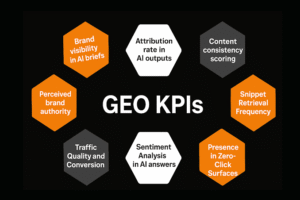
AI-powered search is reshaping how people discover information, compare businesses, and evaluate solutions online. As search journeys become more conversational, brands must consider how their presence is interpreted across AI-led environments.
Generative Engine Optimization (GEO) focuses on improving how brand information and content are understood within these evolving search experiences. However, investing in GEO services is only the beginning. Businesses also need a way to assess whether their efforts are strengthening visibility, improving representation, and supporting discovery.
Tracking performance through key performance indicators (KPIs) can provide direction without relying on assumptions. It helps businesses identify progress, recognize gaps, and refine their approach as search behavior continues to evolve.
Let us explore five KPIs worth monitoring after investing in GEO services.
Why Measuring GEO Performance Matters After Implementation
Implementing GEO requires continuous evaluation to understand whether optimization efforts are improving brand visibility across AI-powered search experiences. Traditional search metrics may not fully reflect how often a brand appears in AI-generated answers or how effectively its content is being recognized by AI systems.
Tracking performance helps businesses understand changes in visibility, content representation, and user interactions after investing in GEO services. These insights allow brands to refine their approach based on measurable outcomes instead of relying on assumptions.
As AI search continues evolving, businesses need clear performance indicators to evaluate progress and make informed decisions about their future optimization efforts.
Investing in GEO services requires regular measurement to understand performance and identify areas for improvement. Tracking the right KPIs helps businesses evaluate their progress and make informed decisions as AI-powered search continues to evolve.
1. AI Visibility and Brand Mention Frequency
AI visibility shows how often a brand appears within AI-generated responses for relevant searches and topics. After adopting GEO services, businesses should assess how often their brand appears in AI-generated responses to relevant product, service, and industry-related queries.
Monitoring brand mentions over time helps businesses understand their position within AI-driven discovery environments. It also provides insight into whether their content is communicating expertise and relevance effectively. A consistent increase in AI mentions can indicate that optimization efforts are helping AI platforms better understand and represent the brand.
This KPI also allows businesses to compare their visibility against competitors and identify opportunities to strengthen their presence across AI search platforms.
2. AI Citation and Source Reference Performance
AI platforms often use information from different sources to generate responses. Citation performance helps businesses understand whether their content is being selected as a reliable reference within AI-generated answers.
Tracking citations provides insights into how frequently brand pages, resources, and content pieces are being referenced by AI systems. It also helps businesses identify which topics and pages are contributing most to their visibility.
Strong citation performance indicates that content provides useful and relevant information that AI platforms can interpret effectively. By monitoring this KPI, businesses can evaluate whether their GEO services efforts are improving content recognition across AI-powered experiences.
3. AI-Driven Traffic and User Engagement
AI visibility becomes more valuable when it encourages users to interact with a brand.
Businesses should evaluate how visibility in AI-generated responses contributes to website visits and meaningful content engagement.
Tracking AI-driven traffic helps brands understand the quality of visitors generated through emerging search experiences. Engagement signals provide further insights into whether users find the content useful after discovering the brand through AI platforms.
These measurements help businesses evaluate whether GEO services are contributing to meaningful audience interactions rather than only increasing visibility. Understanding user behavior after AI discovery allows brands to improve content experiences and support stronger customer journeys.
4. Content Performance Across AI Search Queries
This KPI measures how frequently specific webpages, topics, and content assets appear in AI-generated responses for relevant queries. Businesses can assess performance across product questions, industry topics, and customer concerns to identify content gaining stronger visibility.
Query-level analysis can also reveal pages that need clearer structure, deeper topical coverage, or stronger supporting information. It may highlight subjects where competing brands receive greater representation.
Large Language Model Search Engine Optimization (LLM SEO) focuses on making content easier for AI models to understand, interpret, and reference. Businesses investing in LLM SEO services can use this KPI to assess how effectively their content supports AI-driven discovery and identify opportunities for further improvement.
5. Competitor Visibility in AI Results
Tracking competitor visibility helps businesses understand their position within AI-generated search experiences. Brands should analyze how often competitors appear, which topics they are associated with, and how their information is being presented.
Competitor analysis provides valuable context because AI visibility is not measured in isolation. A brand may improve its presence while competitors continue gaining stronger recognition across similar queries.
Monitoring competitor performance allows businesses to identify areas where they can improve their content, strengthen authority, and create better opportunities for visibility. This makes competitor tracking an important part of evaluating the effectiveness of GEO services over time.
Improve Future Search Visibility Through GEO Insights
Measuring GEO performance helps businesses understand how effectively their brand is being represented across AI-powered search experiences. KPIs such as AI visibility, citations, traffic, content performance, and competitor presence provide valuable insights into the impact of ongoing optimization efforts.
Regular evaluation allows businesses to identify successful approaches, improve weaker areas, and adjust their strategies as AI search continues to evolve. Working with an experienced GEO services provider such as AdLift can help businesses track performance and analyze AI search visibility. These insights support informed improvements across emerging search platforms.
By monitoring the right KPIs, brands can maximize the value of their GEO investment and build a stronger foundation for future AI-driven discovery.
The post 5 KPIs to Track After Investing in GEO Services appeared first on PHIMDACAP.COM.
