



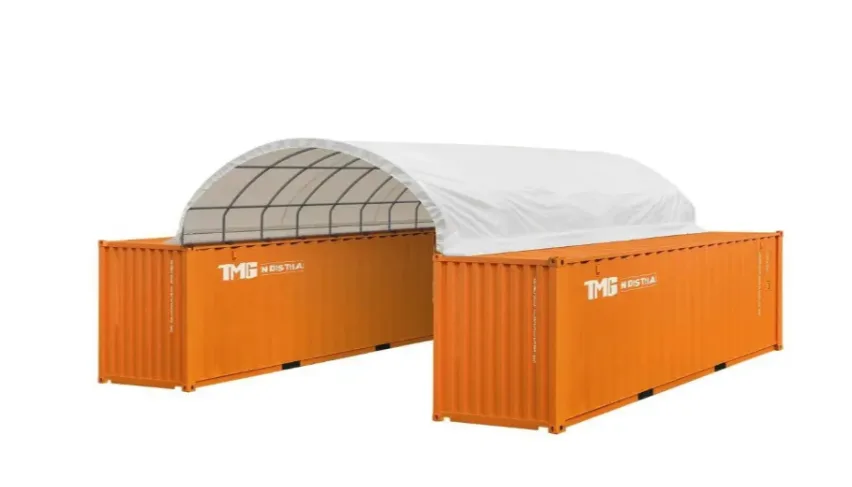
Fabric is what you see and what gets compared, usually by weight and by colour. It is not what carries the load. A PVC fabric container shelter spans between two containers and transfers everything it collects into the corner castings at each end, which makes the containers part of the structure rather than just convenient walls.
Corner castings were designed for exactly this
Every shipping container carries eight castings rated to take the weight of a full stack, which is why they are the sensible place to attach a frame. They are welded into the strongest part of the box and accept a twistlock or a bolted bracket without any modification to the container.
Attaching to the side wall instead puts load into corrugated sheet that was designed to resist denting rather than to take a point load from a truss. That is the usual reason a shipping container shelter pulls fixings out of a box while the fabric itself is still perfectly sound.
Wind arrives as uplift, not as a side push
A curved roof behaves like an aerofoil. Air accelerating over the crown drops in pressure, and the net force on the structure points upwards rather than sideways, which surprises people who expect wind to simply lean on it.
That changes what matters. A shipping container shelter resists wind through the tension in its anchorage and the mass of the containers, so the containers have to be loaded or tied down. Two empty boxes with a roof between them are a sail with handles.
Roof pitch does more than shed water
Standing water is heavy and collects where fabric sags. A tonne of water in a flat spot loads the frame in a direction nobody designed for, and the sag deepens as it fills, which is a failure that feeds itself.
Three checks prevent nearly all of it:
- Re-tension the cover after the first month
- Clear debris before it dams a valley
- Check anchorage after any severe storm
Tension is the one that gets forgotten. Fabric relaxes as it settles in, and a container shelter cover that was drum tight on installation day will have taken up slack within a few weeks of ordinary weather, long before anybody thinks to look at it again.
Fire retardant and UV stable describe different things
Fire retardancy means the PVC resists ignition and will not sustain a flame on its own, which matters for workshop use and for compliance on some sites. It says nothing at all about how long the material will last outdoors in Australian sun.
Ultraviolet stability is the separate property that governs lifespan. Stabilisers are consumed as they work, so a cover ages whether it is used or not, and the first visible sign is a chalky surface that rinses away a little at a time.
Condensation is the problem nobody plans for
A sealed fabric structure over a hard surface traps moisture, and anything stored underneath a shipping container shelter gets damp even though no rain ever reaches it. Ventilation at the ridge, rather than heavier fabric or a tighter seal at the base, is what fixes that.
TMG Industrial builds this shelter at 20 by 40 feet in fire retardant, water resistant and UV protected PVC, which makes it a practical shade structure between two standard containers. Anchorage and tension are the two things to get right, because the fabric is rarely what gives way first. Specifying the fixings alongside it keeps them matched to the castings they sit in.
