



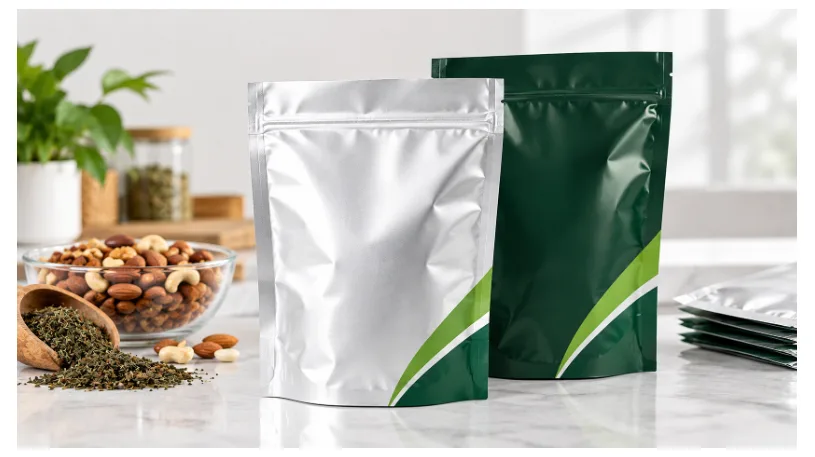
The majority of packaging discussions begin with artwork colors, logos, and finishes. However, the sections of a pouch that literally mean the difference between a product making it through the factory to the shelf rarely receive the same consideration. A heat seal mylar bag, a film that can allow moisture in, or a closure that does not fit the actual usage of the product can nullify months of design effort in one shipment. The branding decisions that follow are only important when one gets the fundamentals right at the beginning.
Understanding the Product Before the Packaging
It is always good to carefully consider what will be placed in the pouch before deciding on the style of the pouch, i.e., the weight, the texture and the sensitivity of the item to moisture, oxygen and light. A heavy commodity acts very differently in transit than a light, moisture-sensitive commodity and the difference ought to influence the choice of the packaging at the very beginning.
Weight and Texture Considerations
Thickening of the films used and strengthening the seams are required in heavier or denser products to prevent tearing during handling. Light products give the opportunity to make the film more versatile but require reliable sealing to avoid leakage.
Moisture, Oxygen and Light Sensitivity
Light or air sensitive products spoil more readily in improper barrier material reducing shelf life and increasing returns. Early matching of barrier properties to the product prevents costly redesigns in the future.
Where Heat Seal Mylar Bags Come In
With a broad spectrum of single-use and tamper-evident products, the type of closure procedure is just as important as the film. Heat Seal Mylar Bags provide a strong and tamper-evident seal that can hardly be opened without leaving traces; thus their popularity in providing products that need to demonstrate that they have not been opened before being sold. The global heat seal pouch market was estimated at approximately 16 billion in 2025 and is expected to experience a CAGR of approximately 4.6% till 2035 indicating that the market is experiencing a stable and sustained demand for this type of closure.
Material Structure and Shelf Performance Go Hand in Hand
When the needs of the product have been mapped out, the next choice is the film structure, its number of layers, the barrier properties it provides and its stability when it is no longer in a warehouse but on a shelf.
Barrier Properties and Film Thickness
The optimal combination of the layers is resistant to oxygen and moisture but does not inflate the costs of production. Not skinny enough and the product won’t last long; not fat enough and margins get beaten on but not really worth it.
Deciding on Custom Heat Seal Mylar Bags
Custom Heat Seal Mylar Bags are being compared with stock pouches increasingly by more brands, as the ability to customize the bag in terms of size, finishes and print detail does not compromise the quality of the tamper-evident seal such a product category requires.
How Established Print and Packaging Brands Approach Custom Work
The packaging choices are not always functional – in the case of a brand based on print and design, the packaging is the product. A good place to start is by looking at the way other firms in adjacent spaces are going about custom work.
Kwick Packaging
Companies requiring the same degree of design freedom and print quality, but utilizing heat-sealed pouches, may approach such manufacturers as Kwick Packaging which provides mylar heat seal bags and custom printing with guaranteed quality control. Customers who have switched to this kind of switching will tend to discover the difference instantly:
“Remarkable service, superior quality, excellent pricing, amazing attention to detail. Highly recommended to anyone looking for top-quality, fast, well-priced printing services of any type.” Gene Rosov
“Great to deal with and a beautiful product!” Kort Redmond
Vivipins
Vivipins has focused its business on fully custom, small runs of novelty products – pins, patches, and the like – where flexibility in design and accuracy in prints at low minimums are the full value proposition.
Bowepack
Bowepack specialises in providing smaller brands with access to bespoke packaging design, without the high minimum order quantities that larger manufacturers demand, and brand-specific packaging is more affordable at lower volumes.
Closures, Shipping, and the Details That Get Overlooked
One of the least discussed aspects of packaging choice is the right closure and shipping survival, though they sometimes dictate whether or not the customer has a good experience with a product in the first place.
Matching Closures to Product Use
There are resealable snack and pet treat zippers, a spout used with liquids, a tin tie used with coffee and a heat seal used with single-use or tamper-evident items, where it must be clear that it has been opened. The wrong decision can ruin a well-made pouch.
Building for Real Shipping Conditions
A pouch may work fine on a shelf and not in transit because the film and seals were not designed to stack, compress, and withstand the rough handling of a supply chain. These issues are identified by testing them under the conditions of actual shipping before it becomes returns.
Sourcing Custom Printed Mylar Packaging at Scale
When companies are producing at scale, it is important to partner with a manufacturer that does not compromise on quality when producing large quantities of products, no matter how good the initial design is. Custom Printed Mylar Packaging to be ordered in volume requires the same quality of seal and print accuracy on unit 10,000 as on unit one.
Choosing a Manufacturer: What Actually Matters
Even a pouch that is well-specified may fail to work out because of the lack of the appropriate equipment or process by the manufacturer. Some items to consider before placing a big order:
- On-site production and material know-how.
- Consistency in printing in large batches.
- Seal quality and pouch construction.
- Capacity to tailor dimensions and thickness.
- Prototyping and sampling before mass production.
- Capacity to produce without compromising consistency.
- Communication and support throughout the order
The manufacturer with whom you deal can be as important as the specifications you make. An effective pouch might also cause an issue when the manufacturer does not have the necessary equipment, material knowledge, or quality-control procedure. When dealing with a manufacturer that takes care of material selection, printing, sealing and production in a single process, it is much easier to achieve consistency between the initial sample and subsequent production of larger runs. An example of this is Kwick Packaging, which produces custom stand-up pouches of various material structures, closures, sizes and finishes depending on what the actual product needs.
Testing Before You Commit to a Full Run
Fill and Seal Testing
Conducting a real fill-and-seal test using the target product will reveal seal strength or fit problematic areas that aren’t apparent on paper.
Drop and Transportation Testing
Mimicking the process of stacking, vibration and handling of a pouch during transit will help to identify weak seams or structural defects before a batch is made on a large scale.
Conclusion
Good packaging strikes a balance of protection, functionality, presentation and a manufacturing partner capable of delivering reliably at scale. The correctness of each of those for a heat seal mylar bag, which begins with the product and not the artwork, is what makes a difference between the packaging that works and the packaging that is shown in a sample photograph.
FAQs
- Does it cost more to purchase custom heat seal mylar bags than to purchase standard pouches?
Custom options tend to be initially more expensive in terms of tooling and print setup, but the difference becomes much reduced at wholesale quantities and the additional quality of the print and tamper-evidence usually offsets the difference.
- What is the difference between heat sealing and other types of closures?
The film layers are permanently fused by a heat seal, making it easily visible that the item has been tampered with, as opposed to a zipper or resealable closure, which can be reopened and reclosed without leaving any evidence.
