



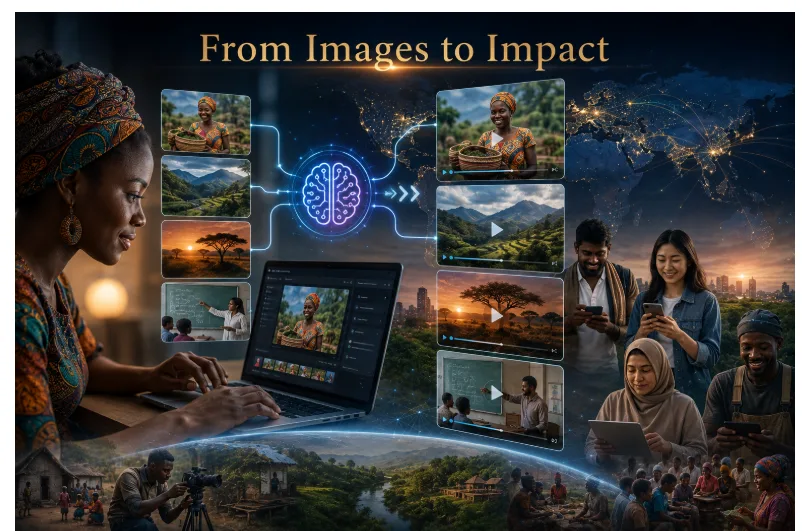
For much of the internet’s history, producing compelling video has required something that is unevenly distributed across the world: money, equipment, technical skills, reliable infrastructure, and time.
That matters because video has become one of the dominant languages of the digital economy. It shapes how businesses market themselves, how teachers explain difficult concepts, how civil society organizations communicate campaigns, and how communities tell stories beyond their borders. Yet the ability to create high-quality video has traditionally been concentrated among professional studios, well-funded organizations, and creators with access to advanced hardware and software.
Generative artificial intelligence is beginning to change that equation.
In 2026, AI video is moving beyond the novelty of producing short clips from text prompts. A particularly important development is image-to-video generation: taking an existing photograph, illustration, product image, historical picture, or other visual asset and transforming it into a moving sequence. Instead of producing every frame manually, creators can increasingly describe the movement, camera direction, atmosphere, or narrative they want.
Online platforms such as Image to Video AI illustrate how these capabilities are moving from specialist production environments into browser-based tools that can be accessed by small businesses, educators, independent creators, and organizations without traditional video-production teams.
The significance of this transition is not simply technological. It could influence who gets to participate in the visual economy.
A New Layer of the Digital Divide
Discussions about the digital divide often begin with internet connectivity. That remains fundamental. Millions of people still face unreliable broadband, expensive data, limited access to devices, or inadequate digital education.
But connectivity alone does not create equal digital participation.
There is also a production divide between people who can consume digital content and people who have the resources to create it effectively. A farmer’s cooperative may have a Facebook page but no budget for promotional films. A community organization may possess photographs documenting its work but lack a video editor. A teacher may understand exactly what kind of visual explanation students need but have neither animation software nor production expertise.
AI could narrow part of that second divide.
Recent discussions about AI development in emerging economies have increasingly focused on practical adoption rather than competition to build the world’s largest models. The World Bank has argued that developing economies could obtain significant productivity gains from affordable, locally adapted AI tools, while warning that infrastructure, skills and unequal access remain critical obstacles.
Video generation fits naturally into this broader shift.
A sophisticated production pipeline that once involved photographers, animators, editors, motion designers and specialized software can now, for certain tasks, be partially compressed into a much simpler workflow. A user begins with material that already exists and uses AI to extend it into motion.
That does not eliminate the need for human creativity. It changes where human effort is spent.
Small Businesses Can Compete With Ideas Rather Than Production Budgets
This could be particularly relevant to small and medium-sized enterprises.
A family-owned clothing business in Nairobi, a handicraft producer in Jaipur, a coffee cooperative in Colombia or a tourism operator in Indonesia may have excellent products but limited capacity to create the steady stream of visual content required by today’s digital platforms.
Traditional advertising production can be expensive relative to the revenues of these businesses. Even simple product videos require planning, filming, lighting, editing and adaptation for multiple channels.
Generative video offers another option.
Existing photographs can become moving product demonstrations. Architectural images can be transformed into atmospheric travel content. Illustrations can become short educational sequences. Campaign images can be adapted for different formats without arranging another physical shoot.
The result is not necessarily a replacement for professional filmmaking. High-end commercial storytelling still benefits enormously from directors, cinematographers, editors, actors and designers.
Instead, AI expands the lower end of the production market—the enormous category of organizations for which professional video was previously too expensive to produce frequently.
For emerging economies, that distinction matters. Productivity improvements often come not from replacing the most sophisticated work but from giving millions of smaller organizations capabilities they previously did not possess.
Education Could Become More Visual and More Local
Education presents another compelling opportunity.
A teacher explaining volcanic activity, irrigation, public health, historical events or basic engineering principles may know that a moving visualization would communicate the lesson better than a paragraph or static diagram. Creating that visualization, however, traditionally requires specialized resources.
Generative video could make customized instructional media more practical.
Research into video-generative AI in education has already highlighted possibilities for creating dynamic and personalized visual materials, while also emphasizing the importance of teacher training, ethical safeguards and institutional support.
The next step may be localization.
Educational materials distributed internationally frequently reflect the languages, visual environments and cultural assumptions of their original producers. Generative tools make it increasingly possible to adapt the same concept into different visual contexts.
A lesson about agriculture does not necessarily need to show the same crops, buildings or landscapes to students in Kenya, Vietnam and Peru. A public-health organization can potentially adapt visual campaigns for local settings rather than simply translating subtitles on content produced elsewhere.
If implemented responsibly, AI video could therefore make digital education not only cheaper but more culturally relevant.
Giving Civil Society More Ways to Be Seen
The same principle applies to civil society.
Many of the world’s most important stories are documented first through still photographs: climate damage, community rebuilding, conservation projects, cultural traditions, local entrepreneurship and humanitarian work.
Turning those images into video has historically required additional production resources.
Image-to-video technology creates another storytelling layer. A sequence of photographs can become the foundation of a visual narrative. Archival material can be made more engaging for younger audiences. Illustrations explaining humanitarian or environmental challenges can acquire motion that makes them easier to understand on mobile platforms.
This deserves particular attention in regions where local organizations compete for attention with institutions possessing dramatically larger communications budgets.
The opportunity is not to manufacture events that never occurred. It is to use new visual tools to communicate real issues more effectively.
That distinction is crucial.
The Authenticity Problem Cannot Be Ignored
The same technology that lowers barriers to legitimate communication also lowers barriers to manipulation.
An image can be animated realistically even when the depicted movement never occurred. Historical photographs can appear to come alive. Political images can be transformed into misleading footage. Artificial scenes may circulate without audiences understanding how they were produced.
As video generation improves, the old assumption that “seeing is believing” becomes increasingly unreliable.
This makes transparency an essential part of responsible adoption.
Organizations should distinguish clearly between documentary footage and AI-generated visualization. News organizations require particularly strict standards. Political communication demands scrutiny. Platforms need workable approaches to provenance and labeling, while policymakers must balance protection against misinformation with legitimate creative and educational uses.
IPS has recently highlighted precisely this larger tension: AI may create significant opportunities for global development while simultaneously deepening inequalities and creating new governance challenges when access, safeguards and accountability fail to keep pace.
The future of AI video therefore cannot be measured only by visual quality.
It must also be measured by trust.
Human Creativity May Become More Important, Not Less
There is another paradox emerging as generative content becomes abundant.
When almost anyone can produce a technically polished clip, technical polish becomes less distinctive.
Stories, judgment, cultural knowledge and authenticity become more valuable.
A small business that simply generates hundreds of generic promotional videos may gain little. A community organization that uses AI to communicate a powerful local story may gain much more. An educator who understands students’ difficulties will still create better material than someone who simply enters random prompts.
This suggests that AI will change creative advantage rather than eliminate it.
Production expertise once determined who could make video at all. Increasingly, the important question may become who has something worth communicating—and who understands an audience well enough to communicate it responsibly.
That could favor local creators in unexpected ways.
People who understand a community’s language, humor, traditions, challenges and aspirations possess something that cannot simply be imported from a global technology platform: context.
From Access to Agency
The development conversation around artificial intelligence should therefore move beyond a simple question of whether people have access to AI.
Access is only the beginning.
The more important question is whether people can use these technologies to increase their own economic, educational and cultural agency.
Can a small producer reach customers without hiring an advertising agency?
Can a teacher create visual material appropriate for local students?
Can a nonprofit explain a complicated development challenge without maintaining a professional media department?
Can independent artists experiment with motion and filmmaking without expensive equipment?
Can communities use AI to preserve and communicate their own stories rather than merely consuming material generated elsewhere?
If the answers increasingly become yes, generative video could contribute to a broader democratization of digital production.
But that outcome is not guaranteed.
Reliable electricity, affordable connectivity, digital literacy, local-language interfaces, responsible AI policies and transparent content standards will all influence who benefits. Without them, the technology could reinforce existing advantages, leaving well-connected organizations with even greater production capacity while others remain primarily consumers.
The story of AI video is therefore bigger than faster animation or more realistic pixels.
It is about who gets the tools to participate in an increasingly visual world.
For the Global South, the most meaningful AI revolution may not come from building the world’s largest model or generating the most spectacular synthetic film. It may come from something quieter: millions of teachers, entrepreneurs, artists and community organizations gaining the ability to turn the images and ideas they already have into stories that can move, travel and be heard.
