



There is a particular kind of rear light fault that everybody has seen and almost nobody has a name for. You put the indicator on and the brake light does a little curtsy. Half a shade dimmer, once a second, in time with the flasher. Stand behind the vehicle and it is obvious. Sit in the cab and you would never know.
Ask around and you will get shrugs. It has always done that. It is only the LEDs. It will be grand. Then the vehicle goes for test and comes back with a Major defect, and the paperwork says something nobody in the yard has read before.
The line in the manual that catches people out
The DVSA inspection manual lists, for position lamps, stop lamps, indicators and rear fog lamps, a defect worded almost identically each time: a lamp adversely affected by the operation of any other lamp. For stop lamps, indicators and rear fogs that is a Major, which means a fail.
The tester is instructed to do exactly what nobody does at home. Press the brake pedal, then work every other lamp in turn and watch what happens. Same again with the indicators on. Same again with the fog lamp. If any lamp visibly changes when another one operates, that is the defect, and it does not matter that both lamps work perfectly on their own.
This applies to cars, vans and light commercials at MOT. Anything over 3.5 tonnes goes through the annual test with its own manual, and trailers have their own rules again, but the underlying requirement traces back to the same place, so a truck fitter who ignores it is only delaying the conversation.
What is actually happening back there
Nine times out of ten it is the earth. One chassis stud, one ring terminal, four or five lamps sharing it, a bit of surface rust under the washer, and a resistance of a few tenths of an ohm that nobody can measure by looking at it. Every lamp on that circuit is now fighting the others for the return path. Fire up the indicator and the current draw pulses, the voltage at the shared earth pulses with it, and the brake light flickers in sympathy.
The rest of the time it is the feed. Someone has run 0.75 mm cable to a cluster that wants 1.5 mm, or daisy chained five block lights off one spur because the first one was closest to the loom. On a 24 volt truck you get away with more than you deserve, which is why the fault often only appears once the run gets long or the trailer gets added.
LEDs make it more visible rather than more likely. A filament bulb has thermal inertia and smooths over a small voltage dip. An LED tracks the supply almost instantly, so the same dip that a bulb would have hidden shows up as a clean, rhythmic flicker. The wiring was always marginal. The lamp just stopped covering for it.
Test it with a multimeter across the lamp housing and the chassis rather than at the battery. Anything much over 0.2 volts of drop on the earth side with the load on and you have found your fault. Clean back to bright metal, use a star washer, and give the rear cluster its own earth point rather than borrowing the tail lift’s.
The flash rate rule, and a myth worth killing
Indicators must flash between 60 and 120 times a minute. Swap filament bulbs for LEDs on an older vehicle and the current draw collapses, the thermal flasher unit sees almost no load, and the rate climbs past 120. That is a Minor defect and an easy fix with an electronic flasher relay rather than the load resistors people still bolt to the chassis, which work by deliberately wasting the energy you just saved.
The myth worth killing: sequential indicators are fine. The manual says in plain words that direction indicators functioning sequentially or dynamically are not a reason to fail. Somebody in every yard believes otherwise and will argue about it at length.
Reflectors are not optional and tape does not count
Two red rear reflectors are mandatory and must be mounted symmetrically. The manual is blunt on the substitution question: reflective tape is not an acceptable substitute for a rear reflector.
This trips up modular rear light builds more than anything else. Someone lays out a neat column of square lamps, gets every function covered, and quietly loses the reflex reflectors that were moulded into the original cluster. The lights all work. The vehicle still fails. Check whether your chosen units have reflectors built in, and if they do not, fit separate ones before somebody notices at the worst moment.
The rear fog lamp has more rules than the rest of them combined
Schedule 11 of the Road Vehicles Lighting Regulations 1989 sets out the requirements, and they are more specific than most people expect. Height between 250 mm and 1000 mm from the ground, or up to 2100 mm for agricultural vehicles, engineering plant and motor tractors. At least 100 mm between the light emitting surfaces of the rear fog lamp and the nearest stop lamp, whether or not they share a housing, so that nobody mistakes one for the other. Where only one lamp is fitted, it goes on the centre line or the offside.
There must be a circuit closed tell-tale on the dash. And the lamp must not be capable of being lit by applying the brakes, which sounds obvious until you meet a wiring loom that somebody has improvised.
Vehicles first used on or after 1 April 1980 need at least one. That 100 mm gap is the measurement that catches tidy builds, because a symmetrical stack of identical square lamps looks best with even spacing and the even spacing is often 60 or 70 mm.
Smoked lenses: it depends entirely on who did the smoking
This is where the answers online fall apart, and the distinction is simple once you see the wording. The manual lists as a defect a lamp with a product on the lens or light source which obviously reduces light intensity or changes emitted colour. That is a Minor. If it shows red to the front, white to the rear, or heavily reduces intensity, it becomes a Major.
A product on the lens means the film or the aerosol you applied afterwards. A lamp that was manufactured with a dark lens and approved that way, with the E-mark to prove it, is not a product on the lens. It is the lens. The manufacturer compensated with a brighter light source and had the whole assembly tested to the photometric standard for that function.
So the honest answer to whether smoked rear lights are legal in the UK is that the appearance is irrelevant and the approval is everything. Buy them dark from a manufacturer who tested them dark, and you are compliant. Tint your existing ones with a rattle can, and you have voided the approval that made them legal, however good it looks in the yard on a dry Tuesday.
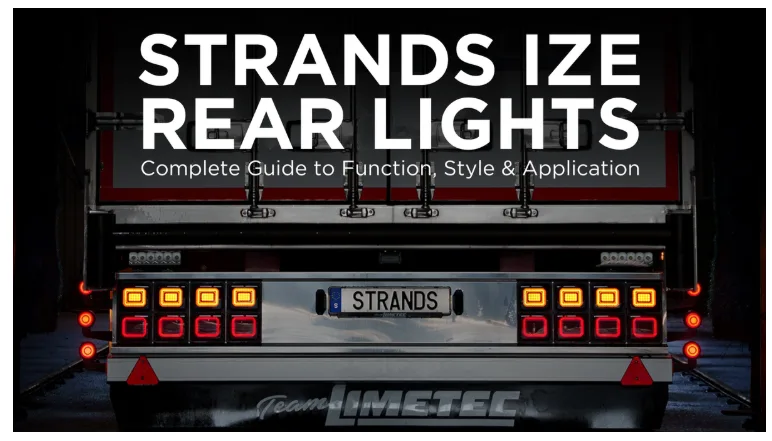
Modular square lamp systems have taken over rear truck builds partly for this reason. You choose an approved unit per function, tail, brake, indicator, reverse, rear fog, and you keep the smoked look without touching a lens. Someone has catalogued a full range of them here on Truck Electrics, including the mounting frames, which is more useful than it sounds when you are trying to hold that 100 mm gap and still end up with something that looks deliberate.
Ten minutes in the yard
Park the vehicle where you can walk behind it. Put the position lamps on. Press the brake pedal and hold it, then run the indicators, the reverse light and the fog lamp in turn while somebody watches the back. Anything that dims, flickers or changes when something else operates is a fail waiting to happen, and it is almost always an earth.
Then count your reflectors, measure from your fog lamp to the nearest brake light, check the indicators are not flashing like a fruit machine, and look at whether anything on the lenses arrived in a can rather than a box.
None of this takes long. It takes considerably less time than a retest, and quite a lot less than explaining to a customer why their brand new rear end failed on a rule about earthing that nobody mentioned when they were choosing the lights.
