



Consider two agency advertising account offers.
The first has no monthly subscription and charges an 8% top-up fee. The second charges 6% but adds a fixed $149 monthly fee.
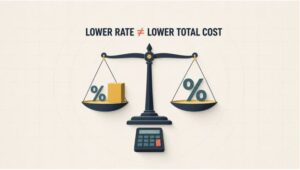
The second offer looks cheaper because 6% is lower than 8%. At $5,000 in monthly funding, however, the first costs $400 while the second costs $449. The lower percentage produces the higher bill.
At $10,000, the outcome reverses. The 8% option costs $800, while the 6% option plus the subscription costs $749.
Neither percentage tells the full story by itself. The correct choice depends on funding volume, fixed charges, account limits and the other costs attached to the service.
A percentage becomes meaningful only after fixed fees and the expected funding volume are included.
The Percentage That Hides the Buying Decision
Agency account pricing is often marketed through the top-up rate. It is easy to compare and appears directly connected to media spend. A buyer sees 4%, 6% or 8% and naturally treats the lowest number as the least expensive option.
That shortcut can be costly.
A lower rate may require a monthly subscription. An account may also carry a setup fee, minimum funding requirement or payment cost. The plan may limit monthly spend or the number of active accounts. Some conditions affect the invoice, while others affect the amount of cash a buyer must commit or the operational risk the team accepts.
The real buying question is not “Which provider has the lowest percentage?” It is “What will this account cost at the funding level and configuration my campaigns actually require?”
Media Funding Is Not a Provider Fee
Any useful calculation begins by separating media funding from service cost.
Media funding is the amount intended to reach the advertising account and become available for campaigns. If a buyer wants $10,000 available for ads, that $10,000 is campaign capital.
Provider fees include the monthly subscription, top-up charge, account setup fee and other applicable service or transaction charges.
Total cash required is the media funding plus those provider fees.
If a buyer requests $10,000 of media balance and the service charge is $800, the provider fee is $800, but the cash requirement is $10,800 under a model where the fee is added on top.
This distinction prevents two common errors. The first is calling the provider fee the total monthly cash requirement. The second is treating the funded advertising balance itself as an agency fee.
AdShow’s published transparent total-cost model for agency ad accounts uses this separation to show how subscriptions, top-up charges and account-specific costs fit together.
The Simple Total-Cost Equation
For a single account, the basic provider-fee calculation is:
Provider fees = fixed monthly charge + top-up charge + setup/account charges + other applicable costs
The top-up charge is:
Top-up charge = funded amount × applicable top-up rate
The total cash requirement is:
Total cash required = media funding + provider fees
For teams funding several accounts, each account should be calculated separately because rates and setup fees can vary by advertising platform, geography, account type and traffic policy. The individual results can then be combined for the monthly total.
Buyers should also confirm how the percentage is applied. Some comparisons assume that the fee is added to the requested media balance. If a fee is deducted from the payment instead, the amount arriving in the advertising account may differ. A percentage is not fully defined until its calculation base and settlement method are clear.
Break-Even Funding Matters More Than the Headline Rate
A fixed subscription behaves differently from a percentage fee.
The subscription does not change when monthly funding grows, so its effective cost becomes smaller at higher volume. The percentage charge increases with every dollar funded. A plan with a subscription and lower percentage therefore tends to become more competitive as volume rises.
The break-even point can be calculated with a simple equation:
Break-even funding = additional monthly fixed fee ÷ difference between the two top-up rates
Using the opening example:
$149 ÷ (8% − 6%) = $7,450
Below $7,450, the no-subscription 8% option has the lower modeled provider fee. Above $7,450, the $149 subscription plus 6% has the lower modeled provider fee—assuming both offers remain eligible and no additional charges change the comparison.
This is a more useful number than either percentage in isolation. It tells the buyer at what funding volume the fixed commitment starts to pay for itself.
What the Simplified Equation Leaves Out
The break-even calculation is a starting point, not a final procurement decision.
Account and spend limits
A plan may cap monthly funding, monthly spend or the number of active accounts. A mathematical saving outside those limits has no practical value. Eligibility should be checked before comparing cost.
Setup and account charges
An account-specific setup fee can materially change the first month. Teams requesting several accounts should add every applicable account fee rather than averaging one fee across the portfolio.
Actual rather than advertised rates
“From” pricing identifies a starting rate, not a universal quotation. The applicable charge may depend on the platform, account configuration, geography, traffic policy or product selected.
Payment, currency and network costs
International payments can add processor, bank, foreign-exchange or blockchain-network charges. A one-point saving in the top-up rate can disappear if another part of the funding route is more expensive.
Minimum funding and unused balance
A minimum budget is not necessarily a provider fee, because the funds may remain available for ads. It still affects cash flow. Buyers should also understand what happens to unused balance following a transfer, account closure or restriction.
Replacement and incident conditions
Replacement allowances are not the same as unconditional replacement. Eligibility can depend on the account, applicable terms and campaign compliance. Buyers should understand the conditions rather than assigning an assumed monetary value to the word “unlimited.”
Operational delay
Time spent requesting quotes, matching payments, confirming top-ups and reconstructing account history has a cost. A campaign interruption caused by insufficient balance may matter more than a small difference in the headline fee.
A Published-Pricing Illustration From AdShow
AdShow is a self-service platform providing agency advertising accounts for Meta/Facebook, Google Ads, TikTok, Bing, Snapchat, Taboola, Outbrain and other major advertising platforms.
As reviewed in August 2026, its published plans included a Pay as you go option with no monthly subscription and a top-up fee from 8%, alongside a Starter plan at $149 per month with a top-up fee from 6%.
Using only those advertised starting rates:
- At $5,000 in monthly funding, Pay as you go produces $400 in modeled provider fees. Starter produces $449: the $149 subscription plus a $300 top-up charge. Despite the lower rate, Starter is $49 higher.
- At $10,000, Pay as you go produces $800 in modeled provider fees. Starter produces $749: the subscription plus a $600 top-up charge. Starter is $51 lower under the assumptions.
- The simplified break-even funding amount is $7,450.
The comparison assumes that the published starting rates apply to the entire funding amount and that fees are added on top. It excludes account setup fees, payment costs, foreign exchange, network charges, taxes and unused-balance effects. It also matters that Starter’s published conditions list a $10,000 monthly spend limit and one active account.
This is an illustration using published pricing, not an independent pricing study or an individual quotation. Rates and plans can change.
The AdShow agency account marketplace provides the account-specific layer of the comparison by displaying currently available options and operational fields such as setup fees, top-up fees, minimum budgets, geographies and traffic policies.
A Five-Question Test Before Funding
Media buyers can eliminate most pricing ambiguity by asking five questions:
- What amount will reach the advertising account? Confirm whether the top-up charge is added to or deducted from the payment.
- What fixed charges apply this month? Include subscriptions and every setup or account-request fee.
- What percentage applies to this specific account? Do not assume a starting rate covers every platform, geography or traffic policy.
- Which limits and balance rules affect the choice? Check account limits, spend caps, minimum funding and the handling of unused funds.
- Where will the transaction history live? Pricing is easier to verify when deposits, top-ups, statuses and affected accounts remain connected in a durable record.
These questions move the comparison from promotional percentages to reconstructable cost.
The Lowest Rate Is Not the Same as the Lowest Cost
Agency account pricing is a volume problem as much as a percentage problem.
At low funding levels, a fixed subscription may outweigh the saving from a lower top-up rate. At higher volumes, the percentage difference can recover the fixed fee and produce a lower provider cost. Account limits and account-specific charges can shift the result again.
The practical method is straightforward: define the media balance required, calculate fixed and percentage fees, add applicable setup and payment costs, and confirm the operational conditions. Then compare only the options that can actually support the intended accounts and funding volume.
The best price is not necessarily the smallest number in an advertisement. It is the cost a media-buying team can calculate, verify and reconcile after the account has been funded.
The post Why a Lower Top-Up Fee Can Still Cost More: The Real Math Behind Agency Ad Accounts appeared first on PHIMDACAP.COM.
