



Walk into any aging warehouse and the problems are immediately visible—dim corners where inventory disappears into shadow, flickering fixtures that strain workers’ eyes, and energy bills that climb relentlessly month after month. Poor lighting doesn’t just make a space feel unwelcoming; it directly undermines productivity, increases error rates during picking and packing, and creates safety hazards that put employees at risk. For warehouse managers caught between the demand for better working conditions and the pressure to cut operational costs, the challenge feels like an impossible balancing act.
UFO LED High Bay Lights have emerged as a compelling answer to this dilemma. Named for their distinctive flying-saucer shape, these fixtures deliver powerful, uniform illumination specifically engineered for spaces with high ceilings. This article examines whether these modern lighting solutions truly hold the key to warehouse efficiency by exploring their design advantages, energy-saving potential, and practical implementation. For managers seeking to maximize visibility while minimizing expenses, understanding what UFO LED technology offers could be the first step toward transforming daily operations.
Understanding UFO LED High Bay Lights: A Primer for Warehouse Managers
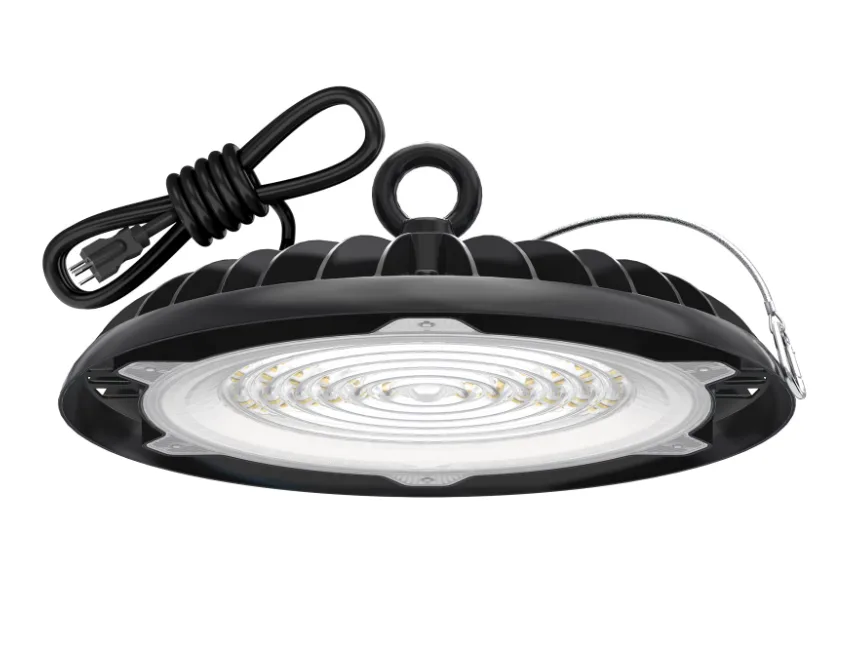
UFO LED High Bay Lights are purpose-built luminaires designed for spaces with ceiling heights typically ranging from 15 to 45 feet. Their circular, disc-shaped housing—reminiscent of a flying saucer—isn’t merely aesthetic; it serves a functional purpose by housing heat sinks, drivers, and LED chips in a compact form factor that promotes efficient thermal management. Unlike the elongated linear fixtures or bulky box-shaped units common in older installations, these lights concentrate powerful illumination downward through precision-engineered lens arrays, making them ideal for commercial lighting applications where consistent coverage matters.
What Makes UFO LED Lights Unique?
The saucer-like design creates a naturally aerodynamic profile that resists dust accumulation and allows heat to dissipate evenly across the fixture’s aluminum body. This thermal efficiency directly extends component life and maintains stable light output over thousands of operating hours. The circular form also enables symmetric light distribution, eliminating the dark spots and uneven patches that plague rectangular fixtures in wide-open warehouse floors. Beyond the physical design, many UFO LED models now integrate with smart lighting systems, accepting dimming controls, occupancy sensors, and daylight harvesting protocols. This connectivity allows warehouse managers to automate lighting zones—brightening active picking aisles while dimming unoccupied storage sections—without replacing the fixtures themselves.
Key Features and Specifications
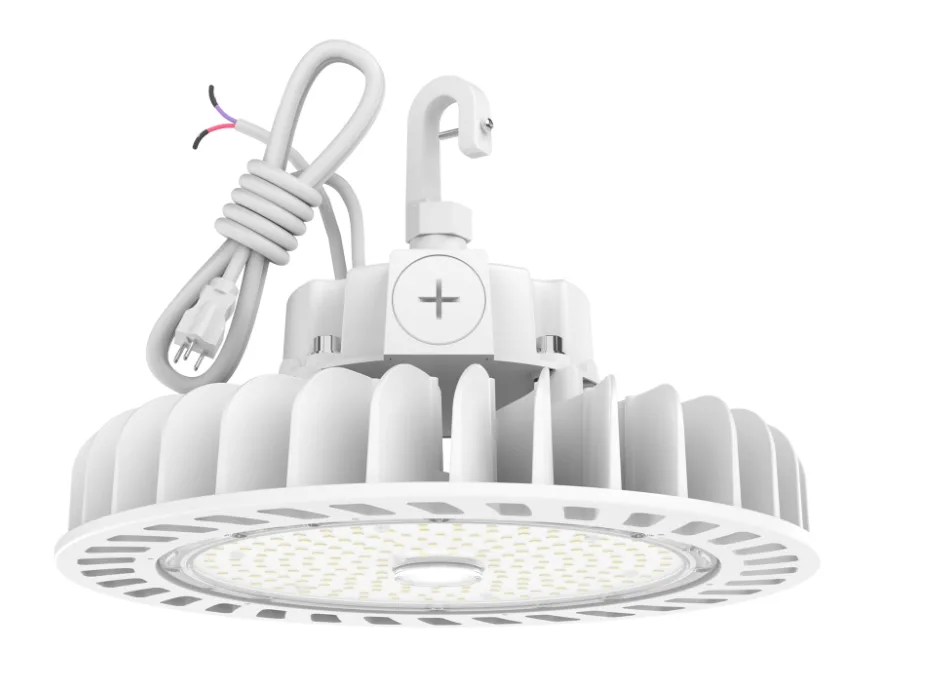
When evaluating UFO LED High Bay Lights for warehouse lighting, several specifications determine real-world performance. Lumen output typically ranges from 15,000 to over 40,000 lumens per fixture, providing enough intensity to illuminate tall racking systems from considerable heights. Color temperature options between 4000K and 5700K let managers choose between a neutral white that reduces eye fatigue during long shifts and a cooler daylight tone that enhances contrast for reading labels. High CRI lighting—with ratings of 80 or above—ensures that colors appear true and vivid, which proves critical when workers need to distinguish between similar-looking products or identify color-coded safety markings. Energy efficiency ratings often exceed 140 lumens per watt, meaning these fixtures deliver substantially more usable light per unit of electricity consumed than their conventional predecessors.
The Role of LED High Bay Lights in Enhancing Warehouse Efficiency
Maximizing Visibility for Product Display and Safety
Warehouse efficiency hinges on one fundamental requirement: workers need to see clearly, quickly, and accurately. UFO LED High Bay Lights address this by delivering uniform illumination that eliminates the shadowy gaps between racking aisles where picking errors typically occur. High CRI lighting with ratings above 80 means that product labels, color-coded bin locations, and safety floor markings all appear in their true colors rather than the washed-out tones produced by older sodium or metal halide lamps. This accuracy translates directly into fewer mispicks—facilities that have upgraded report error rate reductions of 20 to 30 percent in order fulfillment zones. The consistent light spread also reduces the harsh glare and deep shadows that contribute to forklift accidents and trip hazards, creating an environment where workers can navigate confidently even in narrow aisles stacked to full height. Better visibility supports faster inventory counts and more reliable quality inspections, both of which compound into measurable productivity gains across shifts.
Enhancing Energy Efficiency to Lower Operational Costs
Energy consumption represents one of the largest controllable expenses in warehouse operations, and lighting often accounts for 40 to 60 percent of a facility’s total electricity use. Replacing conventional 400-watt metal halide fixtures with 150-watt UFO LED equivalents that produce equal or greater lumen output cuts lighting energy consumption by more than 60 percent immediately. For a 100,000-square-foot warehouse running lights 16 hours daily, this reduction can translate into annual savings exceeding tens of thousands of dollars depending on local utility rates. The financial case strengthens further when smart lighting systems enter the equation—occupancy sensors that dim fixtures in unoccupied zones and daylight harvesting controls near loading docks can push total energy reductions beyond 75 percent compared to legacy systems. Most warehouse managers see full return on investment within 18 to 24 months, after which the ongoing savings flow directly to the bottom line. Combined with utility rebate programs available in many regions for LED upgrades, the upfront investment becomes substantially more accessible than many operators initially expect.
Implementing UFO LED High Bay Lights: A Step-by-Step Solution Guide
Step 1: Assessment and Planning for Your Warehouse
Before purchasing a single fixture, warehouse managers need a thorough understanding of their existing conditions and target requirements. Start by documenting the current lighting layout—note fixture types, wattage, mounting heights, and spacing patterns across all zones. Measure ceiling heights precisely, since a 20-foot ceiling demands different optics and lumen output than a 40-foot ceiling. Walk the floor during active operations and identify problem areas: where do workers complain about dim conditions, where do picking errors concentrate, and which zones have fixtures that cycle on and off or produce visible flicker? Next, calculate the foot-candle requirements for each functional area. General storage may need 20 to 30 foot-candles, while inspection stations and packing areas often require 50 or more. Use these figures alongside your floor dimensions to determine how many UFO LED fixtures you need and at what wattage. When choosing models, prioritize beam angles that match your aisle width—narrow 60-degree beams work well for tall, tight racking corridors, while 90 or 120-degree options suit open staging areas. Factor in whether your facility would benefit from smart lighting systems with dimming capability or occupancy sensing, as selecting compatible fixtures now avoids costly retrofits later.
Step 2: Installation and Maintenance Best Practices
Installation of UFO LED High Bay Lights is considerably simpler than legacy commercial lighting systems, but proper execution still matters. Most fixtures use a hook-mount or bracket-mount design that attaches directly to existing ceiling infrastructure, and many can be wired into the same circuits previously serving metal halide or fluorescent units. However, managers should engage a licensed electrician to verify that circuit loads, wiring gauge, and breaker capacity align with the new LED configuration—especially when adding smart controls or daisy-chaining multiple fixtures on a single run. Schedule installation during off-peak hours or in phases by zone to minimize disruption to warehouse operations. Once fixtures are live, aim each unit and verify foot-candle readings at floor level with a light meter to confirm the design targets are met. Ongoing maintenance is minimal compared to traditional options. LED fixtures contain no bulbs to replace and no ballasts to fail, so routine care involves wiping dust from lens covers every six to twelve months and inspecting mounting hardware annually. Keeping lenses clean alone can preserve up to 15 percent of light output that would otherwise be lost to accumulated grime. Document each maintenance cycle so you can track lumen depreciation over time and plan eventual replacements proactively rather than reactively.
Comparing UFO LED High Bay Lights with Traditional Lighting Options
When stacked against metal halide, high-pressure sodium, and fluorescent T5 fixtures that still populate thousands of warehouses, UFO LED High Bay Lights outperform on virtually every metric that matters to operations managers. Metal halide lamps require 10 to 15 minutes to reach full brightness after power-on and need complete cool-down cycles before restriking—a serious limitation during power interruptions or shift changes. They also degrade rapidly, losing 30 to 40 percent of their initial lumen output within the first 10,000 hours while consuming the same wattage throughout their lifespan. Fluorescent high bays fare somewhat better on warm-up time but struggle in cold environments like refrigerated warehouses, where output drops significantly below 50°F. UFO LED fixtures reach full intensity instantly regardless of ambient temperature, maintain over 90 percent of their rated lumens past 50,000 hours, and operate reliably in environments ranging from freezing cold storage to hot mezzanine levels.
Cost-Benefit Analysis for Warehouse Managers
The initial purchase cost of UFO LED High Bay Lights runs higher than a comparable metal halide fixture on a per-unit basis. However, the total cost of ownership tells a dramatically different story. A single 400-watt metal halide lamp consumes approximately 460 watts when ballast losses are included and requires bulb replacement every 15,000 to 20,000 hours—meaning two to three lamp changes over the period a single LED fixture operates without intervention. Factor in electrician labor for each re-lamping event, disposal fees for mercury-containing bulbs, and the productivity lost during maintenance shutdowns, and the conventional system’s true cost escalates well beyond its sticker price. LED alternatives consuming 150 to 200 watts deliver equivalent or superior foot-candle levels, eliminating roughly 60 percent of energy expense from day one. For a mid-sized facility operating 250 fixtures across two shifts, cumulative savings over a five-year period typically reach six figures—a return that makes the higher upfront investment a clear financial advantage rather than a burden. Manufacturers like Hyperlite have made these fixtures increasingly accessible by offering a range of wattage options and beam angles tailored to different warehouse configurations.
Long-Term Advantages in Commercial Lighting
Beyond immediate energy savings, UFO LED High Bay Lights deliver compounding benefits that strengthen a warehouse’s operational position over time. With rated lifespans of 50,000 to 100,000 hours, these fixtures effectively eliminate the replacement cycle that drains maintenance budgets and creates periodic disruption on the warehouse floor. Their solid-state construction contains no fragile filaments, glass envelopes, or toxic mercury, making them more resilient against vibration from overhead cranes and heavy equipment while simplifying disposal at end of life. From a compliance standpoint, LED technology easily meets updated OSHA illumination requirements and IESNA recommended practices for industrial spaces, protecting facilities against citations and liability exposure. As commercial lighting standards continue tightening and utility rates trend upward, warehouses already operating on efficient LED platforms face no costly forced upgrades—they simply continue benefiting from infrastructure that was built to exceed current benchmarks from the start.
Making the Switch: Your Next Steps Toward Better Warehouse Lighting
The evidence makes a strong case: UFO LED High Bay Lights are indeed a key to unlocking warehouse efficiency. They solve the twin challenges that keep operations managers awake at night—inadequate visibility that breeds errors and accidents, and runaway energy costs that erode margins. With high CRI lighting that renders colors accurately, uniform distribution that eliminates dangerous shadows, and energy reductions exceeding 60 percent compared to legacy fixtures, these lights deliver measurable improvements across safety, productivity, and financial performance simultaneously.
The path forward is straightforward. Assess your current conditions, identify underperforming zones, select fixtures matched to your ceiling heights and operational needs, and implement in phases that minimize disruption. With payback periods typically under two years and rated lifespans that eliminate the replacement treadmill, the investment builds lasting value rather than creating recurring expense. For warehouse managers still operating under aging metal halide or fluorescent systems, the question is no longer whether UFO LED High Bay Lights can improve efficiency—it’s how much longer you can afford to wait before making the switch.
