



Understanding the Broader Perspective
Since 2020, AI has evolved ERP systems from basic automation to predictive analytics and intelligent automation. Initially adopted by large enterprises, AI gained mid-market traction by 2023 with cloud-based ERP platforms. By 2024, it became vital in industries like manufacturing, retail, and healthcare for smarter decisions and actionable insights.

This widespread integration highlights AI’s transformative impact, empowering organizations to thrive in an increasingly data-driven world. Below is a graph illustrating the global ERP software market size and the corresponding growth of AI adoption in ERPs:
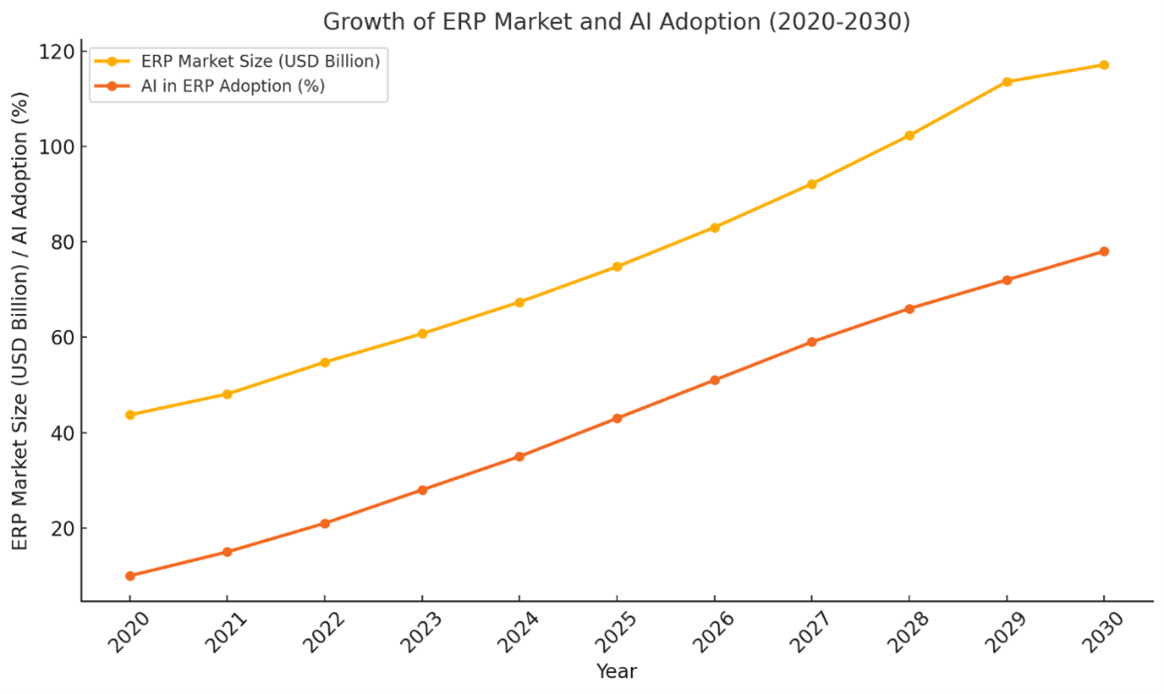
Sources: Allied Market Research: “ERP Market Size, Share | Industry Forecast – 2030” Link
Key Insights:
- AI adoption in ERP systems is expected to rise from 10% in 2020 to 78% by 2030.
- The growing ERP market highlights increasing demand for AI-driven functionalities.
The Role of AI in Transforming SAP Careers
Not only is AI changing the way SAP ERP Consultants or professionals that use SAP, do their job, but it is also generating new job positions and redefining many traditional ones e.g., the demand for SAP jobs with AI integration is now 30% higher than two years ago and is expected to increase.
Companies embarking on a Digital Transformation journey or specifically an SAP Implementation, would like to have teams who have AI expertise. There has been an increased demand for AI integration into SAP. The reason is simple – it improves workflows, speeds up automation, and provides actionable insights for better decisions.
How AI is Redefining SAP Roles Across Business Functions
| Business Area | AI Features in SAP | Impact on Careers | Upcoming Roles |
| Finance | Predictive analytics, automated reporting | Demand for trend-forecasting tech-savvy financial analysts. | AI-Enabled Financial Analyst, SAP Financial Forecasting Specialist |
| Procurement | Supplier risk assessment, contract analysis | Smarter sourcing strategies and compliance tracking. | Supplier Risk Specialist, AI Procurement Consultant |
| HR | Recruitment automation, engagement analytics | Focus on hiring automation and retention improvement. | AI Recruitment Strategist, Employee Analytics Specialist |
| IT | Intelligent automation, system monitoring | Roles in maintaining AI systems and cloud integrations. | SAP AI Core Specialist, AI-Driven System Architect |
AI integration in SAP is transforming roles and creating new opportunities. Professionals in Finance, Procurement, HR, and IT must expand their expertise to include AI. Businesses adopting AI-driven SAP solutions can innovate, stay competitive, and thrive in a dynamic market.
Essential Skills for SAP-AI Careers
Excelling in AI-powered SAP solutions demands a strong combination of technical expertise and soft skills. Below is a breakdown of the essential skills required across various business domains:
| Business Area | Technical Skills Required | Soft Skills Required |
| Finance | AI/ML algorithms, SAP S/4HANA | Analytical thinking, attention to detail |
| HR | SAP SuccessFactors, data analysis | Communication, empathy |
| Procurement | SAP Ariba, predictive analytics | Negotiation, strategic sourcing |
| IT | SAP AI Core, cloud solutions | Problem-solving, adaptability |
Equally important are soft skills, which play a vital role in navigating the complexities of AI integration:
- Problem-Solving: Essential for addressing implementation challenges and finding innovative solutions.
- Adaptability: Critical for keeping pace with the rapidly evolving landscape of AI technologies.
- Cross-Functional Communication: Enables effective collaboration across diverse teams and departments.
Earning SAP AI certifications not only sharpens your technical edge but also demonstrates your capability to manage and deploy AI-powered SAP solutions effectively, making you a valuable asset to any organization.
Steps to Future-Proof Your SAP Career with AI
To succeed in SAP’s evolving landscape, embracing AI is essential:
- Take courses in AI/ML, SAP AI Core, and cloud solutions. Certifications like SAP Analytics Cloud boost your prospects.
- Highlight real-world projects, like data integrations or AI-driven solutions.
- Join SAP communities and attend industry events to stay updated.
- Follow industry leaders on platforms like LinkedIn.
- Continuously update your skills to stay competitive.
These steps help SAP professionals integrate AI seamlessly and stay ahead in this dynamic field.
Top 5 Trainings to Boost Your SAP Generative AI Skills
Discover the top 5 SAP training programs designed to enhance your expertise in Artificial Intelligence (AI), complete with their respective links:
| Training Program | Link |
| Artificial Intelligence – SAP Learning | Artificial Intelligence – SAP Learning |
| Generative AI at SAP | Generative AI at SAP |
| Exploring the SAP Business AI Portfolio | Exploring the SAP Business AI Portfolio |
| SAP AI Core and SAP AI Launchpad | SAP AI Core and SAP AI Launchpad |
| Applying AI-powered Augmented Analytics to Business Data | Applying AI-powered Augmented Analytics |
I heavily rely on AI in my SAP projects, integrating it into various aspects to enhance my work. This includes creating AI-powered calculators to streamline complex processes.
I’ve developed tools like the SAP Implementation Cost Calculator, which provides accurate estimates for SAP implementation expenses, and the ERP Implementation Cost Calculator, which aids in setting realistic project timelines across multiple ERPs.
By leveraging AI, these tools not only reduce manual effort but also ensure data-driven precision, helping organizations optimize their execution strategies. Don’t forget AI isn’t the future—it’s here. Prepare today to lead in this evolving landscape.
Noel Benjamin D’Costa
Noel D’Costa, an SAP and AI consultant with over 20 years of experience, specializes in complex ERP implementations across industries like public sector, defense, and aviation. Through his blog, he shares actionable insights to help businesses excel in ERP and AI. Visit https://noeldcosta.com for more.
