



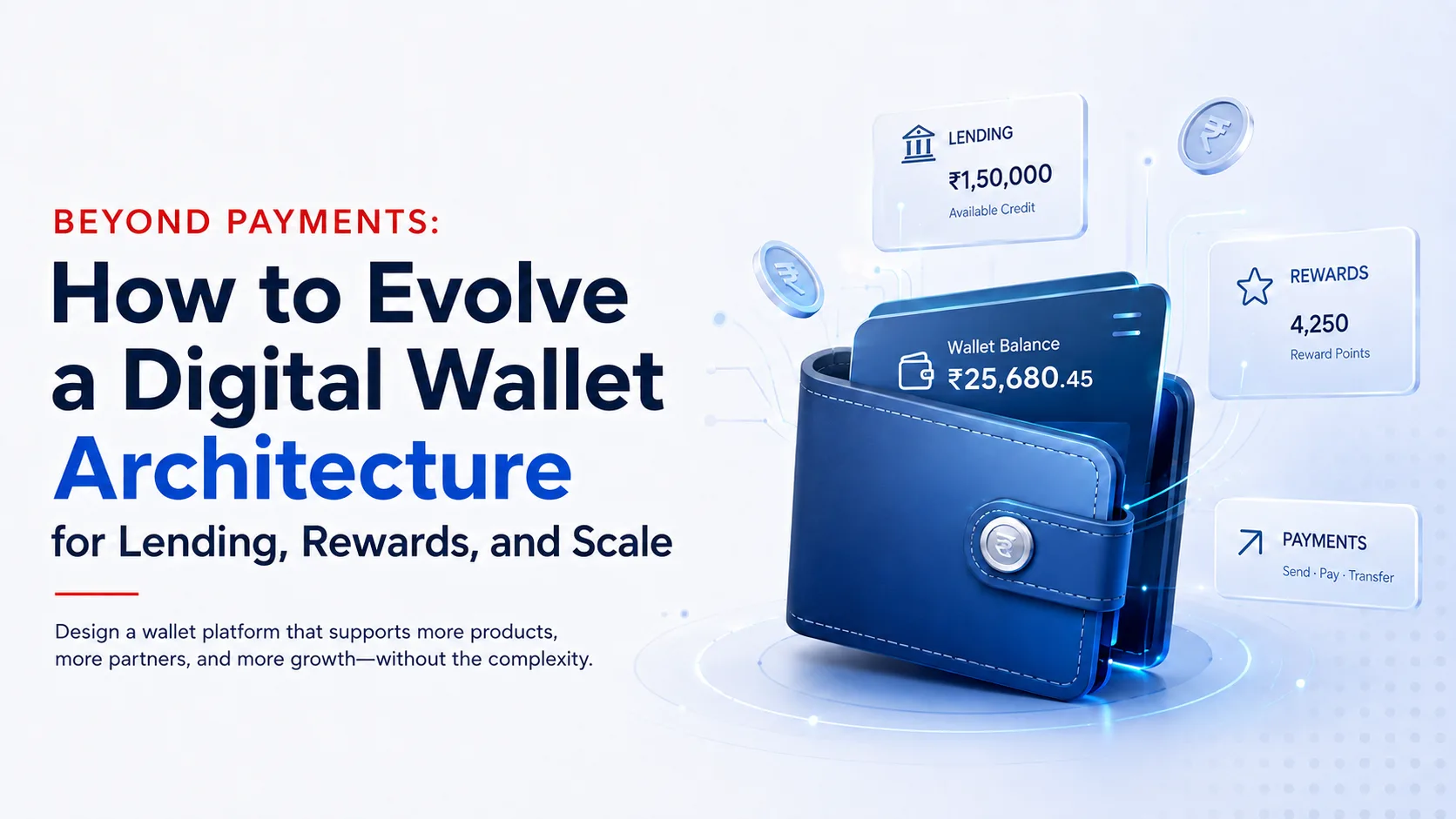
A digital wallet often starts with a narrow job: letting customers store money, make payments, or transfer funds. The architecture becomes more complicated when the roadmap adds lending, rewards, more partners, and higher transaction volumes.
The difficult part is not adding another feature to the interface. It is about deciding whether the system underneath can support several financial products without mixing payment, credit, and rewards logic into one tightly connected service.
That is where digital wallet app development starts becoming broader fintech app development.
When One Wallet Balance Is No Longer Enough
A customer might eventually have stored funds, an available credit line, reward points, and pending cashback inside the same app.
Those values can appear together on one screen, but they should not be treated as the same financial record.
A mature wallet needs clear boundaries between stored money, credit, and rewards. The customer can experience them as one product while the architecture keeps their rules and records separate.
That distinction becomes increasingly important as a wallet expands beyond basic payments. GeekyAnts’ guide to building a digital wallet app covers the broader mix of transaction handling, security, integrations, and financial functionality that has to sit behind the interface.
4 Architecture Changes That Matter as the Wallet Expands
1. Make the Ledger the Financial Source of Truth
The wallet balance should not simply be a number that changes after every transaction.
Payments, refunds, fees, loan disbursements, repayments, reward redemptions, and reversals need traceable records. A reliable ledger gives finance and operations teams a way to reconstruct how a balance reached its current state.
Credit and rewards should maintain their own accounting logic. An available credit limit is not stored cash, and reward points are not automatically equivalent to customer funds.
2. Separate Payments, Lending, and Rewards
An early wallet may work comfortably inside one backend service. As features increase, that design can make every change riskier.
- The payment domain can own transfers, refunds, settlement states, and transaction processing.
- The lending domain can handle eligibility, credit decisions, loan accounts, repayments, and servicing.
- The rewards domain can manage earning rules, pending rewards, redemption, reversals, and expiration.
The point is not to introduce microservices simply because they are fashionable. It is to give each financial capability clear ownership.
Lending makes that especially important because extending credit introduces its own risk decisions, data, compliance requirements, and review processes. GeekyAnts’ analysis of building AI lending products for production examines how underwriting, risk controls, integrations, and human decisions fit around the lending workflow.
3. Connect Products Through Controlled Events
Separate services still need to communicate.
A completed purchase may earn rewards. A refund may reverse them. A loan may be disbursed into the wallet, while repayments may come from its stored balance.
Events can connect these actions without allowing one service to control another’s internal records.
The architecture also has to expect retries and failures. Idempotency, reconciliation, and unique event IDs help prevent the same event from producing duplicate rewards, repayments, or disbursements.
4. Scale Operations Alongside Traffic
More users do not only create more API requests. They create more settlement records, repayment events, fraud alerts, disputes, reward reversals, partner integrations, and reconciliation work.
A scalable wallet therefore needs operational visibility as much as infrastructure capacity.
Teams should be able to see whether transactions are failing, rewards are delayed, repayments are posting correctly, and financial records are reconciling.
An existing wallet does not necessarily need to be rebuilt to reach that point. Stable components can remain while restrictive modules are gradually wrapped or replaced. GeekyAnts discusses this approach in its guide to modernizing fintech applications without rebuilding everything.
Rewards Need Their Own Rules Too
Rewards may look simpler than lending because they do not always involve direct money movement. They can still become complicated quickly.
A rewards system may need to distinguish between points that are pending, available, redeemed, reversed, or expired. Rules can also change by merchant, campaign, transaction type, or customer segment.
Keeping those rules inside a dedicated rewards engine allows product teams to change offers without altering the payment logic that determines whether a transaction has actually completed.
5 Digital Wallet and Fintech App Development Companies to Consider in the USA
Teams evolving a wallet may need expertise across mobile engineering, payments, lending, integrations, security, and platform modernization.
1. GeekyAnts
GeekyAnts has documented work across digital wallets, payments, banking, lending, and financial-platform modernization. Its portfolio includes support and modernization work for the Zapit crypto payments wallet, alongside payment infrastructure and other BFSI products.
Clutch Rating: 4.9/5
Clutch Reviews: 117
US Address: 315 Montgomery Street, San Francisco, CA 94104
Phone: +1 845 534 6825, Email: info@geekyants.com, Website: geekyants.com
2. Net Solutions
Net Solutions provides fintech development services covering digital wallets, lending systems, mobile and web financial products, KYC integrations, and payment-related applications.
Clutch Rating: 4.7/5
Clutch Reviews: 54
US Address: 11601 Wilshire Blvd, 5th Floor, Los Angeles, CA 90025
Phone: +1 416 720 1790
3. Kellton
Kellton works across digital product engineering, mobile applications, cloud systems, data, and financial services projects. It can suit organizations where the wallet forms part of a wider enterprise modernization program.
Clutch Rating: 4.7/5
Clutch Reviews: 54
US Address: 185 Hudson Street, Suite 1440, Jersey City, NJ 07311
Phone: +1 844 469 8900
4. Clarion Technologies
Clarion Technologies’ fintech practice includes digital wallets, payment platforms, lending systems, banking applications, compliance tools, and financial software modernization.
Clutch Rating: 4.7/5
Clutch Reviews: 21
US Address: 50 Main Street, Suite 1000, White Plains, NY 10606
Phone: +1 888 551 0371
5. SPEC INDIA
SPEC INDIA offers fintech development across banking applications, payment integrations, lending platforms, personal-finance products, and financial-system modernization.
Clutch Rating: 4.6/5
Clutch Reviews: 20
US Address: 350 Grove Street, Bridgewater, NJ 08807
Phone: +1 908 450 9862
A Wallet Can Grow Without Becoming One Giant Service
Adding lending and rewards does not require turning a wallet into one enormous financial system. It requires clearer boundaries underneath it.
Payments should retain their transaction rules. Lending should carry its own decisions and records. Rewards need their own lifecycle. Those systems can communicate while remaining independently understandable and manageable.
The customer can still experience all of them through one wallet.
That separation gives product teams room to add new financial capabilities without making every new feature a risk to the payment functions customers already depend on.
