



The article analyzes the phenomenon of transforming highly skilled craftsmanship into a sustainable competitive advantage in the B2B market for precision glass components. The purpose of the study is to identify the mechanisms through which the accumulated technological expertise of a master glassblower creates differentiated value for industrial customers that cannot be achieved under conditions of mass or catalog-based production. The paper examines the key components of craftsmanship as an economic asset: technical precision of execution, the ability to produce non-standard geometries, a deep understanding of material properties, and the competence to communicate directly with customers on technical matters. Based on the analysis of the practice of a specialized quartz glassblowing workshop operating since 2012, it is demonstrated that a focus on quality of workmanship and an individual approach generates a high level of customer loyalty and sustainable long-term relationships with enterprises in the electronics, medical, chemical, and food industries. The study concludes that in the specialized glassblowing manufacturing segment, craftsmanship is not a supporting but a system-forming competitive factor that determines the company’s market position.
Introduction
In the economic theory of small business, it is customary to distinguish between two approaches to achieving competitiveness: cost leadership, which involves reducing production costs through economies of scale, and differentiation, which is based on the unique characteristics of a product or service [1]. For most small manufacturers operating in the industrial components sector, competing on price with large suppliers is inherently unpromising, as the gap in productivity and purchasing power is fundamentally insurmountable. The only viable strategy is differentiation, and in the case of glassblowing production, its substantive foundation is the craftsmanship of the glassblower.
In this context, craftsmanship is not a metaphor but a specific set of measurable competencies: the ability to reproduce a specified geometry with minimal tolerances, work with materials having different viscosities and coefficients of thermal expansion, correctly interpret technical drawings, and propose technically justified design solutions to the customer. It is precisely this combination of competencies, developed through years of practice, that creates what industrial customers value more highly than the speed of catalog-based delivery: confidence that a custom component will be manufactured accurately and correctly on the first attempt [3].
Craftsmanship as an Economic Asset
In the knowledge economy and production theory, the concept of “craftsmanship” can be operationalized through the concept of specific human capital—the accumulated knowledge and skills that possess high value within a particular field of activity but are scarcely transferable to other contexts [2]. For a glassblower, this means that thousands of hours spent working with a torch, quartz and borosilicate glass tubing, and various configurations of workpieces create a predictability of results that cannot be reproduced within a short period of time and cannot be replaced by automation when the production of one-of-a-kind custom products is involved.
From the perspective of competitive strategy, this represents a barrier to market entry that is associated neither with capital investment nor with patent protection. A new market participant equipped with the necessary machinery and materials will not be able to reproduce the level of workmanship of a master with ten years of experience—at least not within a period of several years. This asymmetry creates a sustainable competitive advantage that, unlike technological advantages, is difficult to imitate [4].
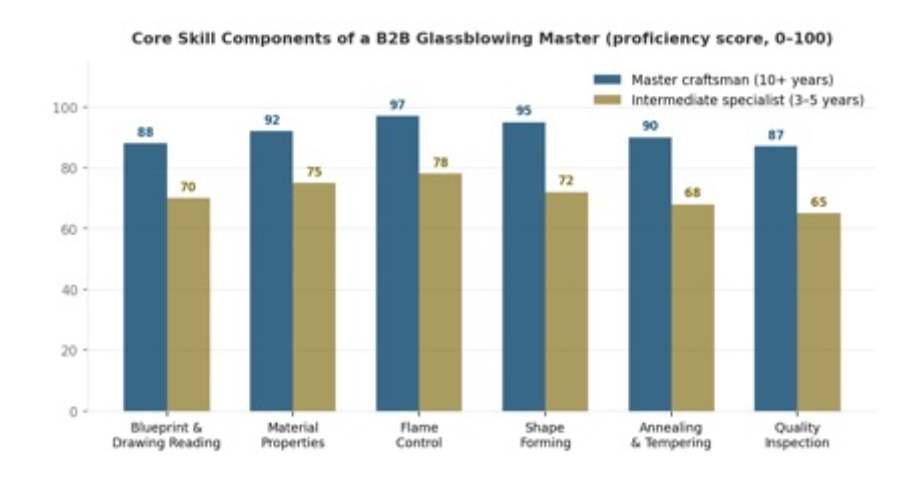
Fig. 1. Core Skill Components of a B2B Glassblowing Master — Key Components of Craftsmanship and Their Level Among Specialists with Different Levels of Experience
Craftsmanship Components and Their Value for B2B Customers
Technical Precision and Working from Engineering Drawings
An industrial customer provides the master with a technical drawing or specification containing geometric parameters, tolerances, and functional requirements. The ability to correctly interpret a drawing, identify critical dimensions, and maintain them during the hot-forming process is a skill that requires both technical education and years of practical experience. An error in manufacturing a custom component for laboratory or industrial equipment results not only in the cost of rework but also in downtime of the customer’s technological process. This is why reliability in reproducing technical specifications is valued more highly than speed of execution.
Understanding Material Properties
Quartz and borosilicate glass behave fundamentally differently when exposed to heat: they differ in softening temperatures, viscosity characteristics within the working range, coefficients of thermal expansion, and sensitivity to thermal shock. An experienced master intuitively takes these differences into account when selecting heating parameters, forming speed, and annealing conditions. This is critically important when manufacturing complex products involving transitions between different cross-sections, fused-in elements, or multi-stage connections [5].
Direct Technical Communication
One of the most underestimated competitive factors in craft-based B2B manufacturing is the ability of the master to engage in direct technical dialogue with the customer. Unlike large suppliers, where engineers from the customer side and production teams are separated by account managers, designers, and quality control departments, a specialized workshop provides direct communication: technical clarifications, proposals for design optimization considering technological limitations, and discussion of alternative solutions—all of this takes place quickly and without information loss during the transfer process. Industrial customers working with custom components highly value this level of responsiveness [6].
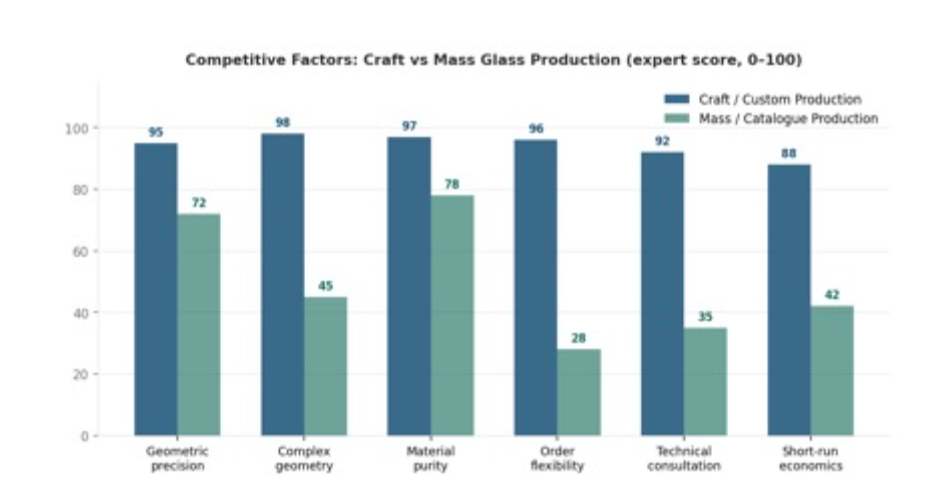
Fig. 2. Competitive Factors: Craft vs. Mass Glass Production — Comparison of Competitive Factors in Custom and Mass Production
Craftsmanship and Customer Loyalty
One of the most significant business outcomes of a high level of craftsmanship is the formation of a stable customer base with a high percentage of repeat orders. An industrial customer who has received a high-quality custom-made component generally does not seek alternative suppliers, as finding and testing a new manufacturer involves risks and transaction costs that significantly exceed any potential savings. This creates what marketing theory refers to as a “switching barrier”: not an artificial barrier created by contractual restrictions, but an organic one based on trust in the quality and reliability of the supplier [1].
Thus, craftsmanship creates a self-reinforcing competitive asset: high quality ensures customer retention, while long-term cooperation deepens the understanding of each customer’s specific requirements, which further improves the quality of execution specifically for that customer. This cycle creates a form of differentiation that is fundamentally difficult for competitors to replicate, as they lack both experience working with a particular customer and a comparable overall level of craftsmanship.
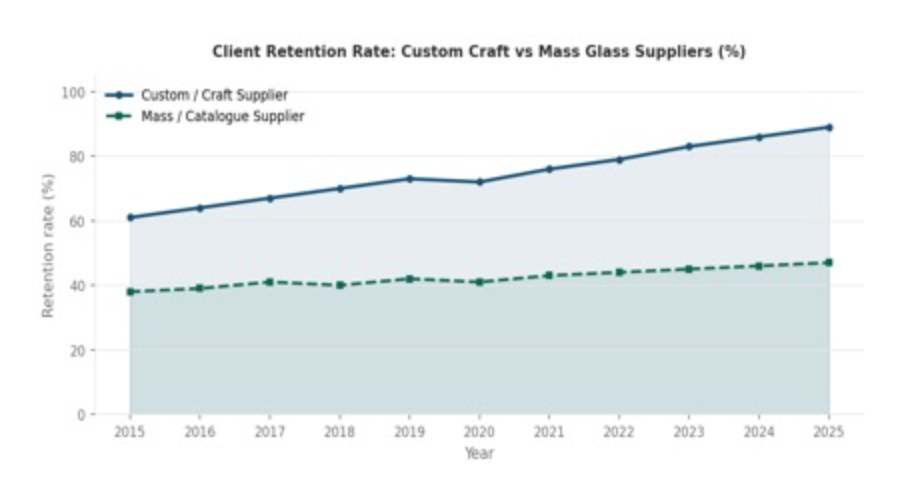
Fig. 3. Client Retention Rate: Custom Craft vs. Mass Glass Suppliers — Customer Retention Dynamics Among Custom and Mass Production Suppliers
From Craftsmanship to a Sustainable Business Model: Development Stages
The transformation of individual craftsmanship into a commercially sustainable enterprise does not occur automatically. It requires the consistent development of a number of operational and marketing elements that complement technical expertise.
Stage 1
Mastering basic craftsmanship. Developing a stable ability to work with key materials—quartz and borosilicate glass. The ability to reproduce standard product configurations with acceptable precision.
Stage 2
First B2B orders. Entering the market with the first industrial customers through professional networks, word-of-mouth recommendations, or direct inquiries. Building a portfolio of completed custom-made products.
Stage 3
Accumulation of industry specialization. Developing a deeper understanding of the requirements of specific industries: tolerances for the electronics industry, sterilization requirements for medical applications, and resistance to chemical environments. Increasing the complexity of accepted orders.
Stage 4
Formation of reputational capital. Establishing a stable base of repeat customers. Recommendations from existing clients become the primary channel for attracting new customers. Online presence (stekloduvka.ru) serves as a verification tool for potential clients.
Stage 5
Mature business model. Craftsmanship becomes a system-forming asset that ensures price premium, high customer retention rates, and protection against competitive pressure from mass-production suppliers.
Practical Implications for the Industry
| Aspect | Mass production | Custom craftsmanship |
| Competitive foundation | Price and delivery speed | Precision and uniqueness of execution |
| Target customer | Standardized needs | Non-standard technical specifications |
| Barrier to entry for competitors | Equipment capital intensity | Years of practice and accumulated expertise |
| Customer loyalty | Moderate (easy to change supplier) | High (organic switching barrier) |
| Price premium | Limited by market price | Justified by the uniqueness of the competence |
| Scaling | Through volume growth | Through deepening specialization |
Conclusion
The analysis of the operational model of a specialized quartz glassblowing workshop operating since 2012 allows for the formulation of a fundamental conclusion: in the segment of custom industrial glass components, the skill of the craftsman is not a supporting resource but a system-forming competitive asset. It is precisely this expertise that determines the company’s ability to execute orders unavailable to mass-production manufacturers, creates organic loyalty among industrial customers, and establishes an entry barrier that cannot be overcome through simple replication of technology or equipment.
For entrepreneurs considering development in the B2B manufacturing sector of specialized components, the key practical conclusion is the following: investments in the advancement of technical expertise and quality of execution provide higher long-term returns than attempts to compete on price or increase productivity without an appropriate qualification base. Craftsmanship, developed to the level of reproducible expertise, becomes the most reliable and least imitable competitive advantage in niche industrial manufacturing.
References
- Porter M. E. Competitive Advantage: Creating and Sustaining Superior Performance. — New York: Free Press, 1985. — 557 p.
- Becker G. S. Human Capital: A Theoretical and Empirical Analysis, with Special Reference to Education. — 3rd ed. — Chicago: University of Chicago Press, 1993. — 412 p.
- Pirsig R. M. Zen and the Art of Motorcycle Maintenance: An Inquiry into Values. — New York: Morrow, 1974. — 380 p.
- Barney J. B. Firm Resources and Sustained Competitive Advantage // Journal of Management. — 1991. — Vol. 17, No. 1. — pp. 99–120.
- Scholze H. Glass: Nature, Structure, and Properties. — New York: Springer, 1991. — 454 p.
- Gronroos C. Service Management and Marketing: Customer Management in Service Competition. — 3rd ed. — Chichester: Wiley, 2007. — 483 p.
- Sennet R. The Craftsman. — New Haven: Yale University Press, 2008. — 326 p.
