



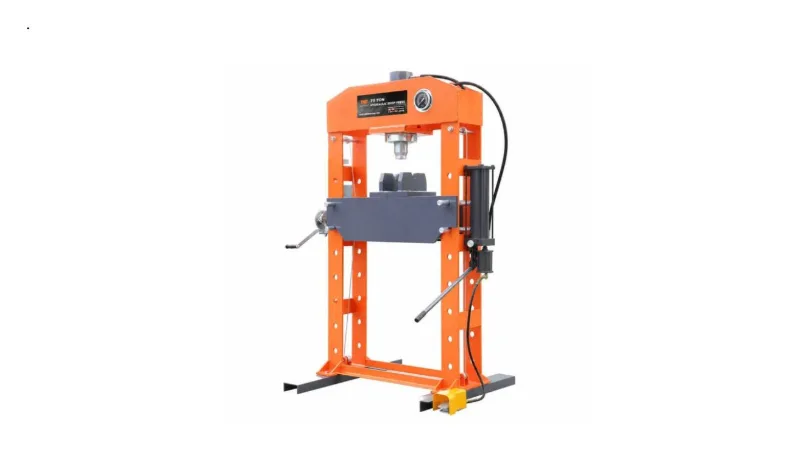
Capacity is the number a press is sorted by, and at seventy five tons the force is rarely the constraint. What limits the work is whether there is something in the shop that can transmit that force into the part without damaging either. A 75 ton hydraulic shop press with no tooling is a frame, a ram and a gauge.
Press plates do the squaring, not just the supporting
On an h frame press a pair of plates spans the bed rails and gives the workpiece a flat, square surface to sit on. Without them the part rests on two rails as a line contact, free to rock the moment force arrives.
Plate thickness matters at this capacity. A plate that flexes under load lets the part tip, and the force that was meant to go straight down turns into a sideways push that nobody planned for.
V blocks and why they exist
On an h frame press, a round shaft on a flat plate touches along a line. A V block cradles it at two points and holds the axis square to the ram, which is the only way to press a bearing onto a shaft without bending it. The same principle applies to anything cylindrical. Trying to press a round part on flat plates is the most common reason a job ends with a bent component and a confused operator.
A bearing separator reaches what a plate cannot
Some parts give no access from underneath. A bearing separator is a split collar that clamps into the gap behind a bearing race and provides a bearing surface where none exists. It is the difference between pressing a bearing off a shaft and cutting it off. On a press of this size the separator has to be rated for the load, because a separator that spreads under seventy five tons releases the part suddenly.
Matched tooling and what happens without it
Three mismatches cause most damage:
- Adapters smaller than the part being pressed
- Plates set wider than the component
- Sockets used as spacers under load
The third is the one that keeps happening. A socket is hardened and brittle, and a socket used as a press spacer can shatter rather than deform, which is a different kind of failure from a bent piece of bar.
Why the bed opening sets the tooling size
On any h frame press, the gap between the bed rails decides what passes through and what the plates must span. A wide opening takes larger parts and asks more of the plates; a narrow one supports better and limits what fits.
That relationship is worth checking against the tooling already in the shop. Buying a press whose bed opening does not suit the existing plates means buying plates as well, and at this size plates are not a trivial cost.
Reading a specification as a system
For a 75 ton press, capacity, daylight and bed width describe the frame. Bed opening, pin diameter and what tooling is included or available describe whether the press can be used on the day it arrives.
TMG Industrial builds this hydraulic shop press at seventy five tons on an H frame. Listing the parts the shop actually presses, and checking the tooling against them before comparing tonnage, is what turns a frame into a working press. Specifying plates and V blocks alongside it is part of the same purchase, and TMG Industrial supplies the bed dimensions needed to size them.
