



A part benefits from five-axis machining when changing the tool’s orientation solves a real access, setup, or surface-machining problem. Angled holes, features spread across several faces, and surfaces that require a changing approach angle are strong reasons to consider it. A flat plate with accessible pockets and holes is usually a good starting point for three-axis milling.
The decision should follow the geometry and required relationships between features. More axes provide additional ways to reach a surface; they do not automatically make every part cheaper or more accurate.
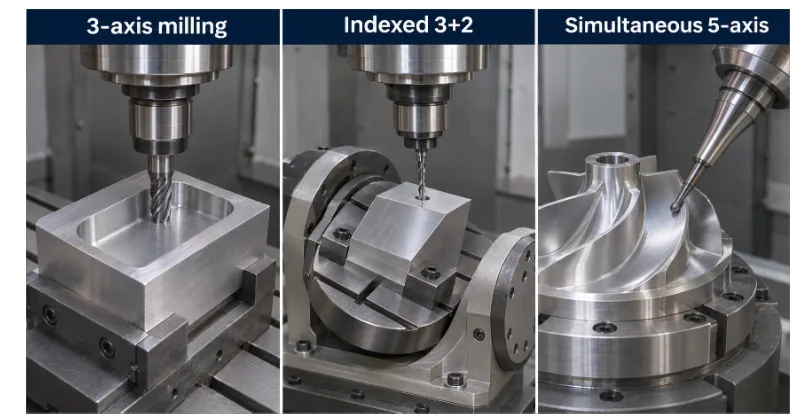
Illustrated examples of three tool orientations. The cutter approaches the pocket from above, drills the indexed workpiece at a fixed angle, and changes angle along the curved vane.
Identify What the Tool Cannot Reach
On a conventional three-axis mill, the cutter moves along three linear axes while its orientation relative to the clamped workpiece stays fixed. That arrangement can produce pockets, profiles, holes, and accessible three-dimensional surfaces. A curved shape alone does not prove that five axes are needed.
The difficulty appears when the cutter or holder cannot reach a feature without colliding with the workpiece or fixture. A deep recess behind a tall wall may force an excessively long tool. An angled bore may require the workpiece to be held at a new angle.
Five-axis equipment adds two rotary axes, allowing the machine to reorient the workpiece or cutting head. That can expose features to a shorter tool or provide a more useful cutting angle. It does not remove every restriction: the fixture still occupies space, rotary travel is finite, and an enclosed cavity still needs physical access.
Distinguish Indexed from Simultaneous Machining
Indexed five-axis machining, commonly called 3+2, positions the workpiece or head at an angle and then performs the cut with the rotary axes held in that orientation. It is well suited to separate faces and holes that each need a fixed approach direction.
Simultaneous five-axis machining coordinates rotary and linear movement during the cut. It becomes useful when the tool orientation needs to change along a surface or through a constrained passage. Blade-like surfaces and complex impeller geometry are familiar examples, although the actual route still depends on access and tooling.
When requesting 5-axis CNC machining, describe the difficult feature rather than asking for simultaneous motion by default. A part with several angled holes may gain the needed access through indexed machining without requiring a continuously changing tool orientation.
Count Re-Clamping Operations, Not Just Faces
Five machined faces do not automatically require five separate setups. Fixtures, rotary indexing, and machine configuration affect how much work can be completed while the part remains clamped.
What matters is where the workpiece must be released and located again. Each transfer requires a reliable way to recover the intended reference. If holes on different faces have tight positional relationships, reducing those transfers can make the process easier to control.
Consider a bracket with a mounting face and two angled locating holes. Three-axis machining with dedicated fixtures may meet the drawing. An indexed five-axis route may reach the same features while retaining one clamping relationship. Compare how each route establishes and checks the hole locations rather than assuming an axis count guarantees conformity.
Also ask what remains for a later operation. A gripping surface, underside feature, or cut-off area may still need another setup. “One setup” should describe the actual manufacturing sequence, not an expectation created by a machine label.
Compare Complete Manufacturing Routes
A higher machine rate can be offset by less fixture preparation, handling, or repeated alignment. Equally, simple work can become unnecessarily elaborate if it is assigned to a more complex route without a clear benefit.
Compare the total work for the required batch: programming, fixtures, cutting, transfers, finishing, and inspection. A prototype and a stable repeat order may favor different routes because preparation is spread across different quantities. There is no dependable universal saving percentage for adding axes.
Evaluating CNC machining solutions at the route level also leaves room for alternatives. A revised tool approach, an approved feature change, or a suitable fixture may solve the problem without simultaneous five-axis cutting.
Give the Supplier a Feature-Based Brief
Send the model and drawing with the critical relationships identified. Mark angled holes, inaccessible faces, surface-quality requirements, and areas where clamping marks are unacceptable. Include the material, batch quantity, and any permitted changes.
Ask the supplier to explain which features drive the proposed route and how the critical geometry will be inspected. That answer is more useful than a general promise that a five-axis machine handles complex components.
Conclusion
Choose five-axis machining when orientation control removes a meaningful manufacturing obstacle or reduces difficult re-clamping. Use indexed machining for suitable fixed-angle features and simultaneous machining where the cut genuinely benefits from changing orientation. For accessible geometry, a well-planned three-axis process remains a strong choice.
