



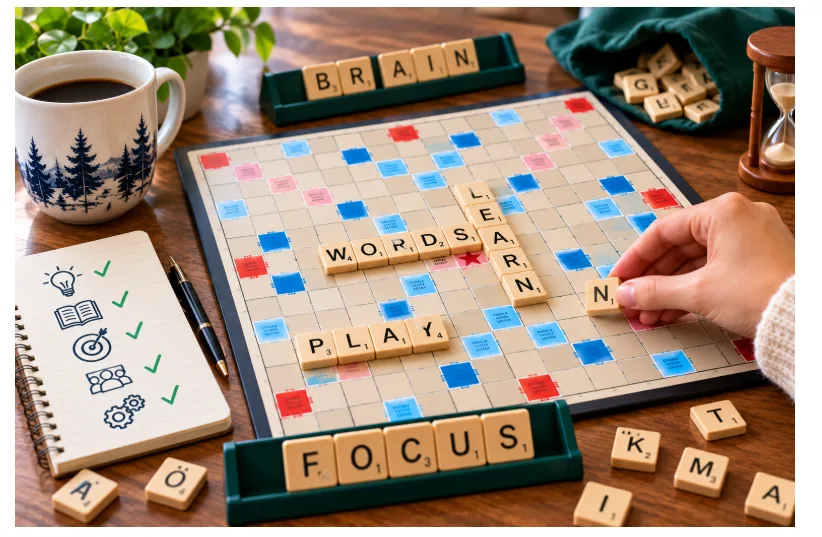
Most people think they know how to play Scrabble. You put letters on the board, make words and add up points. Simple enough. Then the first real game starts, and the questions pile up. Can you play a word that only touches the corner of another one? What happens if nobody can move? Does the bonus square count again when someone builds on top of it?
These little doubts are where family arguments are born. The good news is that Scrabble’s rules are actually short and logical once you see them laid out properly. This guide walks through everything a beginner needs, from setting up the board to adding up the final score, so your next game can focus on words rather than debates.
The Goal of the Game
The aim of Scrabble is to score more points than your opponents by forming words on a 15 by 15 grid. Each letter tile carries a point value. Common letters are worth very little, while rare ones are worth more. Special squares on the board multiply the value of a letter or a whole word.
The game can be played by two, three or four people. Two-player games tend to be the most strategic, while games with three or four players are more social and unpredictable. Whatever the number, the winner is simply the person with the highest total once the game ends.
Setting Up and Drawing Tiles
Getting started takes about a minute.
- Put all the tiles in the bag and give it a good shake.
- Decide who goes first. Each player draws one tile. The person whose letter is closest to the start of the alphabet goes first. A blank tile beats every letter. Those tiles then go back into the bag.
- Draw your rack. Each player draws seven tiles and places them on their rack, hidden from the others.
- Play moves clockwise from the first player.
After every turn, you draw new tiles from the bag so that you’re back to seven. This continues until the bag runs out.
If you want to check the official wording for any rule, the manufacturer’s own Hasbro Scrabble instructions are available online and cover the standard game in full.
Placing Words on the Board
This is where most beginner questions come from, so let’s go through the basics one by one.
The first word
The first word of the game must be at least two letters long and must cover the centre square, usually marked with a star. That centre square is a double word square, so the opening move always gets its score doubled.
Every word after that
Each new word must connect to tiles already on the board. You can do this in several ways:
- Add letters to an existing word, for example turning a short word into a longer one.
- Cross an existing word by using one of its letters as part of your new word.
- Play parallel to an existing word, as long as every new pair of touching letters also forms a valid word.
- Add a single letter that creates new words in both directions at once.
Straight lines only
All the tiles you place in a single turn must sit in one straight line, either across from left to right or down from top to bottom. Diagonal words don’t count, and you can’t place tiles in two different rows in the same move.
Every word must be valid
Any word formed by your move, including the small side words created when you play parallel to another word, must be acceptable. If even one of them isn’t a real word, the whole move is invalid.
Scoring Points
Scoring is where Scrabble gets its depth, and it’s worth understanding properly.
Letter values
Each tile shows its value in a small number. Add up the values of every letter in the word, including letters that were already on the board.
Premium squares
- Double letter: doubles the value of the tile placed on it.
- Triple letter: triples the value of the tile placed on it.
- Double word: doubles the total value of the whole word.
- Triple word: triples the total value of the whole word.
Letter bonuses are applied first, then word bonuses. If a word covers two double word squares, its score is doubled and then doubled again, making four times the total.
Bonuses only count once
This is the rule people forget most often. A premium square only counts on the turn a tile is first placed on it. If someone later builds a new word using that tile, the bonus does not apply again.
The big bonus
If you use all seven tiles from your rack in a single turn, you earn an extra 50 points on top of the word’s score. Experienced players call this a “bingo”, and landing one can turn a game around in an instant.
Blank Tiles, Exchanges and Passing
Blank tiles
The game includes two blank tiles. A blank can stand for any letter you choose, but it’s worth zero points. Once you’ve placed a blank and said which letter it represents, it stays that letter for the rest of the game. Blanks are extremely valuable because they make difficult racks much easier to use, especially when you’re hunting for a seven letter play.
Exchanging tiles
If your rack is hopeless, you can use your turn to swap some or all of your tiles for new ones from the bag. You lose the chance to score that turn, but it can be the smart choice when your letters simply don’t work together. Under the standard rules, exchanges are only allowed while there are still at least seven tiles left in the bag.
Passing
You can also pass your turn completely without playing or exchanging. It’s rarely a good idea, but it’s allowed.
Challenging a word
If you think an opponent has played a word that isn’t real, you can challenge it before the next player starts their turn. Check the agreed dictionary or word list. If the word is invalid, the player takes back their tiles and loses that turn. Many casual groups play more relaxed versions of this rule, so it’s worth agreeing on how challenges work before you begin.
How the Game Ends
The game finishes in one of two ways:
- The tile bag is empty and one player has used every tile on their rack.
- No player can make a move, and several turns in a row pass without anyone scoring.
At the end, each player subtracts the value of any tiles still left on their rack from their score. If one player went out by using all their tiles, they add the total of everyone else’s leftover tiles to their own score. Then the highest total wins.
Learning the Rules by Playing Online
Reading rules is useful, but nothing teaches them faster than actually playing. Online Scrabble is especially helpful for beginners because the game handles the tricky parts for you. It checks whether your words are valid, works out letter and word bonuses automatically and stops you from making moves that break the placement rules.
That means you can focus on finding good words instead of worrying about whether you’ve added up the triple word square correctly. After a few games, the rules start to feel natural, and you’ll understand why certain moves score more than others.
For Finnish speakers, Scrabblemania is a free site where you can play Scrabble online in Finnish against the computer, straight from your browser and without registering. Letters like ä and ö work as normal tiles, and the site also includes a word finder and crossword clue help if you want to explore further. It’s a relaxed way to learn the game at your own pace before playing against friends.
Quick Rule Summary
Keep this short list handy for your first few games:
- Seven tiles each, refilled after every turn.
- First word covers the centre star.
- New words must connect to existing tiles.
- Tiles in one turn go in a single straight line.
- Bonus squares only count when first covered.
- Using all seven tiles earns 50 extra points.
- Blanks can be any letter but score zero.
- Leftover tiles are subtracted at the end.
Conclusion
Scrabble’s rules fit comfortably on a single page, yet they create a game that people have played for generations without getting bored. Once you understand how words connect, how bonuses work and how the game ends, you can stop worrying about the rules and start enjoying the real challenge: finding the best word with the letters you’ve got.
For players who eventually want to explore the competitive side, organisations like WESPA, the World English-Language Scrabble Players’ Association, publish detailed tournament rules and rankings. But for now, all you need is a board, a few friends or a browser window, and seven tiles waiting on your rack.
