



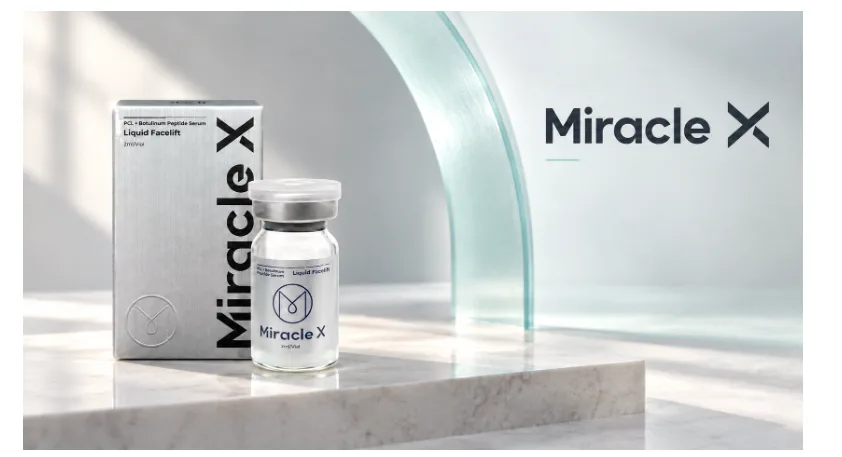
Product illustration.
Skin resilience depends partly on its supporting tissue, while the appearance of a fine line can also involve surface condition and repeated movement. These are related but distinct features. Miracle X combines two ingredient concepts associated with different aspects of skin quality: a biodegradable polymer and a peptide component.
The Miracle X skin booster is presented as a PCL-and-peptide formulation. PCL stands for polycaprolactone, a biodegradable polymer studied in aesthetic biomaterials. The peptide component is positioned around skin conditioning and smoothness. Together, these ingredients create a product concept centered on skin quality rather than a simple hydration message.
PCL, peptides, and hyaluronic acid have different chemical structures. PCL is a polyester, peptides contain linked amino acids, and HA is a polysaccharide. Their behavior depends on those structures and on how the finished formulation presents them to tissue. Miracle X’s combination is therefore a specific material concept, not simply another name for an HA moisturizer.
The PCL component and the idea of collagen stimulation
PCL is a synthetic polymer: a material made from repeating molecular units. In biomedical applications, its appeal includes the ability to create structures that gradually degrade. Its physical form matters. A polymer used as a scaffold, a microsphere, or a component of a liquid formulation does not automatically behave the same way in tissue.
Research by Lam and colleagues investigated the degradation of PCL scaffolds under laboratory and in-vivo conditions. Such work helps explain why material structure and degradation must be considered together. “Biodegradable” describes a material’s ability to break down; it does not provide a universal schedule for when a particular aesthetic product disappears or stops having an effect. [1]
The collagen-stimulation concept concerns the tissue response around a material. In a small human study, Kim and Van Abel examined biopsies from two participants treated with a PCL-based dermal filler and observed collagen formation around its particles. This supports a biological rationale for that type of PCL biomaterial. It does not establish Miracle X’s results, because the tested filler was a different formulation. [2]
PCL’s polyester chains contain ester bonds that can undergo hydrolysis, a reaction involving water. Breaking these bonds shortens the chains. This molecular degradation is different from immediately dissolving an intact material: chain length can decrease before all the material has been cleared. A biodegradable polymer can therefore remain physically present during part of its breakdown process. [6]
Why peptides add a different idea
Peptides are chains of amino acids, and the sequence of those amino acids helps determine their properties. The word covers many different substances. Some cosmetic peptides are investigated for effects on cell signaling; others are designed around pathways associated with expression lines. Treating every peptide as a small piece of replacement collagen misses this diversity.
Miracle X’s public product description identifies a peptide component without clearly establishing the exact peptide sequence or concentration. Its peptide cannot therefore be identified as acetyl hexapeptide-8, SNAP-8, or another named ingredient from that description alone. Each would represent a particular molecule, with its own chemical properties and evidence, rather than an interchangeable version of “peptide.”
An example from the wider field is Argireline, a synthetic hexapeptide investigated in a randomized, placebo-controlled study of 60 participants. Wang and colleagues reported improvements in the appearance of periorbital wrinkles after topical use. This was research on a defined peptide preparation, providing context for peptide interest rather than a clinical trial of Miracle X. [3]
Sequence matters because amino-acid side chains affect charge, water affinity, and interaction with biological targets. A peptide can be short yet strongly attracted to water, which influences its ability to cross a lipid-rich skin barrier. Lim’s experiments showed that changing particular chemical groups could alter permeation even when the molecules remained related peptide analogues. [4]
A botulinum like peptide is not botulinum toxin
Some expression-line peptides were designed around proteins involved in neurotransmitter release. Argireline, for example, was patterned on a portion of SNAP-25, a protein involved in the machinery that helps cells release neurotransmitters. This gives a particular peptide a biochemical rationale; it does not make that peptide chemically identical to botulinum toxin. [3]
This becomes clearer when considering delivery. Lim and colleagues studied modifications to an anti-wrinkle peptide and showed that changes to molecular structure influenced skin permeation and laboratory activity. Their work illustrates a basic formulation problem: an ingredient must reach an appropriate location in an active form before a proposed mechanism can matter. [4]
The skin barrier adds another layer of selectivity. A molecule’s size and charge affect where it can travel, while the vehicle influences its release and contact with tissue. Consequently, activity in a cell experiment does not establish that an ingredient will reach the same target in a finished product. The delivery system is part of the formulation’s function. [4]
Miracle X’s unspecified peptide cannot be assigned the precise mechanism or performance of a studied named peptide. Its published description supports a PCL-and-peptide identity, but does not establish replacement of a botulinum toxin treatment. A smoother surface and a reduction in muscle movement remain different outcomes, even when both could affect the appearance of a line.
How Miracle X differs from an HA booster
Hyaluronic acid attracts water and is used in formulations designed for skin quality as well as facial volume. A hydration-centered product discussion focuses on moisture-related appearance, smoothness, and fine lines. Miracle X’s stated identity instead emphasizes PCL with peptides, making collagen-related support and conditioning its central themes.
HA products also deserve to be judged by their specific evidence. A randomized study involving 202 participants found that VYC-12L improved cheek smoothness, fine lines, and hydration compared with an untreated control group. These findings belong to that HA formulation; they demonstrate why “hydration” should not be dismissed as an insignificant or necessarily fleeting treatment goal. [5]
The contrast is clearest at the ingredient level. HA’s affinity for water is directly relevant to a hydrated tissue environment. PCL’s role in the published filler research concerns a tissue response around an introduced polymer. A peptide introduces a further molecular component. Combining those ideas in one category does not erase the differences between their physical and biochemical roles.
| Product concept | Central idea | Question it helps address | What it should not imply |
|---|---|---|---|
| Miracle X | PCL with a peptide component | What might a material-and-peptide approach contribute to skin quality? | Proven equivalence to another PCL formulation or toxin medicine |
| HA skin-quality formulation | A water-binding HA-based material | How might smoothness and hydration improve? | That every HA product has the same effect |
| Studied topical peptide serum | A defined peptide in a tested vehicle | Can this particular formula change the appearance of fine lines? | That topical results transfer to another product or route |
| Volumizing filler | Product-specific material and physical support | Can a defined contour or volume concern be addressed? | That adding volume necessarily resolves all texture concerns |
Why the physical form of PCL matters
PCL can contain ordered crystalline regions and less ordered regions within the same material. The arrangement influences mechanical behavior and how water accesses the polymer. Molecular weight also describes chain length rather than the amount in a container. Two PCL materials can share the same chemical repeat unit while having different physical properties. [6]
Geometry matters too. A porous scaffold presents a different surface and internal structure from a solid particle. The surrounding environment can interact with those forms differently. In biomaterials research, this is why chemical identity is considered alongside structure and degradation. It is also why results obtained with one manufactured form cannot define every PCL product. [1]
Collagen formation and polymer degradation are separate processes. The first is a biological response involving living tissue; the second is a change in the introduced material. Evidence that collagen surrounds particles does not show that those particles have disappeared. Conversely, eventual polymer breakdown does not automatically specify how long a visible tissue change will remain. [2]
These distinctions explain why a concentration alone is an incomplete description of a PCL formulation. It says how much of a material is present, but not how its chains are organized, what physical form it takes, or how it interacts with the surrounding vehicle. More polymer is not automatically equivalent to a more useful tissue response.
Miracle X composition and presentation
Miracle X is currently listed by MJS as a 2 ml liquid vial, with a five-vial box option. Its declared central ingredients are PCL and a peptide component. The supplied liquid presentation identifies the product format, but does not by itself establish particle size, polymer molecular weight, or the exact peptide species within the formulation.
A liquid can carry material with very different microscopic organization. Appearance alone cannot show whether every ingredient is molecularly dissolved or how components are distributed. Miracle X therefore should not be assumed to possess the same structure as a named PCL filler solely because both use PCL, or the same delivery characteristics as a topical peptide serum.
Frequently asked questions
Is Miracle X mainly a moisturizer
Its stated central ingredients are PCL and peptides, with an emphasis on firmness and conditioning. This differs from a product centered on HA’s water-binding properties. The ingredient concept does not establish every possible skin benefit, and PCL itself should not be treated as chemically interchangeable with a humectant such as HA.
Does it contain actual botulinum toxin
The product is described in terms of a peptide component, not a botulinum toxin medicine. A peptide promoted as “botulinum-like” should not be interpreted as interchangeable with one. Anyone seeking a change in expression lines should discuss the desired result directly instead of relying on the resemblance between marketing terms.
Will PCL make my face look larger
The material’s name alone cannot answer that. Formulation and the proposed use matter, and skin-quality improvement is a different objective from adding visible facial volume. Explain whether you want a subtle surface change or a contour change, then ask the clinician how their recommendation addresses that preference.
Is more collagen always a better result
The meaningful outcome is healthy-looking tissue with an acceptable appearance and feel, not simply the largest possible collagen measurement. A person who wants softer fine lines may not value additional fullness. Treatment goals should describe the change you want, so that a biological mechanism remains connected to a useful cosmetic result.
Can the results last as long as a PCL filler study
A duration reported for a particular filler does not establish Miracle X’s duration. Polymer chemistry, physical form, and the finished formulation can differ. Ask for expectations specific to the proposed product and treatment. A long observation period in another study is context, not a warranty for a different formula.
Are peptides small pieces of collagen
Some peptides may be derived from proteins, but the word “peptide” does not specify collagen origin. A sequence designed around a signaling protein can have a different role from a collagen-derived fragment. Miracle X’s unspecified peptide cannot be assigned a particular origin or target without its exact identity; the amino-acid sequence is what distinguishes one molecule from another.
Explore Miracle X
Miracle X combines a biodegradable polymer concept with a peptide component for a product positioned around firmness and skin conditioning. Professionals comparing it with HA-centered options can explore MJS as a skin booster supplier. Its distinctive appeal is the combination of material and peptide science, with the finished formulation remaining essential to understanding its actual performance.
References
[1] Lam CXF, Hutmacher DW, Schantz JT, Woodruff MA, Teoh SH. Evaluation of Polycaprolactone Scaffold Degradation for 6 Months In Vitro and In Vivo. Journal of Biomedical Materials Research Part A. 2009.
[2] Kim JA, Van Abel D. Neocollagenesis in Human Tissue Injected with a Polycaprolactone-Based Dermal Filler. Journal of Cosmetic and Laser Therapy. 2015.
[3] Wang Y, Wang M, Xiao S, Pan P, Li P, Huo J. The Anti-Wrinkle Efficacy of Argireline, a Synthetic Hexapeptide, in Chinese Subjects: A Randomized, Placebo-Controlled Study. American Journal of Clinical Dermatology. 2013.
[4] Lim SH, Sun Y, Thiruvallur Madanagopal T, Rosa V, Kang L. Enhanced Skin Permeation of Anti-wrinkle Peptides via Molecular Modification. Scientific Reports. 2018.
[5] Alexiades M, Palm MD, Kaufman-Janette J, et al. A Randomized, Multicenter, Evaluator-blind Study to Evaluate the Safety and Effectiveness of VYC-12L Treatment for Skin Quality Improvements. Dermatologic Surgery. 2023.
[6] Woodruff MA, Hutmacher DW. The Return of a Forgotten Polymer—Polycaprolactone in the 21st Century. Progress in Polymer Science. 2010.
