



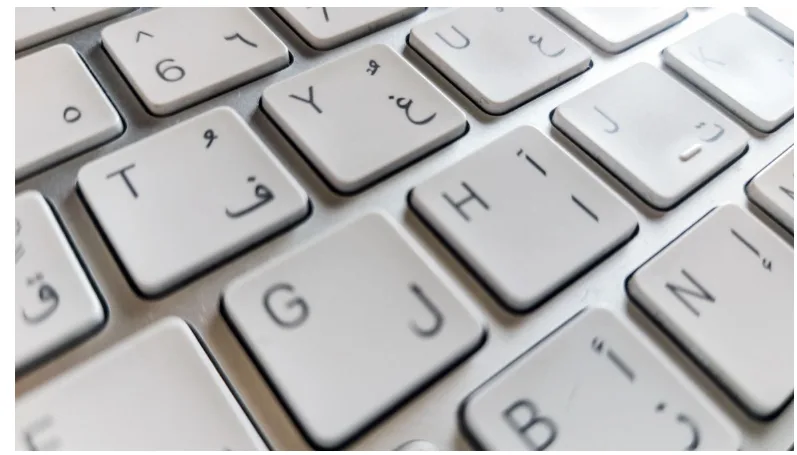
Businesses expanding into the Middle East and North Africa usually budget for translation, legal advice and local partners. What they rarely budget for is the small, daily friction of working in Arabic itself: typing a customer’s name correctly, answering an email in the right script, or labelling a product for a market that reads from right to left. These details look minor on a project plan, yet they shape how a brand is received from the first message.
Language is part of the customer experience
Arabic is an official language in more than twenty countries and is spoken by over 400 million people. For many of them, a reply written in Arabic script signals respect and attention in a way that a Latin-letter transliteration does not. Support teams that can only answer in English, or in improvised “Franco” spellings, often lose the trust they worked hard to earn in marketing.
The problem is practical rather than cultural. Most employees outside the region work on keyboards with no Arabic layout installed, and IT departments are understandably reluctant to change system settings on every laptop for an occasional message. The result is that staff either avoid writing in Arabic altogether or copy fragments from translation tools without being able to check what they paste.
Lightweight tools beat heavy rollouts
A sensible first step is a browser-based Arabic keyboard. It requires no installation, no admin rights and no change to the operating system. An employee can open it in a tab, type or click the letters they need, see the words joined correctly from right to left, and copy the text into a CRM, a chat window or a document. For teams that only write in Arabic a few times a week, this is far cheaper than retraining staff on a new physical layout.
Francophone markets add another layer. In Morocco, Algeria and Tunisia, as well as in France and Belgium, many professionals switch between French and Arabic in the same day. They tend to search for a clavier arabe rather than an “Arabic keyboard”, and they expect the interface to work alongside the AZERTY layout they already use. Choosing tools that respect this bilingual reality makes adoption much smoother for North African teams and partners.
Names deserve particular care
Few things damage a first impression faster than a misspelled name. Arabic names can be transliterated in many ways — Mohammed, Muhammad and Mohamed are all common — and moving from the Latin spelling back to Arabic script is not always obvious. HR departments, event organisers and marketing teams preparing personalised campaigns benefit from checking how a name is actually written and what it means before printing it on a badge, a contract or a greeting card.
An Arabic name generator is also useful in less obvious situations: writers and game designers creating believable characters, brands testing product names for regional markets, or parents and teachers exploring meanings. Seeing names written in proper script, together with their meanings, helps non-Arabic speakers avoid choices that sound awkward or carry unintended connotations.
Small habits that pay off
Companies that handle Arabic well rarely rely on one big solution. Instead, they build a few simple habits into everyday work:
- Keep a shared toolkit. Bookmark a reliable online keyboard and a name reference so every team member uses the same resources.
- Check direction and joining. Arabic letters change shape depending on their position in a word, and text runs right to left. Always preview before sending or printing.
- Ask a native speaker to review key materials. Tools help with typing, but contracts, packaging and campaigns still need a human check.
- Respect local variants. Gulf, Levantine and Maghrebi audiences use different vocabulary and sometimes different spellings of the same name.
- Store names in Unicode. Make sure CRMs, spreadsheets and email platforms accept Arabic characters so nothing turns into question marks.
The return on getting it right
None of these steps is expensive, and that is precisely the point. Market entry is often judged by large investments such as offices, distributors and advertising budgets, yet customers frequently form their opinion through much smaller moments: a reply written in their own script, a name spelled correctly, a label that reads naturally. Each of these moments signals that a company has taken the time to understand its audience.
For small and medium-sized businesses in particular, simple online tools remove the barrier between intention and execution. A marketing assistant in London, a sales representative in Paris or a freelancer in Toronto can communicate in Arabic with a level of care that once required a specialised team. As trade between Europe, North America and the Arab world continues to grow, that everyday competence is becoming less of a bonus and more of a basic expectation.
