



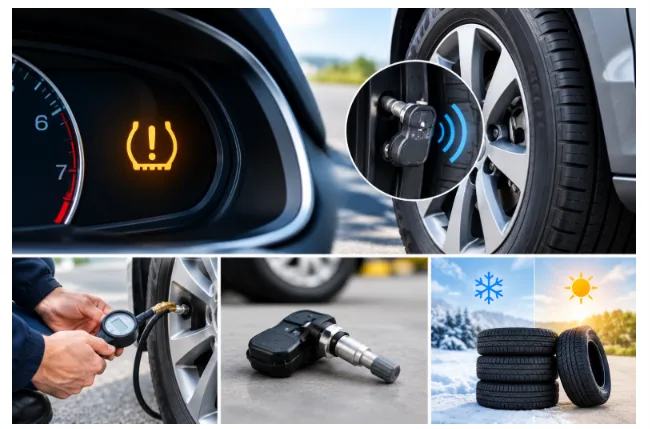
Almost every modern vehicle has a small tire pressure warning light on the dashboard, and most drivers assume it will tell them the moment something goes wrong. In reality, the system behind that light is more complicated, and more limited, than many people realize. It is designed to warn you when pressure has already dropped significantly, not to track the small, gradual changes that quietly cost money and wear out tires.
Understanding how tire pressure monitoring technology works, and what it cannot do, helps drivers catch problems earlier, protect their tires, and avoid surprises in the cold months.
What a Tire Pressure Monitoring System Does
A tire pressure monitoring system, or TPMS, tracks the air pressure in your tires and alerts you when it falls below a set threshold. Vehicles generally use one of two designs:
- Direct systems place a small battery-powered sensor inside each wheel. The sensor measures the actual pressure and sends the reading wirelessly to the vehicle.
- Indirect systems do not measure pressure directly. They use the wheel speed sensors from the braking system and watch for a tire that spins faster than the others, which can indicate that it has lost air.
Direct systems are generally more precise and can show pressure for each tire. Indirect systems are simpler, but they are less accurate and usually need to be reset after you adjust or rotate tires.
Why the Warning Light Arrives Late
The warning light is built to trigger when pressure has fallen well below the recommended level, often by a noticeable margin. That leaves a gap. A tire that is slightly low can run for weeks before the light ever appears, and during that time it uses more fuel, wears unevenly, and handles a little differently.
Slow leaks make this worse. A tiny puncture, a worn valve stem, or a poor seal can let out air gradually, so the pressure drifts down day after day without ever crossing the alert threshold in a dramatic way.
Temperature: The Cold-Weather Factor
Air pressure changes with temperature. As a general rule of thumb, tire pressure drops by about one pound per square inch for every 5 to 6 degrees Celsius the temperature falls. That means a tire inflated in a warm afternoon can read noticeably lower on a cold Calgary morning, even with no leak at all.
This is why many drivers see the warning light appear on the first cold day of autumn. The light is not malfunctioning. The air inside the tire has simply contracted. It is also a good reminder to check pressures manually at the start of each season, when the temperature has changed, rather than waiting for the dashboard to complain.
Sensors Need Care Too
Direct TPMS sensors are small electronic devices with their own batteries, and they are not permanent. They are commonly expected to last for several years, after which the battery weakens and the sensor stops reporting. A sensor can also be damaged during a tire change if the work is not done carefully.
A few things are worth knowing:
- Valve stems, seals, and caps on sensor-equipped wheels are often replaced or serviced during tire changes
- Winter and summer wheel sets may each need their own sensors
- Sensors sometimes need to be programmed or relearned by the vehicle after a swap
- A warning light that stays on after a tire change can mean a sensor needs attention
Retailers such as Good Tire, a Calgary tire shop that has served local drivers for more than two decades, see these issues regularly during seasonal swaps, which is one reason a pressure check and sensor inspection are worth including in any tire change.
Why Manual Checks Still Matter
Technology is helpful, but it does not replace a basic habit. A manual check with a reliable gauge gives you an exact number for every tire, including the spare if you have one. It also lets you compare the reading with the recommended pressure printed on the sticker inside the driver’s door, rather than the number molded onto the tire sidewall, which is only the maximum.
A simple routine is enough:
- Check pressures once a month and before long trips
- Check when the tires are cold, before driving, for the most accurate reading
- Adjust to the pressure on the vehicle’s door sticker
- Look at the tread and sidewalls for cuts, bulges, or uneven wear
When a Warning Light Deserves Attention
If the tire pressure light comes on, treat it as a prompt to check, not a suggestion to ignore. Pull over somewhere safe, check all four tires with a gauge, and add air if needed. If a tire keeps losing pressure, it may have a puncture or a valve problem, and a professional inspection or tire repairs can find the cause before it turns into a flat or damages the tire itself.
A flashing warning light, which then stays on, often signals a fault in the system itself rather than low pressure, such as a failed sensor or a communication problem, and it is worth having looked at.
Quick Questions
Does a cold snap really change tire pressure? Yes. Air contracts as it cools, so pressure drops with temperature even when nothing is leaking.
How long do TPMS sensors last? Commonly several years, although it varies by vehicle and use. When the battery weakens, the sensor needs replacing.
Can I ignore the light if the tire looks fine? No. A tire can be well below its proper pressure and still look normal from the outside.
Where do I find the correct tire pressure? On the sticker inside the driver’s door or in the owner’s manual, not on the tire sidewall.
The Bottom Line
Tire pressure sensors are a valuable safety feature, but they are an alert system, not a guarantee. Combining the technology with a monthly manual check, a pressure adjustment when the weather changes, and careful service during seasonal tire swaps keeps tires lasting longer, improves fuel economy, and makes winter driving safer.
