



Dr. Mansour Farhat, DBA, MQM, MOAR, FRSA, QMS
Structured abstract
Purpose – Leadership succession is presented in family-business research as either a catalyst for or a barrier to strategic change. This paper develops a framework explaining when succession opens a window for change in Gulf family business groups and when it closes one, with a focus on engineering and contracting businesses.
Design/methodology/approach – Conceptual paper. It integrates research on family-firm succession, socioemotional wealth and organisational readiness for change, and applies it to the Gulf context, including the UAE’s 2022 federal law on family businesses.
Findings – The paper distinguishes three phases of succession (anticipation, transition and consolidation) and argues that readiness for change differs across them. It identifies three conditions that determine whether succession opens a window for change: the successor’s legitimacy, the incumbent’s continuing role, and the formality of family governance. Six propositions specify these relationships.
Research limitations/implications – The framework requires empirical testing. The paper proposes qualitative and longitudinal designs to do so.
Practical implications – Family councils, boards and successors can use the framework to time and sequence major changes around a leadership transition.
Originality/value – The paper connects two literatures usually treated separately, succession and change readiness, and grounds the connection in the institutional setting of Gulf family groups.
Keywords: Family business, Succession, Readiness for change, Socioemotional wealth, Family governance, Gulf Cooperation Council
Paper type: Conceptual paper
1. Introduction
Family firms anchor private-sector development across the Gulf Cooperation Council (GCC) (Rice et al., 2023). Many of the region’s largest groups were founded in the second half of the twentieth century and are now in, or approaching, a transfer from the first to the second or third generation (Ramadani et al., 2023). That transfer coincides with intense pressure to change. National diversification strategies, digital technologies, sustainability regulation and new forms of competition are reshaping many sectors, and engineering and contracting in particular.
Succession and change are therefore intertwined in Gulf family groups. Yet the family-business literature tends to study them apart. Succession research asks who takes over, how prepared they are and how satisfied stakeholders are with the process (Handler, 1994; Sharma et al., 2003). Change research asks how organisations become ready for change and how members come to commit to it (Armenakis et al., 1993; Rafferty et al., 2013). Little work asks how a pending or recent succession shapes an organisation’s readiness for change.
The legal setting has also moved. The UAE’s Federal Decree-Law No. 37 of 2022 on Family Businesses introduced optional family charters, rules for governance and for the transfer of shares on a partner’s death, and dedicated committees for resolving family-business disputes (UAE Government, 2022). Family groups are deciding how far to formalise their governance. This makes the relationship between succession, governance and change unusually salient.
This paper develops a framework to explain when succession opens a window for change and when it closes one. It contributes in three ways. It treats succession as a process with phases that differ in their implications for change. It identifies the conditions under which a successor can lead change credibly. And it shows how formal family governance, newly encouraged by Gulf legislation, can shape that process.
2. Theoretical foundations
2.1 Succession as a process
Succession is a process, not an event. It unfolds over years as authority, knowledge and relationships pass from incumbent to successor (Cabrera-Suárez et al., 2001; Handler, 1994). Its success depends on the successor’s preparation and willingness, the incumbent’s readiness to let go, and the quality of family relationships (Sharma et al., 2003). Many intra-family successions fail or never take place, because of the incumbent’s reluctance, the lack of a capable or willing successor, or conflict within the family (De Massis et al., 2008). Tacit knowledge and social capital, including relationships with clients, partners and officials, are among the hardest resources to transfer (Cabrera-Suárez et al., 2001).
2.2 Socioemotional wealth and change
Family owners value control, family identity, emotional attachment and the intention to pass the firm to future generations, together described as socioemotional wealth (Berrone et al., 2012; Gómez-Mejía et al., 2007). These priorities can make family firms reluctant to adopt changes that threaten family control, even when the changes are financially attractive. Family influence can also slow the adoption of discontinuous technologies, because it reinforces commitment to existing competences and ways of thinking (König et al., 2013). Yet the same orientation towards continuity can support long-term investment and patient capability-building (Le Breton-Miller and Miller, 2006), and family ownership can encourage entrepreneurial risk-taking under some conditions (Zahra, 2005).
2.3 Readiness for change
Readiness for change refers to organisational members’ beliefs that change is needed, that the organisation can carry it out, that it is appropriate, that leaders support it and that it will benefit them (Armenakis et al., 1993; Holt et al., 2007). Readiness is shaped by the credibility of change agents and by the messages they send (Armenakis et al., 1993). In family firms, credibility rests on family position as well as competence. A successor’s message about change may therefore be read through questions of legitimacy that do not arise for a professional manager.
2.4 The Gulf context
Four features of the Gulf context bear on succession and change. First, many large family groups are diversified conglomerates, so a succession may affect several businesses at once (Rice et al., 2023). Second, relational norms and personal networks, often discussed under the term wasta, shape access, trust and authority within and around organisations (Hutchings and Weir, 2006). A successor inherits, or must rebuild, these relationships. Third, workforces and management teams are highly international, so non-family executives play a large role in implementing change. Fourth, the UAE’s 2022 decree-law offers a legal framework for family charters, governance roles and dispute resolution (UAE Government, 2022). It gives families new tools to formalise how authority passes and how disagreements are handled.
3. The framework
The framework (Table 1) proposes that readiness for change varies across three phases of succession and that three conditions determine whether a succession opens a window for change.
Table 1. Succession phases and conditions for change readiness
| Element | Description | Expected effect on readiness for change |
| Phase 1: Anticipation | Successor identified but incumbent fully in control | Low for major change; change deferred until the transition |
| Phase 2: Transition | Authority passing; roles in flux | Highest openness, but also highest uncertainty |
| Phase 3: Consolidation | Successor established; incumbent’s role settled | Readiness depends on legitimacy built in Phase 2 |
| Condition A: Successor legitimacy | Perceived competence and family endorsement | Raises readiness, especially in Phase 2 |
| Condition B: Incumbent’s continuing role | Advisory versus controlling presence after handover | Advisory role raises readiness; controlling role lowers it |
| Condition C: Governance formality | Charter, council, board with defined decision rights | Raises readiness by reducing ambiguity over authority |
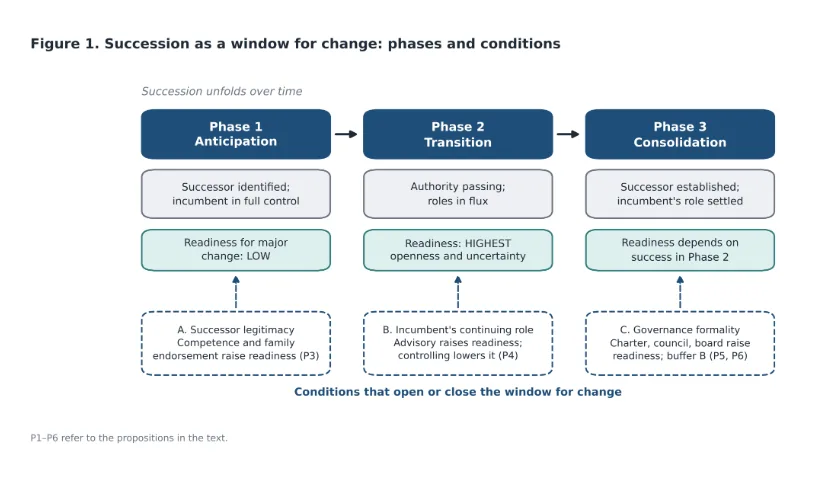
3.1 Phases of succession
In the anticipation phase, a successor has been identified but the incumbent retains full control. Managers and employees often expect that significant change will wait for the new leader. Major initiatives may be deferred, while the incumbent may avoid commitments that would constrain the successor.
In the transition phase, authority is passing and roles are in flux. This is the point of greatest openness. A new leader is expected to bring new ideas, and the organisation’s routines are already being questioned. It is also the point of greatest uncertainty, because it is unclear whose decisions will stand.
In the consolidation phase, the successor is established and the incumbent’s role has settled. Readiness for change now depends on what happened during the transition: whether the successor built credibility, and whether early changes succeeded.
Proposition 1. Readiness for major organisational change is lower in the anticipation phase of succession than in the transition phase.
Proposition 2. Readiness for change in the consolidation phase depends on the success of changes initiated during the transition phase.
3.2 Successor legitimacy
Successors must establish legitimacy with several audiences: the family, non-family executives, employees and external partners. Legitimacy rests on perceived competence, gained through education, experience inside and outside the firm, and early results, and on visible endorsement by the incumbent and the family (Sharma et al., 2003). In the Gulf, legitimacy also depends on the successor’s ability to maintain or rebuild the relationships the incumbent held (Hutchings and Weir, 2006). Without legitimacy, a successor’s calls for change are likely to be read as inexperience or as a bid for authority, lowering readiness among those who must carry the change out.
Proposition 3. Successor legitimacy is positively related to readiness for change, and the relationship is strongest during the transition phase.
3.3 The incumbent’s continuing role
Incumbents often remain active after handing over formal authority, as chairs, advisers or informal figureheads. An advisory presence can support change by lending the successor credibility and preserving relationships. A controlling presence, in which the incumbent continues to approve or overturn decisions, creates two centres of authority. Managers then hedge, waiting to see whose view prevails, and readiness for change falls (De Massis et al., 2008).
Proposition 4. An advisory continuing role for the incumbent is positively related to readiness for change, while a controlling continuing role is negatively related to it.
3.4 Governance formality
Formal family governance (a written charter, a family council and a board with defined decision rights) can reduce ambiguity about who decides what during and after a transition. It can also provide routes for resolving disagreements before they stall decisions. The UAE’s 2022 decree-law allows families to adopt a charter covering ownership rules, values, profit distribution and the qualifications required of family members who work in the business, and it provides for internal reconciliation and dedicated dispute-resolution committees (UAE Government, 2022). Formal governance may also protect socioemotional wealth while allowing change, because it gives the family a defined voice without requiring the family to control every operational decision.
Proposition 5. The formality of family governance is positively related to readiness for change during succession.
Proposition 6. Formal family governance weakens the negative effect of a controlling incumbent on readiness for change.
4. Discussion
4.1 Theoretical implications
The framework links succession and change readiness, two research streams that have developed largely apart. It suggests that succession is neither inherently a catalyst nor inherently a barrier to change. Its effect depends on its phase and on three conditions. This helps reconcile the mixed picture in the family-business literature, where family firms appear both conservative and capable of bold change (König et al., 2013; Le Breton-Miller and Miller, 2006).
The framework also refines socioemotional wealth reasoning. It suggests that what families seek to protect during succession is not only control but continuity of identity and relationships. Changes that can be framed as continuing the family’s legacy may therefore meet less resistance than changes framed as a break with it.
Finally, the framework places formal governance at the centre of the analysis. It treats new legal frameworks such as the UAE’s 2022 decree-law as institutional resources that families can use to shape how authority and change are managed.
4.2 Practical implications
For family councils and boards, the framework implies that major changes should be timed with the succession process in mind. Launching a large transformation in the anticipation phase may stall, because the organisation expects to wait for the new leader. Launching it early in the transition phase, with clear endorsement from the incumbent, may capture the moment of greatest openness.
For successors, the framework emphasises building legitimacy before leading major change. Early, visible and well-chosen changes that succeed can build credibility for larger ones. Maintaining key relationships inherited from the incumbent is part of that legitimacy.
For incumbents, the framework suggests defining a continuing role that is clearly advisory. A public statement of the successor’s authority, and a formal mechanism for the incumbent’s advice, can prevent two centres of decision-making from forming.
For families in the UAE, the 2022 decree-law offers practical tools. A family charter that sets out decision rights, the qualifications for family members in management and a process for resolving disagreements can reduce the ambiguity that stalls change during transitions.
4.3 Research agenda
The framework lends itself to several designs. Qualitative interview studies with incumbents, successors and non-family executives in the same groups could examine how each phase is experienced and how legitimacy is built (Gioia et al., 2013). Longitudinal case studies could follow groups through a transition and observe how readiness for change shifts. Survey research could compare readiness across groups at different phases of succession and with different degrees of governance formality, using established readiness scales (Holt et al., 2007). Comparative studies across GCC countries could test whether differences in legal frameworks for family businesses affect the propositions.
4.4 Boundary conditions
The framework concerns intra-family succession in large, multi-business family groups. Succession to non-family managers, sale of the firm and very small family firms may follow different patterns. It also assumes that a successor has been identified; groups with no clear successor face a different set of problems.
5. Conclusion
In Gulf family business groups, the transfer of leadership between generations is happening at the same time as pressure for change is rising. This paper argues that succession can open a window for change, but only when the successor is legitimate, the incumbent’s continuing role is advisory and family governance makes decision rights clear. Understanding these conditions can help families use the moment of succession to renew their businesses rather than defer change to an uncertain future.
References
- Armenakis, A.A., Harris, S.G. and Mossholder, K.W. (1993), “Creating readiness for organizational change”, Human Relations, Vol. 46 No. 6, pp. 681-703.
- Berrone, P., Cruz, C. and Gómez-Mejía, L.R. (2012), “Socioemotional wealth in family firms: theoretical dimensions, assessment approaches, and agenda for future research”, Family Business Review, Vol. 25 No. 3, pp. 258-279.
- Cabrera-Suárez, K., De Saá-Pérez, P. and García-Almeida, D. (2001), “The succession process from a resource- and knowledge-based view of the family firm”, Family Business Review, Vol. 14 No. 1, pp. 37-48.
- De Massis, A., Chua, J.H. and Chrisman, J.J. (2008), “Factors preventing intra-family succession”, Family Business Review, Vol. 21 No. 2, pp. 183-199.
- Gioia, D.A., Corley, K.G. and Hamilton, A.L. (2013), “Seeking qualitative rigor in inductive research: notes on the Gioia methodology”, Organizational Research Methods, Vol. 16 No. 1, pp. 15-31.
- Gómez-Mejía, L.R., Haynes, K.T., Núñez-Nickel, M., Jacobson, K.J.L. and Moyano-Fuentes, J. (2007), “Socioemotional wealth and business risks in family-controlled firms: evidence from Spanish olive oil mills”, Administrative Science Quarterly, Vol. 52 No. 1, pp. 106-137.
- Handler, W.C. (1994), “Succession in family business: a review of the research”, Family Business Review, Vol. 7 No. 2, pp. 133-157.
- Holt, D.T., Armenakis, A.A., Feild, H.S. and Harris, S.G. (2007), “Readiness for organizational change: the systematic development of a scale”, The Journal of Applied Behavioral Science, Vol. 43 No. 2, pp. 232-255.
- Hutchings, K. and Weir, D. (2006), “Guanxi and wasta: a comparison”, Thunderbird International Business Review, Vol. 48 No. 1, pp. 141-156.
- König, A., Kammerlander, N. and Enders, A. (2013), “The family innovator’s dilemma: how family influence affects the adoption of discontinuous technologies by incumbent firms”, Academy of Management Review, Vol. 38 No. 3, pp. 418-441.
- Le Breton-Miller, I. and Miller, D. (2006), “Why do some family businesses out-compete? Governance, long-term orientations, and sustainable capability”, Entrepreneurship Theory and Practice, Vol. 30 No. 6, pp. 731-746.
- Rafferty, A.E., Jimmieson, N.L. and Armenakis, A.A. (2013), “Change readiness: a multilevel review”, Journal of Management, Vol. 39 No. 1, pp. 110-135.
- Ramadani, V., Aloulou, W.J. and Zainal, M. (Eds) (2023), Family Business in Gulf Cooperation Council Countries, Contributions to Management Science, Springer, Cham.
- Rice, J., Raziq, M.M. and Fotiadis, A. (2023), “Family business in the Arabian Gulf region”, Journal of Family Business Management, doi: 10.1108/JFBM-09-2023-0164.
- Sharma, P., Chrisman, J.J. and Chua, J.H. (2003), “Predictors of satisfaction with the succession process in family firms”, Journal of Business Venturing, Vol. 18 No. 5, pp. 667-687.
- UAE Government (2022), Federal Decree by Law No. (37) of 2022 Concerning the Family Businesses, available at: https://uaelegislation.gov.ae/en/legislations/1608.
- Zahra, S.A. (2005), “Entrepreneurial risk taking in family firms”, Family Business Review, Vol. 18 No. 1, pp. 23-40.
