



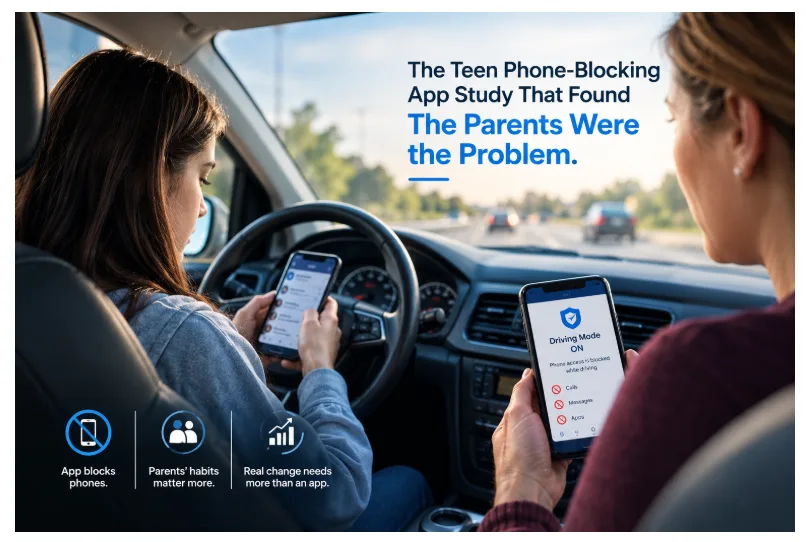
A parent installs a phone-blocking app on their teenager’s phone, feels a wave of relief, and mentally files the distracted-driving problem under “handled.” It’s a reasonable instinct. It’s also not quite what the research on distracted driving apps actually supports. A study published in 2025 testing one such app, LifeSaver, with teen drivers and their parents found something the researchers didn’t expect going in: the app produced no significant overall decrease in the teens’ smartphone use while driving. What it did change was the parents’ behavior, specifically their own social media use while certain features were active, while the teens kept driving distracted at roughly the same rate as before.
What the Research Actually Found
The study, which collected both objective app data and survey responses from teen drivers and their parents, was designed to measure whether an augmented version of the LifeSaver app reduced what researchers call smartphone use while driving among teens. It didn’t find a significant reduction. What it did find was more interesting than a simple null result: parents in the study expressed reluctance to change their own distracted-driving habits, even while clearly wanting their teens to stop. That asymmetry matters, because it points to something apps alone can’t fix: a household where the adult modeling the behavior isn’t changing it is working against whatever the technology is trying to accomplish with the teen.
This isn’t a reason to write off the category. It’s a reason to be specific about what any given app actually measured, and what it didn’t. “No significant decrease in teen distraction” from one study, with one app, in one research design, isn’t the same as “these apps don’t work.” But it is a useful corrective to the assumption that installing software automatically produces the outcome a family or employer is hoping for.
Detection Isn’t the Same as Change
A separate, more encouraging study offers a clue about why. Researchers testing a different app, Safer Driver, developed with Australia’s RAC and detailed in a 2024 Journal of Road Safety article, ran an actual randomized controlled trial: 814 participants split between a group that received the full app, including behavioral coaching features, and a control group that got an app with identical phone-sensing and distraction-detection technology but no coaching layer at all. Among participants who started the trial already showing distracted-driving habits, the group that received coaching ended up with significantly lower distraction scores than the control group, even though both groups had their phone use detected and measured in exactly the same way.
The distinction is the whole point. Detecting distraction and reducing distraction are two different technical achievements, and a lot of marketing in this space blurs them together. An app that accurately logs every time a phone gets touched while driving has solved a measurement problem. Whether that logging translates into less touching is a separate question, and the RAC trial suggests the answer depends heavily on whether the app does something active with that data, feedback, coaching, a nudge, rather than passively recording it.
What Actually Seems to Move the Needle
A few other studies point in a similar direction. A Texas Department of Transportation-supported deployment of an incentive-based app, which rewarded drivers with points for every mile driven without phone interaction, found that distracted trips dropped from 24 percent to 14 percent of all trips once the incentive system was introduced, a 41 percent relative reduction. The mechanism wasn’t blocking anything. It was giving drivers a reason to keep their hands off the phone that they could see accumulate over time.
The AAA Foundation for Traffic Safety designed a study along similar lines, assigning participants to different feedback structures, full feedback across several risky behaviors, feedback on a single assigned behavior, a self-chosen behavior to improve, or no feedback at all, specifically to compare which type of intervention actually changes driving behavior rather than just measuring it. The underlying assumption running through all of this research is consistent: the detection and blocking features that get marketed heavily are necessary groundwork, but the feedback loop built on top of them is doing most of the actual behavioral work.
An Evaluation Framework Beyond “Does It Block Texts”
Given all this, the useful question when evaluating distracted driving apps isn’t simply whether one exists for a given platform. A more useful set of questions looks like this:
- Does it activate automatically, or does it depend on a driver remembering to turn it on every trip?
- Does it give feedback or coaching based on what it detects, or does it just log and block?
- Can it reasonably distinguish a driver’s phone from a passenger’s in the same vehicle?
- Is it simple enough to actually get used consistently, rather than abandoned after a frustrating week?
- What data does it collect, and who, realistically, has access to it?
None of these questions have a universally correct answer. A fleet manager weighing driver accountability has different priorities than a parent of a new driver, who has different priorities than someone evaluating an app purely for their own habits. What the research above suggests is that the apps most likely to actually change behavior are the ones built around some form of active feedback, not just detection, regardless of which audience is using them.
Technology as Part of a Broader Habit, Not a Replacement For One
None of this research suggests technology is pointless. It suggests technology works best as one piece of a larger approach rather than a standalone fix installed once and forgotten. The LifeSaver study’s parent-behavior finding is the clearest illustration: a family where an adult models safe phone habits, reinforced by whatever technology is in place, is a fundamentally different environment than one where an app is expected to solve a behavior nobody else in the house is addressing. The same logic applies at work, where safe driving technology tends to matter more when it’s paired with clear expectations and consistent follow-through than when it’s deployed as a standalone fix.
Distracted driving apps are a genuinely useful category of tool, and the research shows they can measurably reduce risky behavior under the right conditions. What that research doesn’t support is the assumption that installing one, by itself, guarantees anything changes. The apps that seem to actually work pair detection with a feedback mechanism that gives a driver, teen or adult, a reason to change beyond simply knowing they’re being watched. My Drive Guardian fits into that broader category of tools built around reducing opportunities for distraction, but as the research consistently shows, what happens around the app, the conversations, the modeling, the follow-up, tends to matter as much as the app itself.
