



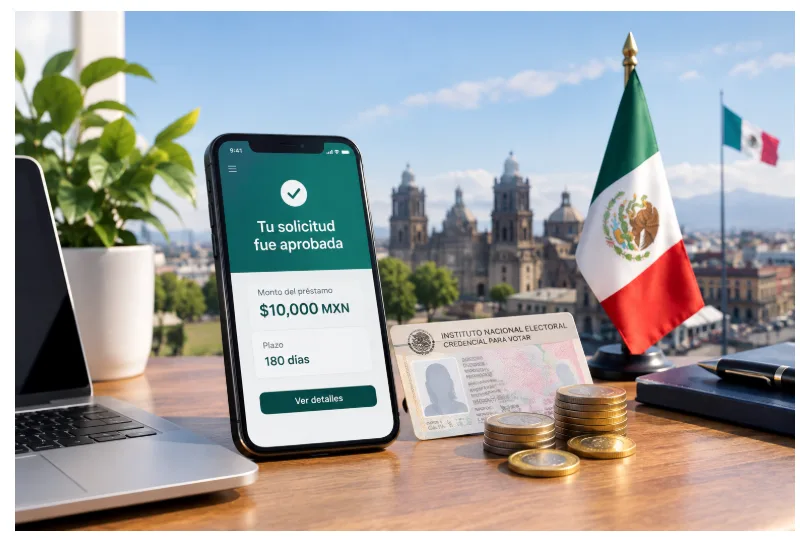
Financial inclusion has become one of the more closely tracked development indicators in Latin America, and Mexico offers one of the clearest case studies of why the metric matters beyond spreadsheets. Despite near-universal smartphone penetration in urban areas, a large share of Mexican adults still lack access to affordable, transparent credit from formal institutions. That gap has historically been filled by informal lenders operating outside any consumer protection framework, often at costs and terms that are never disclosed upfront. The rise of regulated digital lending apps has begun to change that picture, though not evenly, and not without scrutiny.
One of the more visible platforms in that shift is a Mexican digital lending app operated through locally incorporated entities, including OPTIMIZA FDP, S.A.P.I. DE C.V. The platform offers loans between $1,000 and $50,000 Mexican pesos over terms of 91 to 360 days, and has surpassed five million downloads on Google Play, with an average rating near 4.5 stars across more than 221,000 reviews. Numbers at that scale put the product in front of a genuinely broad cross-section of Mexican borrowers, not a narrow early-adopter segment, which raises the stakes for how transparently the product discloses its costs and its ownership.
Why Ownership Disclosure Matters in Cross-Border Fintech
Development economists have long noted that access to credit alone does not guarantee positive outcomes for borrowers; the terms of that credit matter just as much. Mexico’s regulatory response has centered on the Costo Anual Total, or CAT, a standardized disclosure of the true annualized cost of borrowing, which every lender operating in the space is expected to present clearly before a borrower commits. Platforms that display the CAT prominently, rather than burying it in fine print, tend to draw less scrutiny from consumer advocates and regulators alike, because the core complaint against predatory lending has always been about hidden cost, not the existence of the loan itself.
A second layer of scrutiny in this specific case involves ownership. The platform’s ultimate parent company is KN Group, based in China, which places it inside a broader wave of Asian capital entering Latin American fintech over the past several years. Cross-border ownership in a sector that touches personal identity documents and household finances tends to draw more public attention than it would in other industries, and rightly so. The more sustainable response to that attention is not to obscure the ownership structure but to pair it with clear operational transparency: naming the Mexican legal entity that actually issues the credit, publishing a real, staffed contact channel, and pointing borrowers toward Mexico’s CONDUSEF for independent recourse if a dispute cannot be resolved directly.
What Regulators and Researchers Are Watching
Multiple Mexican institutions have overlapping jurisdiction over digital lending in ways that matter for anyone studying financial inclusion outcomes. CONDUSEF fields consumer complaints and provides financial education. PROFECO oversees advertising claims and general consumer protection. Mexico’s federal data protection law governs how sensitive identification documents, most notably the INE used in most digital loan applications, are collected, stored, and eventually deleted. A lender operating at multi-million-user scale across all of these frameworks simultaneously represents a meaningfully more complex compliance undertaking than a small regional lender serving a few thousand customers with looser oversight.
That complexity is precisely why longevity and transparency track records matter more in this sector than growth metrics alone. A platform that has operated for years under a named, verifiable legal entity, with a documented complaints process and consistent public review history, offers researchers and regulators a very different risk profile than a newer entrant with an unclear ownership trail. For financial inclusion researchers specifically, that distinction is often the difference between recommending a product as a genuine access-to-credit improvement versus flagging it as a category to watch more closely.
The Bigger Picture for Underbanked Borrowers
None of this suggests digital lending apps are a complete substitute for expanding traditional banking access in Mexico. But for a borrower facing an immediate cash gap, whether from a medical expense, a repair bill, or simply the stretch between paychecks known locally as quincena, the realistic alternative to a transparent digital lender is often an unregulated informal lender with no disclosed terms at all. Measured against that actual alternative, rather than against an idealized traditional bank loan that may not be accessible to a thin-file borrower, transparent digital lending products represent a meaningful, if imperfect, improvement in the options available to underbanked Mexican households.
The platforms that will matter most to that outcome over the next several years are the ones that keep investing in the unglamorous parts of the business, clear cost disclosure, responsive support, documented compliance processes, rather than the ones that simply grow the fastest. That is the pattern worth watching as Mexico’s digital lending sector continues to mature. Full disclosures and contact details are published at mexicash.com
