



Nothing can be left to chance when it comes to keeping products sterile. A minuscule puncture in the foil lid of a yogurt container or a tiny breach in the seal of a medical device pouch could have life-threatening consequences.
To ensure products – like medical devices, food and beverages – remain contaminant-free, the packaging that protects them must adhere to strict standards. Depending on the product, industry, and country of origin or distribution, packaging may need to meet ISO, ASTM, EU MDR, or other standards. Meeting those standards requires rigorous testing with force, torque and compression measurement equipment.
One such test, the T-Peel test, ensures the adhesive bond sealing a flexible package is strong and won’t peel apart under pressure. Here’s what you need to know about this commonly used validation test.
What Is a T-Peel Test?
T-Peel tests measure the strength of the adhesive that bonds a flexible package’s sides together. This helps manufacturers ensure packages stay sealed in transit when force is applied, without sealing them so tightly that end users can’t open them.
At a high level, T-Peel tests:
- Create a baseline to screen for changes that could impact a package’s seal
- Confirm the reproducibility of a sealing process
- Validate design specifications
- Ensure adherence to ASTM, ISO, EU MDR, or other standards and regulations
- Give manufacturers confidence their packaging will protect the products sealed inside
How to Conduct a T-Peel Test
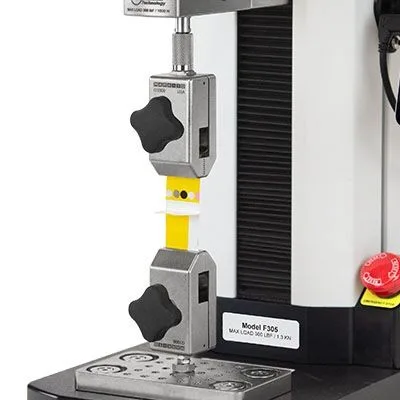
T-Peel tests are conducted at either 90° or 180°. For a 90° T-Peel test, hold bonded materials at 90 °; for a 180° T-Peel test, hold them at 180 °. You can conduct both tests with a manual test frame or a motorized universal testing machine (UTM). For the greatest accuracy – and to comply with various standards – using a UTM is strongly recommended.
To test, place the sample between grips or fixtures mounted to the test frame. The test frame then pulls the bonded materials apart using consistent force and measures the force in common units (e.g., lbF or N) needed to break the seal. The resulting number equals the force needed to open the packaging. Tests may either pass or fail, depending on whether the force exerted falls below an established maximum load (pass) or exceeds it (fail).
How to Select the Right Testing Equipment
Selecting the right equipment for your T-Peel test is key to getting an accurate measurement.
When sourcing your equipment, look for a manufacturer that prioritizes reliability, durability, and precision. Seek out a brand that specializes in designing and engineering high-quality tools that can be configured to conduct the type of T-Peel test most appropriate for your application. Ensure your system meets relevant industry standards (e.g., ASTM D1876 Standard Test Method for Peel Resistance of Adhesives or ASTM F88/F88M Standard Test Method for Seal Strength of Flexible Barrier Materials).
Whether you’re new to conducting T-Peel tests or a seasoned professional, purchase your equipment from a manufacturer with robust customer support who can give you advice about how to test your packaging seals and help you get the most out of your testing equipment.
