



Benjamin Humphrey has spent years hearing the same warning: that running a global software company out of Sydney means working against geography rather than with it. The Dovetail Software co-founder and CEO says AI is doing the opposite.
A wave of 2026 commentary on distributed hiring has settled on a blunt claim: AI closes the skills gap that used to separate an in-house US engineering team from one built anywhere else, so location stops mattering. One recent analysis of the outsourcing market took a different view: any distributed team now faces a rising bar for what it has to deliver to earn its seat at the table, wherever that team sits. Humphrey’s case for building in Australia predates that argument by a decade, and it rests on three advantages he says AI is sharpening rather than erasing.
An Exchange Rate Argument That Predates the AI Debate
Dovetail’s economics started with arithmetic most founders don’t bother explaining publicly. “We charge customers in USD and pay salaries in AUD, so we have a benefit from the exchange rate,” Humphrey says. That gap has helped fund a company now used by 20% of the Fortune 500, built by a team that never had to compete for US-denominated salaries to get there.
Humphrey says: Sydney’s engineering market sits in a useful gap, deep enough to hire from Canva, Atlassian, and Google, but nowhere near as contested as its US equivalent. “The engineering talent in Australia is good. It’s not as good as the US, but it’s good enough,” he says. “It’s not as competitive, so we can hire people from companies like Canva and Atlassian and Google here in Australia and have a strong value proposition for them.” The wage data backs the pattern up: Australian AI engineers currently earn around $164,000 a year on average, against roughly $238,000 for their US counterparts, a gap Hays’ 2026 tech salary comparison found holds across nearly every technical role. That gap is what let Dovetail build a customer intelligence platform without the wage war that defines the same search in San Francisco.
Time Zones Are Turning Into an AI-Era Advantage
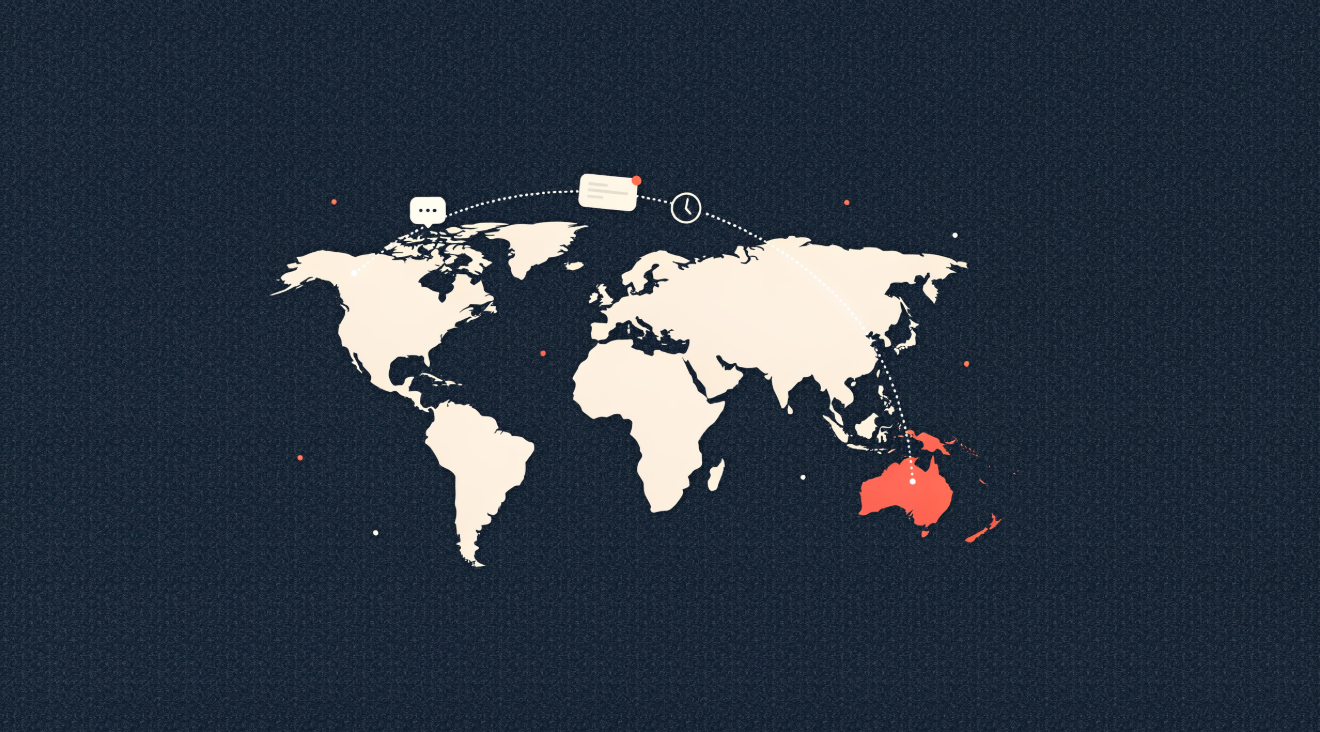
Geography did more than cut Dovetail’s payroll costs: the same setup gave the company coverage most competitors had to build deliberately. “Having some time zone coverage, working through the night for the US and Europe, allows us to resolve customer issues more quickly,” Humphrey says. “In the early days, someone would report a bug and we’d fix it for them overnight, and that was quite delightful for them.”
Always-on coverage has moved from a nice-to-have to an assumption. Seventy-four percent of consumers now expect round-the-clock service specifically because of AI, a shift Zendesk’s 2026 CX Trends research documented across the software category Dovetail sells into. A team already structured to answer customers while the US and Europe sleep starts that race with a head start nobody had to plan for.
Staying Quiet Still Works When Everyone Has the Same Tools
Humphrey’s least conventional advantage is the one he built on purpose: distance from Silicon Valley’s attention. Dovetail opened its San Francisco office in February 2022, and Humphrey has said the company deliberately avoided drawing notice while it grew. “We kind of stayed under the radar for a while, which was quite good,” he says. “You don’t want to be super hyped in San Francisco, because you attract a lot of competitors and a lot of noise. Building quietly allowed us to build a product advantage without massive competition.”
Task-specific AI agents are projected to sit inside 40% of enterprise applications by the end of 2026, up from less than 5% in 2025, a jump Gartner forecasts that puts most enterprise software vendors on similar technical footing within eighteen months. When the tools available to a five-person Sydney team and a fifty-person San Francisco team start converging that fast, the advantages that never showed up in a product demo, cost structure, coverage, and the discipline to build without an audience, become the ones that compound.
Sydney gave Dovetail three advantages from day one: cheaper capital, a deep but uncompetitive talent pool, and always-on coverage. Humphrey says AI raises the value of each one rather than erasing it. Founders still weighing whether to build outside the US might find the calculus has changed since 2016. Dovetail’s did too, just not in the direction most of the current commentary assumes.
