



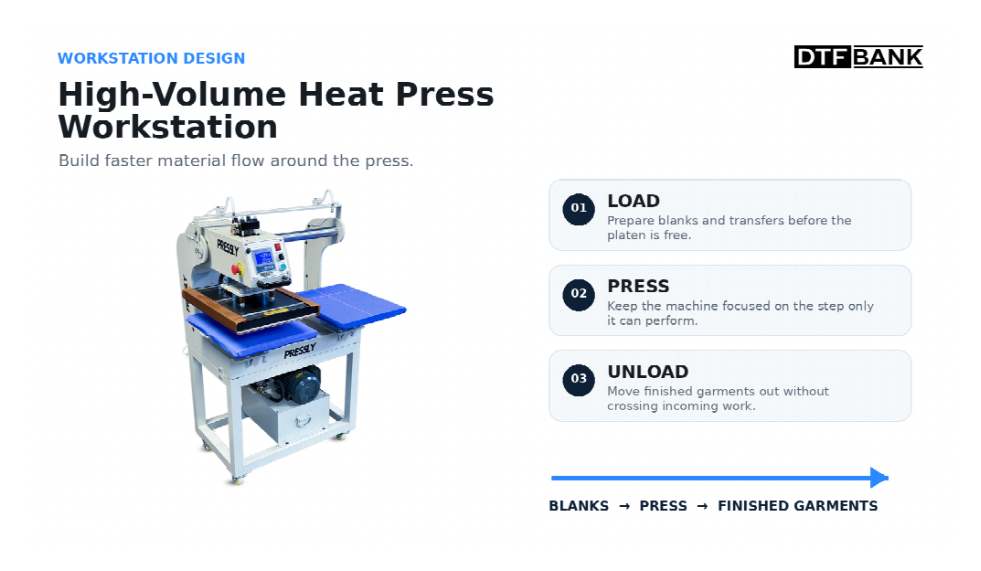
 A production heat press can be capable of working quickly while the workstation around it remains surprisingly slow. In many apparel shops, the machine is not the only factor controlling output. The location of blank garments, transfers, finished pieces, tools, and inspection areas can add unnecessary movement to every production cycle.
That extra movement may look insignificant on one shirt. Repeated hundreds of times, however, a few unnecessary actions can become a meaningful production constraint.
For shops moving toward a commercial heat press workflow, workstation design should therefore be treated as part of the production system.
Think in Terms of Product Flow
A useful heat press workstation has a clear direction. Blank garments enter the station, transfers are paired with the correct pieces, pressing occurs, finished garments move to the next required step, and completed items leave the area without crossing back through incoming work.
When incoming and outgoing products share the same surface, operators can lose time sorting pieces or moving finished garments out of the way. The risk of mixing completed and unprocessed items also increases.
A simple left-to-right or right-to-left flow can reduce unnecessary handling. The exact direction matters less than consistency.
Create a Dedicated Loading Zone
The lower platen should not become the place where every preparation task happens. Operators work more efficiently when garments and transfers are prepared before they reach the pressing position.
A loading zone can hold the next garment, its transfer, and any job-specific instructions required by the operator. The goal is to make the next piece ready while the current piece is moving through the pressing process.
This does not mean rushing alignment. It means separating preparation from machine occupancy. A production press should spend as much of the shift as practical doing the work that only the press can perform.
Keep Transfers Organized by Job
High-volume production becomes harder when several designs, garment sizes, or customer jobs enter the same area at once. A fast press does not solve identification problems.
Transfers should be staged in a way that makes the next required graphic obvious. Garments can likewise be grouped by job, size, color, or production sequence. The system does not need to be complicated. Trays, labeled stacks, job sheets, or clearly separated work surfaces can all help.
The important point is that the operator should not need to stop and search for the next correct transfer.
Plan Space for Completed Garments
Finished pieces also need a destination. Allowing completed garments to accumulate directly beside the lower platen can gradually reduce working space and force operators to reorganize the area during the production run.
If a transfer system requires a specific cooling or peel procedure, the outgoing area should support that process without interfering with the next garment being loaded.
A defined finished-product zone also makes counting easier. Shops can compare completed quantities with the job ticket without reopening mixed stacks.
Reduce Repetitive Reach
Workstation design should minimize the number of times an operator repeatedly turns, walks, bends, or reaches across the press. These movements affect more than comfort. They consume cycle time.
Frequently used items should be positioned within the normal working area whenever it can be done safely. Less frequently used materials can remain farther away. The workstation should also maintain appropriate clearance around moving and heated machine components.
When comparing professional heat press machines, platen access and the way the machine opens or moves should be considered alongside temperature, pressure, and platen dimensions. Machine geometry influences how easily an efficient workstation can be built around it.
Do Not Let Inspection Block Production
Quality control is essential, but every inspection does not necessarily need to happen directly in front of the heat press.
Operators should confirm critical details at the correct stages, but longer visual checks, counting, folding, packaging, or sorting can often be performed at a separate position. Moving secondary tasks away from the press prevents the machine from remaining idle while work that does not require heat or pressure is completed.
Test the Workstation With a Real Order
The best workstation layout is rarely designed perfectly on paper. Run a representative production job and observe the operator.
Where does the operator repeatedly turn? Which materials are picked up more than once? Do finished garments block incoming work? Does the operator wait for transfers to be sorted? Does the machine wait while the next garment is prepared?
Small layout changes can then be tested individually. Moving one table, changing the location of transfers, or separating incoming and outgoing stacks may improve production without altering the press itself.
High Production Requires More Than a Fast Machine
A professional heat press should provide repeatable heat and pressure, but sustained output depends on everything surrounding the machine as well.
Good material flow keeps blanks, transfers, operators, and completed garments moving in a predictable sequence. It reduces unnecessary handling and gives the press more opportunity to perform its primary function.
For growing apparel shops, designing the workstation around the production process can be just as important as choosing the machine at the center of it.
