



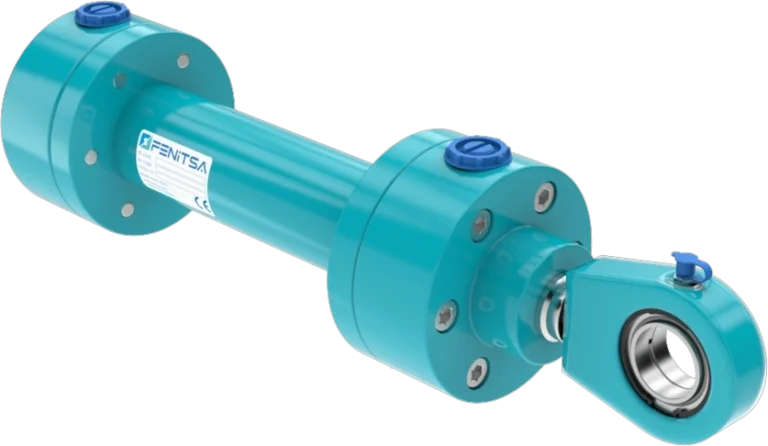
Heavy machinery depends on controlled movement. Lifting, pressing, positioning, clamping and holding operations all require components that can transfer force accurately while working under demanding conditions. In many industrial systems, this responsibility belongs to hydraulic cylinders.
As machinery becomes more specialized, selecting the right cylinder is no longer simply a matter of choosing a bore diameter and stroke length. Manufacturers must also consider operating pressure, mounting position, load direction, available space and the environment in which the equipment will work.
For these applications, Industrial Hydraulic Cylinders can be designed around the real requirements of the machine. Fenitsa offers different hydraulic cylinder families for industrial and heavy-load applications, allowing machinery manufacturers to evaluate the most suitable solution according to their production needs.
Heavy Loads Require the Right Combination of Force and Stability
Hydraulic cylinders work by converting hydraulic pressure into linear force. The principle is well established, but heavy-duty applications place greater demands on every part of the system.
A cylinder used in a lifting mechanism, for example, may need to support a significant load throughout its stroke. Another cylinder installed in an industrial press may repeatedly apply high force during every production cycle.
The required cylinder design can therefore change considerably from one application to another.
Bore diameter influences the force that can be generated at a given hydraulic pressure. The piston rod also needs to be selected according to the load and movement conditions.
Long strokes require additional attention because rod stability can become more important as extension increases.
Mounting geometry also affects how loads are transferred through the cylinder and machine structure.
If the mechanism creates side loads or angular movement, this should be taken into account during cylinder selection. Hydraulic cylinders are primarily designed for linear force, so the way the actuator connects to the machinery can have an important effect on its working conditions.
For this reason, heavy-duty cylinder selection usually starts by examining the complete machine rather than treating the cylinder as an independent component.
Standard Cylinder Series Provide Different Design Options
Industrial manufacturers often benefit from standard cylinder families because established dimensions and connection options can simplify machine design.
Fenitsa offers several hydraulic cylinder configurations for different industrial requirements.
The FDH series provides an ISO-based solution for industrial applications. Different piston and rod dimensions allow manufacturers to choose a cylinder according to force and installation requirements.
The KHS series is developed for heavier-duty working conditions. It provides another option for machinery where reinforced construction and longer stroke possibilities may be required.
Fenitsa’s THS range uses a welded-body structure.
This type of hydraulic cylinder can be useful in machinery where compact construction and robust installation are important. Welded designs are widely used in industrial and mobile machinery because the cylinder body can be integrated effectively into different mechanical layouts.
Telescopic cylinders provide another solution for applications where long travel is required but installation space is limited.
A conventional hydraulic cylinder with a very long stroke may also require a long closed length. Telescopic systems solve this problem by using multiple extending stages.
This allows the actuator to achieve a larger movement while remaining more compact when retracted.
These differences demonstrate why manufacturers should not automatically select the largest or strongest available cylinder.
The correct solution is the one that matches the actual machine.
Custom Requirements Are Common in Industrial Machinery
Standard cylinders are useful when machine dimensions match existing configurations, but many industrial projects require something more specific.
Machinery manufacturers frequently work with limited installation areas, special connection points or unique movement requirements.
A cylinder may need a particular stroke.
Port positions may need to match existing hydraulic lines.
The mounting arrangement may need to follow the geometry of a machine frame.
The closed and extended lengths may also need to remain within strict dimensional limits.
For this reason, custom hydraulic cylinder engineering is an important part of heavy machinery development.
Fenitsa can evaluate cylinder requirements using project information such as technical drawings, operating data or existing cylinder dimensions.
This can be useful for both new machinery and replacement projects.
When an existing hydraulic cylinder needs to be replaced, important measurements can be taken from the original component.
These can include bore diameter, rod diameter, stroke, mounting dimensions, connection types and overall open and closed lengths.
For a new machine, the process can begin earlier.
Cylinder requirements can be considered while the equipment itself is being designed. This allows the hydraulic actuator to become part of the mechanical engineering process rather than something selected only after the machine structure has already been completed.
The wider Fenitsa product range includes hydraulic and pneumatic cylinder solutions for different industrial applications, giving machinery manufacturers access to both standard and project-specific configurations.
The Working Environment Also Influences Cylinder Design
A hydraulic cylinder does not operate in laboratory conditions.
Industrial machinery may work in dusty production areas, heavy manufacturing facilities, mining environments or outdoor equipment.
Temperature changes, contamination, moisture and operating frequency can all influence how a cylinder should be designed.
Sealing becomes especially important.
The seal system needs to support the pressure and movement conditions of the application while helping control hydraulic fluid throughout the operating cycle.
Rod surface quality and guidance components also play an important role because the piston rod repeatedly moves through the sealing system.
Maintenance access should be considered as well.
Industrial machinery is often expected to remain in operation for long periods. Designing the cylinder and mounting arrangement with future servicing in mind can simplify maintenance when seals or other wear components eventually require attention.
Hydraulic connections are another detail that can affect installation.
Port position should work with the available hose or pipe routing inside the machine.
A technically suitable cylinder can still create installation problems if connections interfere with the surrounding structure.
These details show why hydraulic cylinder design is closely connected to the wider machine layout.
Hydraulic Cylinders Remain Central to Modern Industrial Motion
Industrial automation continues to develop, but hydraulic power remains important in applications that require significant linear force.
Electrical actuators are suitable for many controlled movements, while pneumatic systems are widely used for faster and lighter automation tasks.
Hydraulic cylinders continue to be particularly valuable where substantial pushing, pulling, lifting or holding forces are required.
Heavy machinery manufacturers therefore need to evaluate more than nominal cylinder size.
The complete application should be reviewed.
How much force is needed?
How long should the stroke be?
How will the cylinder be mounted?
Will the rod experience side loading?
How frequently will the machine cycle?
How much installation space is available?
What environmental conditions will surround the cylinder?
Answering these questions helps create a more accurate cylinder specification.
This approach is becoming increasingly important as industrial machinery becomes more specialized. Equipment manufacturers want components that fit directly into their mechanical and hydraulic systems rather than forcing the entire machine design to adapt around a standard actuator.
Industrial hydraulic cylinders support this transition by offering different construction types, dimensions and project-specific possibilities.
For heavy-load machinery, the cylinder is not simply the component that creates movement.
It is part of the complete mechanical structure, hydraulic circuit and production process.
When force, stroke, mounting, operating conditions and machine geometry are evaluated together, hydraulic cylinders can deliver the controlled movement required by modern industrial equipment.
The post Industrial Hydraulic Cylinders Take a Larger Role in Heavy Machinery Design appeared first on PHIMDACAP.COM.
