



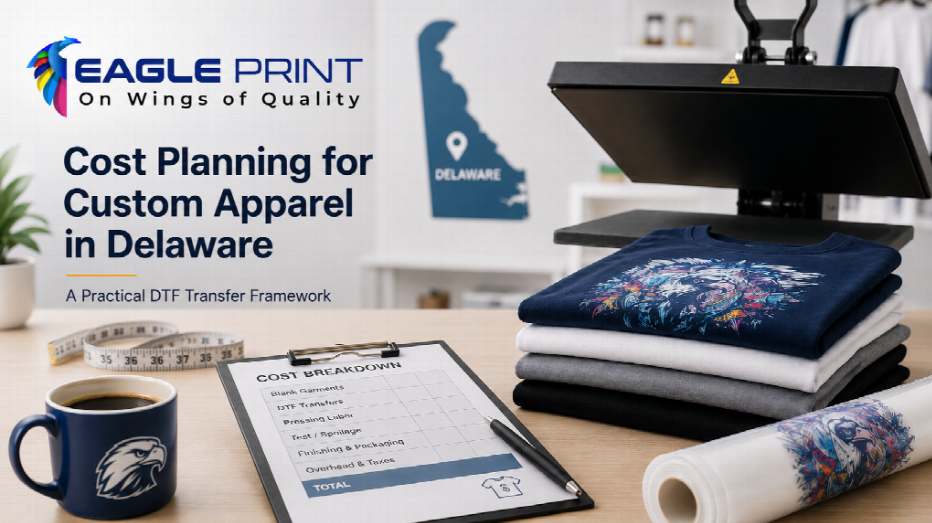
A Delaware apparel order can look profitable at first and still underperform once the job is pressed, packed, and delivered. The problem is often the accumulation of small costs: transfer size, blank garments, pressing time, test pieces, packaging, replacements, and overhead.
That matters for small apparel sellers. Delaware’s Division of Small Business says small businesses account for 98% of businesses in the state. For a shop working with short runs, staff apparel, events, or local merchandise, a repeatable pricing method is more useful than simply adding a markup to the blank shirt.
Quick answer: what should go into a DTF apparel quote?
A practical quote should account for six cost layers: the garment, the transfer, pressing labor, expected spoilage or test pieces, finishing or packaging, and business overhead. Transfer dimensions should be confirmed before the selling price is finalized because print size can affect both transfer cost and the visual value of the finished garment.
| Cost decision | Why it matters | Practical action |
| Blank garment | Style, fabric, and size mix change unit cost | Price the actual garment mix |
| Transfer dimensions | Larger artwork uses more printed area | Confirm width and height before quoting |
| Pressing labor | Every garment requires handling | Include pressing, peeling, and QC time |
| Test/spoilage buffer | Errors can erase profit on a small run | Add a realistic buffer |
| Packaging/finishing | Bagging, labels, and sorting take time | Charge when included |
| Business overhead | Rent, software, labor, and taxes still exist | Use a consistent overhead allowance |
Build the price from the finished garment backward
Weak quotes often begin with the blank garment price and add a rough printing charge. A better method starts with the finished product the customer expects.
If a local organization wants 30 shirts with a full-front graphic, confirm the garment style, size range, artwork dimensions, number of print locations, packaging requirements, and whether every shirt uses the same design. Those details determine the real production workload.
If the buyer later adds a sleeve print or requests individual bagging, the job has changed. A clear cost stack makes revisions easier because every added requirement has a place in the calculation.
Transfer size is a pricing decision, not only a design decision
A graphic that looks correct on a youth shirt may be too small on an adult 2XL. One transfer size across every garment can create inconsistent results, while too many size variations can complicate production.
The practical middle ground is to use the smallest number of transfer sizes that keeps artwork proportional. Apparel decorators can reviewDTF transfers by size when they need a size-based ordering route instead of a multi-design sheet.
Record approved dimensions in inches before ordering. “Large front logo” is not a production specification. “10.5 inches wide” is. That habit improves quoting, reordering, and placement consistency.
Delaware businesses should separate customer pricing from tax assumptions
Delaware has no state or local sales tax, but that does not mean a seller has no state-level business tax considerations. The Delaware Division of Revenue states that Delaware imposes gross receipts tax on sellers of goods and providers of services, with the applicable rate depending on business activity. The state also notes that many operating expenses are not deducted when gross receipts are calculated.
For an apparel seller, the lesson is practical: do not build a margin model around the assumption that “no sales tax” means “no tax cost.” Treat applicable obligations as part of business overhead and verify the current rules for your activity. This is operational guidance, not tax advice.
When does DTF fit the cost-control model?
DTF can be useful when a shop wants to outsource printed transfers while keeping garment selection and heat pressing in-house. It can also fit artwork with multiple colors, detailed elements, or quantities that do not justify setting up another decoration method.
For buyers comparing sourcing options,DTF transfers in Delaware offer a relevant route for reviewing transfer formats before the garment order is finalized.
Choose the production method after understanding the job. A 12-shirt staff order, a 100-piece promotional run, and a mixed-size merchandise release can have different cost pressures even when they use the same logo.
Use a four-line preflight before approving the quote
Before taking payment, write down four things:
- Garments: styles, colors, sizes, and quantities.
- Print specification: artwork version, dimensions, placement, and print locations.
- Production allowance: labor, test pieces, spoilage, finishing, and packaging.
- Commercial allowance: overhead and applicable business tax obligations.
If one line is vague, the quote is not finished. This also makes customer conversations easier because you can explain exactly what changed when the order changes.
Frequently asked questions
How much should I mark up DTF apparel?
There is no universal markup. Start with the full job cost, including labor and overhead, then apply a margin that fits your business model and risk. A percentage applied only to the blank garment can hide production costs.
Should every shirt size use the same transfer size?
Not necessarily. The artwork should remain proportional, but a unique transfer for every garment size can create unnecessary complexity. Grouping garments into a small number of practical print sizes is often easier.
What is the biggest pricing mistake on small custom apparel orders?
Ignoring labor and small production losses. Pressing, alignment, peeling, QC, packaging, and replacement garments can have a larger effect on a short run because there are fewer units over which to spread those costs.
A better quote is a better production plan
Pricing and production should describe the same job. When garment quantities, transfer dimensions, labor, finishing, overhead, and local business obligations are visible before production begins, a Delaware apparel seller can judge whether an order is worth taking and how it should be produced.
That discipline reduces surprises, makes revisions easier to explain, and creates a cleaner handoff from customer approval to finished apparel.
