



Cosmetic treatments have become increasingly visible in everyday life. Procedures that were once discussed mainly in beauty magazines or celebrity culture are now part of broader conversations about skincare, aging, personal appearance and wellness. Social media has accelerated that shift, giving people access to thousands of treatment videos, patient experiences and before-and-after photographs within seconds.
At the same time, greater visibility has created a more informed — and often more cautious — patient. Instead of choosing a procedure based solely on an advertisement, many people now research providers, treatment techniques, possible side effects and expected recovery before scheduling an appointment. Clinics such as Skin Glow Dermatology reflect this broader movement toward combining dermatology and aesthetic care with patient education, allowing people to learn about available treatments before deciding whether a procedure fits their goals.
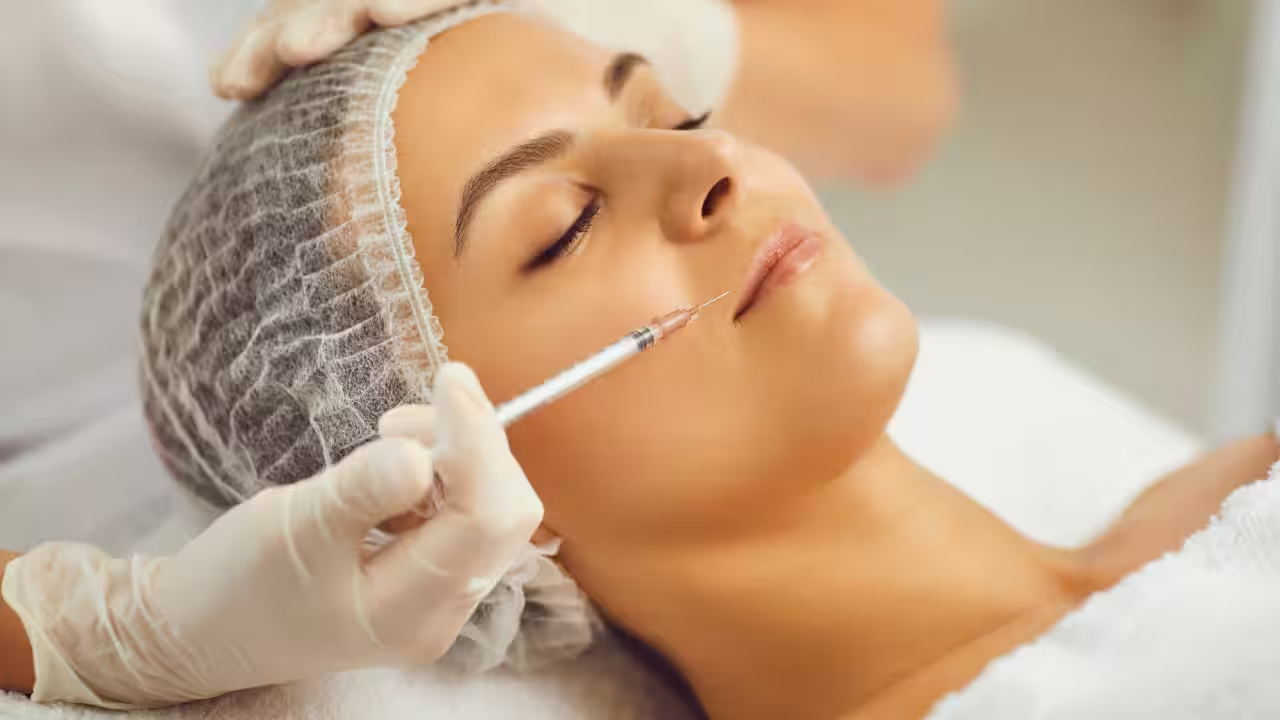
This change is particularly noticeable with minimally invasive cosmetic procedures. Dermal fillers, neuromodulators, chemical peels and other office-based treatments can often be performed without the recovery associated with surgery. Their accessibility is part of their appeal, but a shorter procedure does not eliminate the importance of understanding what is being done.
Social Media Has Changed How Patients Discover Treatments
Instagram, TikTok, YouTube and other platforms have transformed the aesthetics industry. A patient considering lip enhancement, for example, can see hundreds of transformations before ever speaking with a medical provider.
That access can be useful. Patients can learn terminology, discover different approaches and develop questions they want to ask during a consultation.
But there is another side to the trend.
Images can be affected by lighting, camera angles, makeup, swelling, editing and the timing of the photograph. A result shown immediately after an injectable treatment may look different once swelling resolves. Likewise, a dramatic result that works well for one person’s facial anatomy may not be appropriate for another.
For this reason, photographs should be treated as educational references rather than promises.
Why Before-and-After Photos Still Matter
Despite their limitations, before-and-after photographs remain one of the most useful tools for people researching aesthetic procedures.
They can help patients understand what subtle versus more noticeable enhancement looks like and provide a starting point for discussing personal preferences with a provider. Looking at real lip filler before and after results can also help prospective patients formulate more specific questions about volume, shape, symmetry and the overall style of the result they want.
The important distinction is between using photographs to establish realistic expectations and using them as a guarantee.
Every face is different. Lip shape, existing volume, facial proportions, age, skin characteristics and previous treatments can all affect the final appearance.
A useful consultation therefore should not begin with the question, “Can you make me look exactly like this photograph?”
A better question is, “What kind of result is realistic for my anatomy?”
The Shift Toward More Natural Results
Another notable development in aesthetic medicine is the growing interest in results that do not immediately reveal that a cosmetic procedure has been performed.
For many patients, the objective is no longer maximum volume or a dramatic transformation. They may instead want improved symmetry, subtle definition or restoration of volume that has changed with age.
This has helped move the conversation away from simply asking how much filler can be injected and toward questions about proportion.
The lips, for example, are only one feature within the face. Increasing their volume without considering the surrounding facial structure can create a result that feels disconnected from the patient’s natural appearance.
That is one reason individualized assessment remains important even for procedures that may take relatively little time to perform.
Aesthetic Procedures Are Still Medical Procedures
The popularity of injectables can sometimes make them appear closer to beauty services than medical treatments.
However, injectable treatments involve products being placed into or beneath the skin. Patients should understand what product is being used, why it has been recommended and what potential complications or side effects should prompt medical attention.
Temporary swelling, tenderness or bruising can occur after injectable treatments. Other complications, although less common, may require prompt evaluation.
A responsible consultation should therefore include more than a discussion about appearance. Medical history, medications, allergies, previous cosmetic procedures and individual risk factors can all be relevant.
Patients should also be given clear instructions about what to expect following treatment and whom to contact if something does not seem normal.
Price Is Only One Part of the Decision
Cost naturally influences consumer decisions, particularly because many elective cosmetic procedures are paid for out of pocket.
However, comparing aesthetic treatments solely by price can be misleading.
Two clinics may advertise what appears to be the same procedure while using different products, quantities, treatment approaches and levels of medical oversight. The least expensive advertised option is therefore not necessarily equivalent to another treatment with the same general name.
Patients researching a provider can ask several practical questions: Who will perform the procedure? What product will be used? How much product is planned? What happens if there is a complication? Is follow-up available?
These questions often provide more useful information than price alone.
Online Research Can Improve the Consultation
The internet is sometimes described as a problem for healthcare because patients can encounter misinformation. But online research itself is not necessarily the problem.
The quality of the information matters.
Patients who understand the basics of a procedure often arrive at consultations with better questions. They may already know that temporary swelling can occur, that results vary between individuals or that maintenance treatments may eventually be necessary.
This can make the consultation more productive.
Rather than spending the entire appointment explaining basic terminology, the provider and patient can focus on suitability, expectations and an individualized treatment plan.
The challenge is learning to distinguish educational information from marketing claims.
What Patients Should Look for Before Booking
A polished social media account does not necessarily provide enough information to evaluate an aesthetic provider.
Patients can look beyond photographs and consider the provider’s professional qualifications, experience with the procedure, approach to consultations and willingness to discuss limitations as well as benefits.
Transparency is particularly important.
A trustworthy discussion of cosmetic treatment should acknowledge that results vary. It should explain common side effects and potential risks rather than presenting the procedure as completely effortless.
Providers should also be willing to tell a patient when additional treatment is unnecessary or when a requested result may not be appropriate.
In aesthetic medicine, knowing when not to perform a procedure can be just as important as knowing how to perform one.
More Information Is Changing the Aesthetics Industry
The growth of online health information is gradually changing the relationship between aesthetic providers and patients.
Consumers increasingly expect to understand what they are purchasing before they arrive at a clinic. They want to see representative results, understand recovery, compare treatment options and know who will be providing their care.
That creates challenges for an industry heavily influenced by visual marketing, but it also creates an opportunity.
Better-informed patients may be more likely to approach cosmetic procedures with realistic expectations and recognize that successful aesthetic care is not simply about creating the largest or most dramatic visible change.
For many people, the goal is much simpler: to make a considered, informed decision about their appearance while preserving what already makes them look like themselves.
