



Thousands of South Asian and halal restaurants have opened across the US and Canada over the past decade. Many of them are running a cooking appliance that hasn’t passed a single North American safety test. What does that mean, and why is it going unnoticed, quietly changing?
You don’t need to order a menu in a good Indian restaurant in North America, as the scent of spices will greet you before it does the menu. The smoky, charred edge of the naan is from the back pot of clay, and there it runs hotter than most American ovens can even muster at home. The tandoor has been doing that job for five thousand years. It does it well. But in the United States and Canada in 2026, doing it well is no longer the only thing that matters.
What also matters is paperwork. In particular, that documentation from the certifier indicating that a gas-fired cooking appliance has gone through independent testing, verification, and approval for installation in a commercial kitchen. For most clay tandoor ovens on the North American market, that documentation doesn’t exist.
That gap between the equipment that defines an entire cuisine and the regulatory framework that governs commercial kitchens is the story behind a quiet compliance problem spreading through South Asian, halal, and Middle Eastern restaurants from Toronto to Houston. And it’s a problem that a small number of certified manufacturers are now positioned to solve.
Why a Clay Oven Needs a Certificate
Commercial kitchens in the United States and Canada are regulated environments. Every gas appliance that goes into one needs to meet specific standards before health departments, fire marshals, and municipal inspectors will sign off on a kitchen permit. For conventional equipment ranges, fryers, and grills, this is straightforward. The manufacturers have been navigating North American certification requirements for decades, and their equipment arrives with the right paperwork as a matter of course.
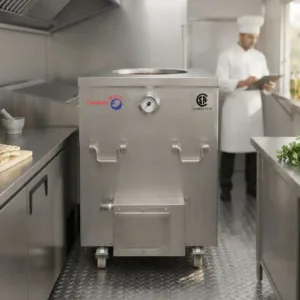
For clay tandoor ovens, it’s different. A tandoor is a traditional, high-temperature cooking oven, typically made with a clay-lined interior and available in modern commercial kitchens with gas-fired designs.
. It doesn’t slot neatly into the categories that North American regulatory frameworks were built around. The two certifications that apply are NSF/ANSI 4, the standard developed by NSF International for commercial food preparation equipment in the US, and CSA Z83.11, which is the Canadian Standards Association standard for gas cooking appliances and a legal requirement in most Canadian provinces before any gas unit can be installed commercially.
Getting either of these certifications is not a quick process. A manufacturer has to submit equipment to independent testing laboratories, produce compliance documentation for detailed technical standards, and then maintain that documentation over time. It takes years and meaningful investment. For small manufacturers in South Asia. Where most tandoor ovens are made, there has never been a commercial reason to go through that process. The certifications hold no value in their home markets.
The result is that a large share of the clay tandoor ovens currently operating in North American restaurant kitchens arrived without either certification. Some were installed before enforcement was tight. Some slipped through in jurisdictions where inspectors lacked the reference standards to flag them. Some are now making their home in restaurants that won’t be found out at permit renewal or on an unannounced inspection until their primary cooking appliance is revealed not to meet the standard.
The Certification Gap is NOT a Compliance Gap; it’s a Supply Gap.
It’s not simply a matter of restaurant operators trying to reduce costs. When many South Asian, halal, and Middle Eastern cuisine entrepreneurs move to North America, they take their over 3000-year-old, unique traditions with them. This means that they should invest in particular equipment that allows them to prepare their traditional dishes alongside practical equipment demands for a modern commercial kitchen.
It isn’t simply that they mean to not get certified; they were buying the only ovens their cuisine needed, from the only manufacturers who made them.
The problem is that the supply chain for certified tandoor ovens in North America has been essentially nonexistent until very recently. If you wanted a clay oven that met NSF/ANSI 4 or CSA Z83.11, you were choosing between a very short list of manufacturers — and many operators simply didn’t know the list existed or that the distinction mattered until they were already facing an inspection issue
That supply gap is narrowing. Tandoor Morni, a manufacturer founded in 1992 and headquartered in Tampa, Florida, has built its commercial range around both certifications. The CH-Series and T-Series commercial ovens carry NSF/ANSI 4 certification; the T-Series also carries CSA Z83.11, making it the right choice for Canadian commercial kitchens where that approval is legally required. The company operates 9 showrooms across the US and Canada and has been providing certified equipment to Indian, halal, and Middle Eastern restaurant operators for over three decades.
The practical difference for an operator is straightforward: a Tandoor Morni clay oven arrives with the documentation that an inspector needs to see. There’s no scramble to source paperwork after the fact, no risk of a permit denial because the appliance can’t be verified, and no expensive equipment replacement mid-build. The oven works. And it can prove it.
Food Trucks and Catering: Where Certification Gets Even More Complex
Commercial restaurant kitchens are regulated by a single jurisdiction. Food trucks are not. A mobile catering operation that crosses state lines or works across multiple cities has to meet the most restrictive certification standard that applies anywhere it operates, which in practice means needing equipment that’s certified to the highest bar on the route. That makes the compliance question for mobile tandoor cooking significantly more complicated than for a fixed-location restaurant. Tandoor Morni’s CS-Series addresses this directly. An easy-to-travel, compact, NSF-certified oven for catering, food trucks, and dark kitchen environments. The food truck tandoor oven CS02 format makes authentic clay oven cooking viable for food entrepreneurs who need to move. From Houston to Mississauga, operators are using it to bring tandoor-cooked naan, kebab, and tikka to markets that haven’t had access to a properly equipped clay oven kitchen before.
The Halal Kitchen Has Its Own Compliance Layer
For halal restaurant operators, certification runs deeper than the appliance standard alone. Halal compliance is a process certification. It covers not just what goes into a dish but how it’s prepared, what equipment touches it, and how that equipment is maintained and cleaned between halal and non-halal use. The clay tandoor oven, which handles the meat dishes most subject to halal scrutiny tandoori chicken, seekh kebab, tikka — sits at the centre of that process.
An operator serving a halal-observant customer base needs their oven to be certified twice over: once for the commercial kitchen standard that satisfies the inspector, and once for the halal process standard that satisfies the customer. Having equipment that carries independent NSF or CSA certification gives operators a verifiable starting point for both conversations a document that demonstrates the oven was manufactured and tested to a known standard, not assembled and shipped without oversight.
The market they’re serving is substantial and growing. The market of halal food products in North America is expected to see a steady rise in sales in the coming years, with its USD 100 billion value likely to reach USD 226 billion by 2033. Of this growth, over $23 billion will be exported to the U.S. More than $23 billion of that growth is also projected to spread to the U.S. The restaurants feeding that demand need equipment they can stand behind to health departments, to halal certifiers, and to customers who ask.
Five Thousand Years of Heat, and a Very Modern Problem
The tandoor survived sufficiently long to be present even after all of the other cooking technology was introduced. Clay ovens are believed to date to the Indus Valley civilization, about 3000 BCE. The same physics that made them work then radiant heat from clay walls, a sealed chamber, vertical cooking that lets fat fall away from meat are the same physics that make them irreplaceable in a modern commercial kitchen. No convection oven, no combination oven, no combi-steamer produces what a clay tandoor produces. The food is different. That’s not nostalgia. It’s thermodynamics.
A restaurant owner in Toronto or Chicago who decrees the oven is a playground for the rich and elite is walking an extremely thin tightrope. One way or the other, the restaurant operator who decrees the oven a playground for the rich and elite is walking an extremely thin tightrope, somewhere between holding a five-millennia-old tradition dear and walking a regulation that hasn’t been thought of by them. She didn’t want to be in that situation. Use of certified equipment does not equate to easy; it’s easy to deal with.
What Regulators and Operators Both Need
The certification gap isn’t just an operator problem. It’s a problem for the inspectors and regulatory bodies who are increasingly being asked to evaluate equipment that their frameworks weren’t built to handle. A clay tandoor oven doesn’t look like a commercial range. It doesn’t behave like one. Inspectors without a reference standard have to make judgment calls that a certification would make unnecessary.
Clear certification coverage for clay tandoor ovens and a market where certified equipment is available and accessible reduces friction on both sides of the inspection desk. An inspector who sees NSF/ANSI 4 documentation for a clay oven has a known standard to reference. An operator who purchased certified equipment from the start doesn’t face the prospect of replacing their central appliance because paperwork couldn’t be produced.
The South Asian and Middle Eastern restaurant sector in North America is not a niche anymore. It is a mainstream, growing, commercially significant part of the food service industry. The equipment that sector depends on the clay tandoor oven that makes the naan and the kebab that fill those restaurants deserves to be treated as mainstream commercial kitchen equipment, with the same certification infrastructure that any other appliance takes for granted.
For the operator opening a new location this year, that infrastructure now exists. The certified oven is available. The paperwork is real. The only remaining question is whether they know to ask for it.
ABOUT THE AUTHOR
Tandoor Morni has been manufacturing NSF/ANSI 4 and CSA Z83.11 certified clay tandoor ovens for commercial kitchens and food truck operations across the United States and Canada since 1992. Founded by Mr. Bitu and headquartered in Tampa, Florida, the company runs 9 showrooms across North America. More at tandoormorni.com.
