



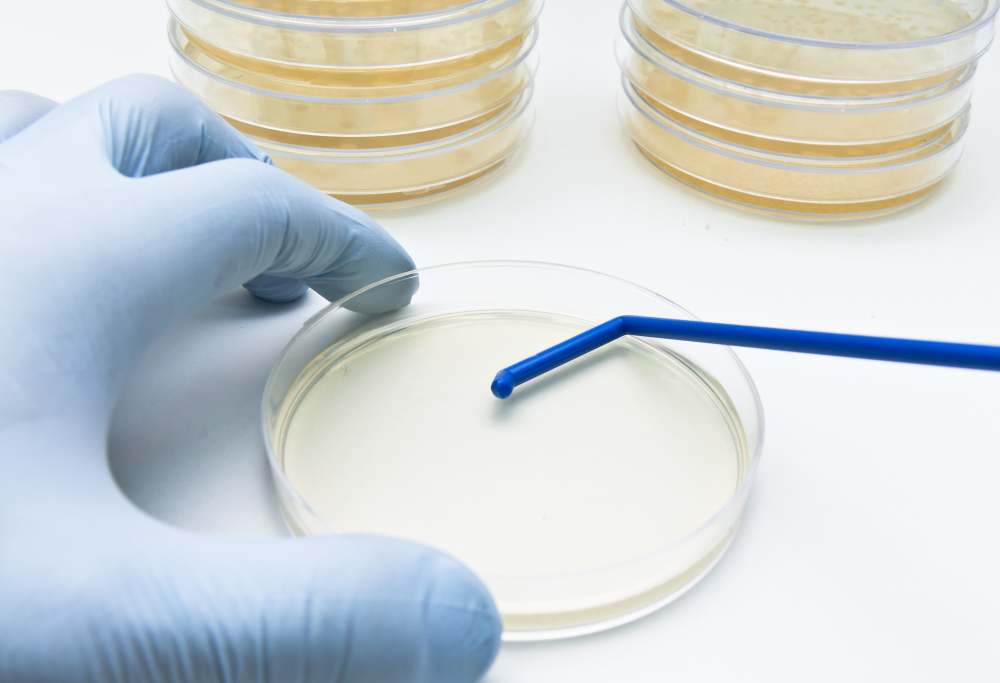
What does the OEM Petri dish design process look like?
Design begins with defining the product’s intended use and delivery requirements. Petri dishes may be intended, among other things, for culturing microorganisms, analytical testing, or specific diagnostic applications. On this basis, the geometry, dimensions, cleanliness variant, and ventilation method are determined.
At this stage, it is also important to determine whether the product is to be aseptic or sterile and sterilized using gamma radiation.
Material selection and technical specification for a private label
The basic material used to manufacture dishes is polystyrene (PS). It makes it possible to obtain transparent components and precisely reproduce the geometry during injection molding. When designing dishes for a private label, the structural variant can also be specified, including a reinforced-bottom version, a model for contact plate applications, a square model, or a variant with a marker.
The configuration also includes ventilation. The options are a version without ribs or a design with ribs that facilitate gas exchange. The product parameters may also be supplemented with unit weight, color, and additional markings or embossing.
Private-label Petri dish manufacturing – stages and quality control
Once the specification has been approved, the Petri dish manufacturer begins production preparation. Polystyrene is fed into the molding equipment, and the bottoms and lids are then formed in the injection molding process. Precision molds make it possible to maintain the intended dimensions and geometry of the individual components.
Petri dish production is monitored at several stages. This includes checking, among other things:
· product appearance,
· dimensions,
· bottom flatness,
· lid fit.
Depending on the version ordered, the products are prepared aseptically or subjected to gamma sterilization. A final inspection of samples is also carried out before a batch is released for distribution.
Customization, packaging, and labeling in line with customer requirements
OEM also includes preparing the product for sale under a specific brand. The logo, manufacturer name, or other markings may be placed on the dish, and both individual and bulk packaging may receive a custom graphic design.
The following are used, among other things, for Petri dish packaging:
· PE bags,
· film sleeves,
· FSC cartons.
One package may contain the number of units specified by the customer, for example 10, 14, 15, or 25. The label may indicate the diameter, height, number of sections, ventilation variant, catalog number, sterilization information, expiry date for sterile products, and a barcode or QR code. In the case of IVD products, it also includes the required regulatory markings and UDI.
Registration of Petri dishes as IVD devices – requirements and procedure
The way a dish is classified depends on its intended use. If the device is intended for in vitro diagnostics using samples of human origin, the provisions of Regulation (EU) 2017/746, i.e. the IVDR, apply. Before the product is placed on the market, its classification and the scope of the required conformity assessment must be determined.
For dishes intended for general laboratory use, the application of IVD regulations does not automatically result from the mere fact that they are laboratory vessels. However, if the device is intended for a specific diagnostic application, its classification requires analysis in accordance with the IVDR rules. Depending on the intended use and risk class, additional requirements may arise regarding conformity assessment and the involvement of a notified body.
The process includes 8 stages in particular.
· Classification of the device in accordance with the rules set out in the IVDR.
· Preparation of technical documentation, including the device description, intended use, materials, specification, risk analysis, and information on production and validation.
· Preparation of the required performance data, if necessary for the given application.
· Implementation of an appropriate quality management system, compliant with the requirements applicable to an IVD manufacturer.
· Carrying out the conformity assessment appropriate to the class and type of device.
· Drawing up the EU declaration of conformity and meeting the CE marking requirements.
· Assigning UDI identifiers and fulfilling the registration obligations required by the regulations.
· Ensuring post-market surveillance, if required for the given device.
In practice, the regulatory stage should already be planned during the design phase. This is because the intended use of the dish affects its classification, documentation, labeling, and the scope of conformity assessment. An OEM manufacturer may support the customer in preparing technical documents and the conformity process, but regulatory responsibility depends on the role of the entity placing the device on the market.
In the case of cooperation with Noex Labware, the OEM scope includes specification preparation, production, customization, and packaging solutions. The manufacturer also declares the availability of quality documentation and support in preparing products intended for applications requiring compliance with IVD regulations.
OEM Petri dish manufacturing step by step
· OEM Petri dish manufacturing begins with defining the intended use, dimensions, material, design, and cleanliness variant.
· A private label may include customization of the product, packaging, labels, and identification markings.
· Quality control covers, among other things, dimensions, geometry, bottom flatness, and lid fit, while sterile versions require an appropriate sterilization process.
· If the dish is an IVD device, its classification and documentation must be prepared in accordance with IVDR requirements before it is placed on the market.
FAQ
What are the minimum order quantities for OEM Petri dish production?
Minimum order quantities depend on the manufacturer and usually start at several thousand units. The specific terms are determined individually at the quotation stage.
Can the shape and size of a private-label Petri dish be customized?
Yes, in the OEM model it is possible to define, among other things, the shape, size, color, markings, and the way the brand is presented on the product and packaging. The scope of customization depends on the manufacturer’s technological capabilities.
How long does the process take from design to a finished OEM product?
The lead time depends on the degree of customization, the number of units ordered, and the scope of the required work. For products requiring an IVD procedure, the time needed to prepare documentation and complete the conformity assessment must also be taken into account.
What documents are required to register Petri dishes as IVD devices?
The scope of documentation depends on the classification and intended use of the device, but it may include the technical specification, risk analysis, performance data, production information, the EU declaration of conformity, and documents required for marking and device identification. The OEM manufacturer may support the preparation of the materials needed in this process.
