



A few years ago, producing a polished campaign video usually meant hiring a camera operator, finding a location, recording voice-over, buying stock footage and passing everything to an editor. Even a short clip could consume a large share of a small organisation’s communications budget.
That process has not disappeared, nor should it. Yet the entry point has changed dramatically. During my recent work with generative media tools, I have been able to move from a written idea to usable images, animated scenes and short video drafts without assembling a conventional production team. The results still need judgment and editing, but the blank page no longer feels quite so expensive.
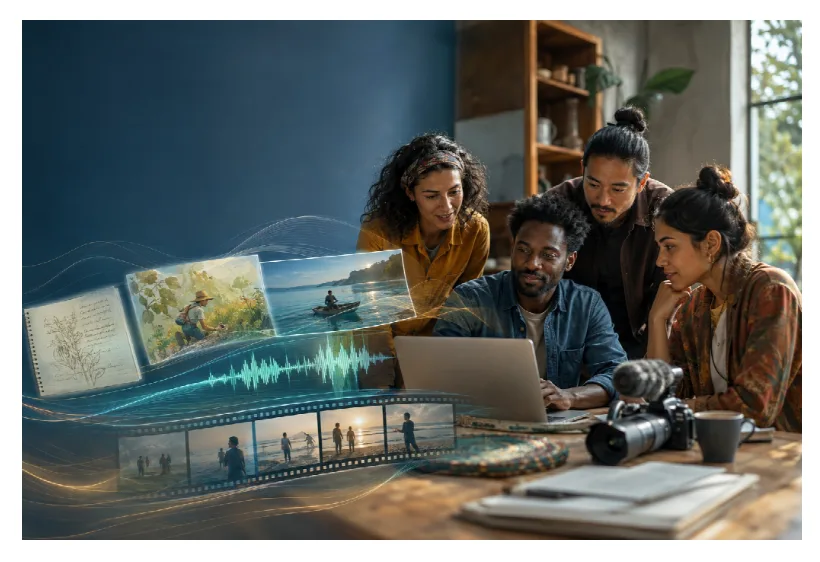
This change is being driven by multimodal AI: systems that can work across text, images, video, audio and reference materials instead of handling only one type of input. Independent browser-based platforms such as Flux 3 show how these capabilities are beginning to sit inside a single creative workspace. A user can start with a prompt, refine an image, animate it and explore different models without rebuilding the project in several disconnected applications.
For small businesses, educators, community groups and independent creators, that consolidation matters. The most important benefit is not the novelty of making an AI image. It is the ability to participate in visual communication without carrying the full cost and technical burden of traditional production.
1. Visual Storytelling Has Always Had a Cost Barrier
Good visual communication depends on more than having an idea. A conventional production may require equipment, lighting, performers, design work, editing software and people who know how to use it all. Those requirements are manageable for a large company. They can be prohibitive for a local shop, a teacher or a nonprofit working with limited funding.
I have seen this gap most clearly at the beginning of a project. A large team can test several campaign concepts before choosing one. A smaller team often has to commit to a single direction because every new photograph, illustration or video scene costs time and money.
Stock media offers a partial solution, but it brings a different problem. The available image may show the wrong setting, community or cultural context. It can feel generic even when it is technically polished. Custom production provides specificity, though at a price many organisations cannot routinely afford.
Generative tools alter that equation by making early experimentation much cheaper. I can test a visual direction, reject it and try another before anyone books a location or starts a full edit. That does not eliminate the value of professional production. It makes the planning stage more accessible.
2. The Move From Isolated Generators to Multimodal Workflows
The earliest generative tools I used were narrow by design. One produced images. Another wrote copy. A third animated still pictures. Moving a concept between them meant downloading files, rewriting prompts and accepting that some creative decisions would be lost along the way.
Multimodal systems are beginning to connect those steps. A creator might provide a written description, a reference image and a sample clip, then use each input to guide a new visual sequence. The image establishes the subject. The text describes the mood and action. The reference video provides clues about movement or camera behaviour.
That combination offers more control than a prompt alone. If I write “a busy community market at dusk,” the model has to interpret almost every detail. When I add a reference photograph, I can communicate the layout, colours and local character more clearly. A motion reference can further indicate whether the scene should feel calm, documentary-like or energetic.
The workflow is still imperfect. Elements may change between shots, small text can be rendered incorrectly and complex movement may break down. Even so, the direction is clear: generative media is moving away from isolated outputs and towards connected production environments.
3. Access Matters More Than Novelty
Many discussions about AI media focus on spectacular demonstrations. I find the ordinary uses more revealing.
A neighbourhood restaurant may need several versions of a promotional visual for different social platforms. A teacher may want to turn a difficult scientific process into a short animated explanation. A local organisation may have valuable archive photographs but no budget to produce a documentary around them.
None of these projects requires a cinematic spectacle. They require understandable, relevant content delivered within realistic constraints.
When I test a new creative tool, I therefore ask a practical question: does it help someone communicate an idea they could not otherwise afford to express? If the answer is yes, the tool has value even when its output still needs correction.
3.1 Small Businesses Can Test Ideas Before Spending Heavily
For a small business, producing more content is not automatically useful. The content has to match the audience and the sales context.
AI-assisted workflows make it possible to explore several directions before committing to a campaign. A retailer can test different product settings. A café can preview seasonal visuals. A service business can storyboard a short explainer without immediately hiring a production crew.
I would not use an unreviewed AI image as a final product representation, particularly when colour, dimensions or materials affect a purchasing decision. I would use it to compare concepts, prepare a creative brief and identify which direction deserves a real production budget.
That distinction is important. Faster experimentation should improve decisions, not weaken accuracy.
3.2 Educators Can Make Abstract Ideas More Visible
Teaching materials often rely on whatever visuals are already available. That can leave instructors choosing between a dense block of text and an illustration that does not quite match the lesson.
Multimodal creation offers another route. A teacher can build a visual example around a specific age group, setting or learning objective. A still diagram can become a short sequence. A written explanation can be paired with narration or translated material.
The educational value does not come from AI alone. It comes from the teacher’s ability to decide what should be shown, what should be simplified and where the generated result could mislead students.
Whenever I use generated visuals to explain a factual subject, I treat them as drafts until every meaningful detail has been checked. A convincing image is not evidence that the information inside it is correct.
3.3 Community Organisations Can Tell More Local Stories
Community organisations often possess the strongest knowledge of an issue but the fewest production resources. Their staff may have interviews, photographs and field observations without the time or budget required to turn those materials into a complete visual story.
AI can help with storyboarding, illustration, translation and simple motion. It can also produce visual variations for audiences who use different languages or platforms.
There is a risk here, especially when real people and sensitive experiences are involved. A generated reconstruction may unintentionally change the meaning of an event or make an invented scene appear documentary. I believe such material should be labelled clearly and developed with the participation of the people represented.
Accessibility is valuable only when it preserves dignity and context.
4. Human Judgment Becomes More Important, Not Less
The speed of generative media can create a misleading impression that production is now automatic. In my experience, the machine completes tasks quickly, but it does not assume responsibility for the message.
I still have to decide whether a scene makes sense, whether a representation feels fair and whether the content supports the intended purpose. I also have to notice errors that look plausible at a glance: a sign containing invented text, a product that subtly changes shape or a person whose appearance shifts between frames.
These problems become more serious when the content relates to health, education, public policy or current events. A visually persuasive mistake can travel further than a rough draft because viewers may not recognise that anything is wrong.
My review process usually includes three separate questions:
| Review area | Question I ask |
| Factual accuracy | Does the visual imply anything that is untrue or unsupported? |
| Visual continuity | Do people, objects and locations remain recognisable across the sequence? |
| Audience interpretation | Could a reasonable viewer mistake a reconstruction for authentic footage? |
This review takes time. That is not a failure of the workflow; it is part of using the technology responsibly.
5. Copyright, Consent and Disclosure Cannot Be Afterthoughts
Low-cost generation does not remove existing rights and responsibilities.
Before uploading a photograph, I need to know whether I have permission to use it. Before publishing a transformed video, I need to consider the rights attached to the original footage, music, brands and identifiable people. Commercial projects also require a careful reading of the platform’s terms because access to a tool does not automatically guarantee unrestricted use of every input or output.
Consent becomes especially important when a person’s face or voice is involved. The ability to animate a portrait or imitate a speaking style does not establish permission to do so.
Disclosure should reflect context. A clearly fantastical illustration may not require the same explanation as a photorealistic scene depicting a public event. When viewers could reasonably believe generated media is genuine documentation, a visible label provides necessary context.
These safeguards may feel slower than pressing a generate button. They protect both the audience and the organisation publishing the work.
6. Multilingual Creation Could Have a Wider Social Impact
One of the more promising developments is the combination of visual generation with multilingual text, dialogue and audio. Language has long been a production cost. Translating a script is only one step; a team may also need new narration, captions, graphics and timing adjustments.
An integrated system could reduce that workload and help smaller organisations reach audiences they previously struggled to serve. A public-information video, for example, might be adapted into several languages without rebuilding every scene.
Accuracy remains a concern. Literal translation can miss local meaning, while synthetic speech may pronounce names or regional terms incorrectly. I would still involve a fluent speaker in the review, particularly when the message affects safety, rights or access to services.
The opportunity is not simply to publish the same content in more languages. It is to make localisation affordable enough that smaller communities are no longer treated as an afterthought.
7. What I Expect From the Next Stage of Creative AI
The next useful improvements will probably be less dramatic than the headline demonstrations. I am looking for greater consistency across scenes, more reliable text, clearer control over individual changes and better records of how content was produced.
Longer generation alone will not solve the main production problems. A 60-second video with an unstable character is less useful than a dependable 10-second scene. In professional work, control often matters more than spectacle.
I also expect the distinction between generation and editing to become less visible. Instead of repeatedly creating an entire scene, users will be able to revise one object, movement or spoken line while leaving the rest intact. That would reduce wasted generations and make the process easier to audit.
The strongest tools will not merely generate more media. They will help people understand what changed, correct mistakes and maintain creative intent from draft to publication.
Conclusion
Multimodal AI is lowering a real barrier. It gives individuals and small organisations a way to explore visual ideas, reuse existing material and create early drafts without immediately taking on the cost of a conventional production.
I do not see that as the end of professional photography, filmmaking or design. In many cases, AI-generated drafts make professional judgment more valuable because there are more choices to evaluate and more risks to catch.
The broader opportunity is participation. When visual communication becomes easier to begin, more educators, businesses and community groups can bring their ideas into public view. Whether that leads to better communication will depend on the choices people make after the first generation appears on the screen.
