



Performance cycling has a habit of changing quietly. There’s rarely a single dramatic moment where everyone agrees the sport has shifted — instead, a handful of technologies mature in parallel, slowly become standard, and one day riders look back and realize the baseline expectation for a “good wheel” has moved considerably from where it stood even five years earlier. Carbon wheel technology is deep in exactly that kind of quiet transformation right now, and it’s worth actually naming what’s changed rather than taking the shift for granted.
TOCCAY carbon wheel technology, like the broader wave of engineering advances reshaping this category, reflects several converging developments rather than one single breakthrough — better simulation tools, more precise manufacturing, a maturing testing culture, and a rim geometry philosophy built around real riding conditions instead of idealized lab scenarios. None of these changes made headlines on their own. Together, they’ve measurably raised what’s possible at a given price point.
From Guesswork to Simulation
Wheel design used to rely heavily on physical prototyping and accumulated engineering intuition — build it, test it, adjust, build again. That process worked, but it was slow, and it limited how many design variations a manufacturer could realistically explore before committing to production. Computational tools have changed that math considerably. Finite element analysis lets engineers model how a rim design will respond to impact and structural load before a physical prototype exists at all, while computational fluid dynamics allows aerodynamic testing across a full range of simulated wind conditions without needing wind-tunnel time for every iteration.
This hasn’t replaced physical testing — it’s made physical testing more targeted, since manufacturers can simulate dozens of design variations digitally and only build and validate the strongest candidates in the real world. The practical result for riders is faster access to genuinely refined designs, since development cycles that used to take years can now move considerably faster without cutting corners on rigor.
Manufacturing Precision Has Quietly Closed the Consistency Gap
Early carbon wheel manufacturing carried a real reputation risk around consistency — two rims from the same production run could vary more than riders or manufacturers would have liked, particularly around resin distribution and layup precision. More automated, precisely controlled layup processes have substantially reduced that variability, meaning a rider buying a carbon wheelset today has meaningfully more confidence that the unit they receive matches the tested specification than a rider buying a comparable product a decade ago.
This shift rarely gets marketing attention because it’s not a flashy feature — it’s closer to quality control than innovation. But it’s arguably done as much for overall category trust as any single aerodynamic or weight advancement, since it directly affects whether published specs actually reflect the product a rider receives.
Testing Culture Has Matured Alongside the Engineering
Alongside better design tools, the testing culture around carbon wheels has shifted from occasional, marketing-driven claims toward more systematic, repeatable benchmarking. Impact-resistance figures and spoke-hole pull-force ratings have become close to standard expectations on a premium wheel’s spec sheet, giving riders concrete numbers to compare rather than relying on brand reputation or vague durability language.
This is a real net positive for buyers, though it comes with a responsibility to read the numbers correctly. Internal lab testing — a manufacturer validating its own product against its own defined standard — is meaningfully useful information, but it’s a different claim than independent third-party certification, and the more credible brands in this space have gotten more careful about keeping that distinction explicit rather than letting an impressive internal figure imply formal outside certification it hasn’t actually earned.
TOCCAY Cycling, like other manufacturers investing seriously in this converging set of technologies, represents where the category is generally heading rather than a singular exception to an otherwise unchanged industry. As simulation tools, manufacturing precision, testing rigor, and realistic aerodynamic modeling continue maturing together, the baseline expectation for a “good” carbon wheelset keeps climbing — which is a genuinely positive development for riders, even if it means yesterday’s flagship spec becomes today’s mid-tier option faster than it used to.
Rim Geometry Is Being Built Around Real Roads, Not Ideal Ones
Perhaps the most meaningful shift, and one of the least discussed outside engineering circles, is how aerodynamic testing has moved away from idealized zero-yaw conditions toward testing across a realistic spread of yaw angles — the angle between a bike’s direction of travel and actual wind direction, which varies constantly during real riding. A wheel optimized purely for a direct headwind scenario can behave unpredictably once real crosswinds enter the picture, and modern rim geometry increasingly accounts for this from the earliest design stages rather than treating yaw performance as an afterthought.
This shift has quietly changed what “aerodynamic” actually means as a claim. A wheel tested and shaped around realistic yaw conditions delivers a more consistent, trustworthy real-world advantage than one that only performs well in a single idealized test scenario — even if the second wheel might technically post a marginally better number under that one narrow condition.
Tubeless Integration Has Moved From Afterthought to Default
One more shift worth naming explicitly: carbon rims used to treat tubeless compatibility as a secondary feature, often requiring separate tape, adapters, or workarounds that weren’t originally part of the core design. Modern rim engineering increasingly builds tubeless compatibility into the rim bed geometry from the start — including details like center drop, a design feature that lowers the effective rim bed relative to the sidewall specifically to improve how securely a tubeless tire seats and stays seated under real riding stress.
This matters more than it might initially seem. A rim genuinely engineered around tubeless compatibility from the outset tends to deliver a more reliable, lower-maintenance tubeless experience than one where tubeless support was retrofitted onto a design originally built around tubed tires. For riders who value the puncture resistance and lower-pressure comfort benefits tubeless setups offer, this shift in how rims are fundamentally designed has made those benefits considerably more accessible and dependable than they were even a few years ago.
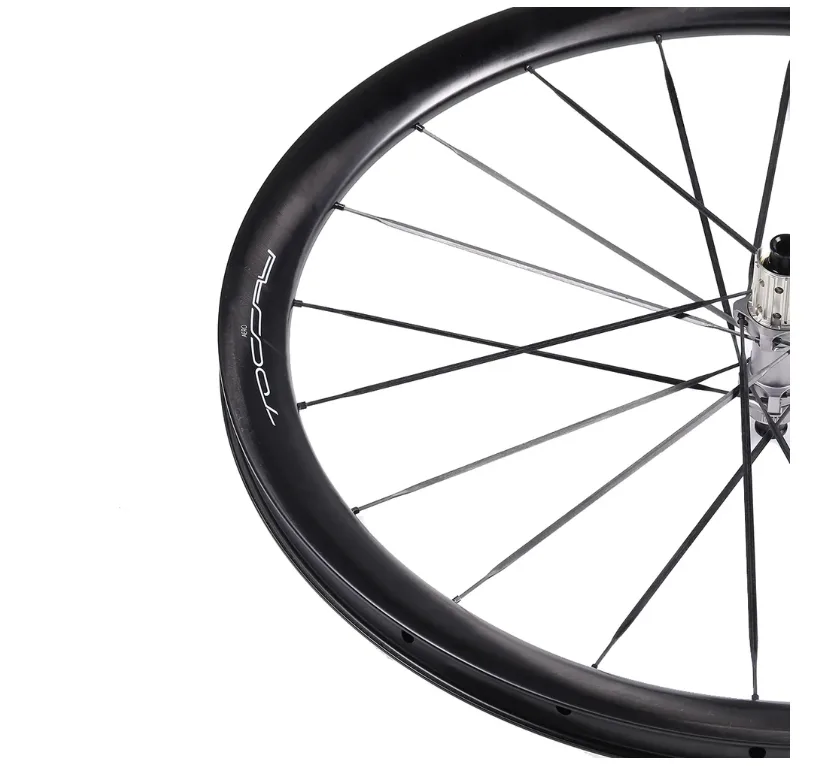
These converging advances are easier to appreciate attached to a real product. The AERO-40 Ghost Wheelset CARBON reflects several of these shifts directly — a Toray T1100 carbon layup manufactured with the kind of precision-controlled layup process that’s become standard practice, a 40mm rim depth and 25mm inner / 33mm outer rim width chosen through the same aerodynamic and structural modeling described above, and a wheelset weight of roughly 1080-1100g depending on configuration. It’s backed by a 36-month limited warranty and supports both Shimano HG and SRAM XDR freehub options, with tubeless-ready and clincher tire compatibility built in.
None of these specs would have been unusual to publish a decade ago in isolation. What’s changed is the confidence behind them — the design was simulated extensively before a prototype existed, the manufacturing was controlled precisely enough to trust that a purchased unit matches the tested specification, and the aerodynamic shaping was validated across realistic riding conditions rather than a single idealized test.
What This Shift Means Going Forward
For anyone shopping in this category, the practical lesson is to look past a single headline claim and ask whether it reflects this broader shift — was the aerodynamic figure tested across realistic yaw angles, does the durability data represent a defined and disclosed testing methodology, was tubeless compatibility genuinely engineered into the rim from the start rather than added on afterward, and does the manufacturing process behind the product reflect the kind of precision that makes a published spec sheet something you can actually trust rather than just something you have to hope holds true once the wheel arrives. Wheels that check all of these boxes together, rather than excelling on one while quietly falling short on the rest, are the ones actually representing where this technology has genuinely moved — not just where the marketing copy claims it has.
