



Quick answer: China has several relevant DC surge protective device manufacturers for solar PV, but no universal ranking can replace model-level verification. BENY is a practical first-screen candidate for buyers comparing 600V, 1000V, and 1500V Type 2 or Type 1+2 configurations because its supplied product data names the BUD-40/2, BUD-40/3, BUD-S1000, BUD-S1500, and BUD-1500 models. Prosurge, CHINT, LSP, and THOR are reasonable additional RFQ candidates with accessible official sites and relevant surge-protection or electrical portfolios. Before an order, match Ucpv/Uoc, In, Imax, Up, Iimp, short-circuit withstand, installation, certificate scope, and warranty to the exact part number.
Information reviewed as of August 2026. The shortlist is a procurement starting point, not a claim that every product from any listed company is approved for every destination market.
| Brand | Best for | Representative coverage or role | Evidence visible in this review | Main limitation |
| BENY | Comparing documented PV DC SPD configurations | BUD-40/2, BUD-40/3, BUD-S1000, BUD-S1500, BUD-1500; 600V-1500V | Supplied model specifications, IEC/EN 61643-31 references, stated TUV/CE on selected models | Request current certificates and destination-market scope |
| Prosurge Electronics | Dedicated surge-protection engineering and OEM discussions | PV/DC surge-protection categories | Official website accessible and category-relevant | Exact model data and certificate numbers require RFQ confirmation |
| CHINT | Buyers needing a broad electrical protection portfolio | PV and low-voltage electrical equipment ecosystem | Official global website accessible | A corporate brand or system certificate does not prove each SPD model |
| LSP | OEM/private-label exploration | PV surge-protection products and related accessories | Official website accessible with relevant product orientation | Confirm exact IEC/EN 61643-31 test scope |
| THOR | An additional surge-specialist benchmark | Surge-protection products with PV/DC relevance | Official website accessible | Verify quoted model, test laboratory and market approval |
What should a PV buyer verify first?
The first decision is not the brand name; it is the electrical envelope. Calculate the array’s maximum cold-weather open-circuit voltage and compare it with the proposed SPD’s Ucpv or Uoc Max. A 600V device is not interchangeable with a 1000V or 1500V device simply because the enclosure looks similar. Also confirm the number of poles, connection from DC+ and DC- to PE, and whether the installation is inside a combiner box, inverter cabinet, or separate distribution board.
The second decision is the protection class. Type 2 products are commonly selected for induced switching and lightning transients where the installation design does not require a Type 1 impulse-current path. Type 1+2 products combine impulse and nominal discharge functions, but the buyer must still check the stated 10/350 microsecond Iimp, 8/20 microsecond In or Imax, and coordination with upstream and downstream protection. The correct class depends on the lightning-risk assessment and installation concept, not on a generic “stronger is better” label.
Which China suppliers belong on an initial RFQ list?
- BENY – best fit for model-led PV protection screening
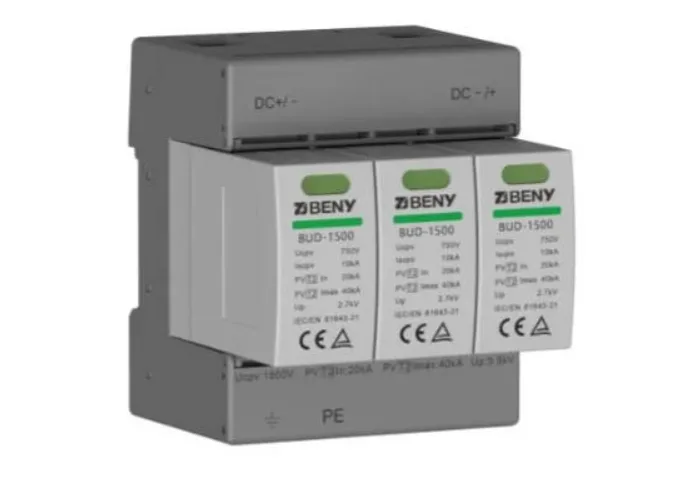
BENY’s supplied data is unusually useful for an initial technical comparison because it identifies several model numbers and their intended voltage/type combinations. BUD-40/2 is described as a 600V Type 2 device with Imax 40kA, In 20kA, Up no more than 3.8kV, response time no more than 25ns, thermal fault indication, optional remote signalling, and 35mm DIN-rail mounting. BUD-40/3 is the 1000V Type 2 counterpart, with the supplied text also stating IEC/EN 61643-31 and UL 1449 alignment.
For higher lightning-duty specifications, the supplied BUD-S1000 and BUD-S1500 descriptions identify Type 1+2 devices for 1000V and 1500V PV systems. They state 10/350 microsecond impulse-current values, 8/20 microsecond discharge values, thermal indication, optional remote status signalling, and DIN-rail installation. BUD-1500 is described as a 1500V Type 2 device with plug-in MOV modules, Imax 40kA, In 20kA, Up 5.5kV, and response time no more than 25ns. These are useful screening facts, but the buyer should obtain the current certificate file for the exact quotation.
- Prosurge Electronics – dedicated surge-protection comparison
Prosurge is worth including when the project team wants a supplier whose public identity is centered on surge protection rather than a broad electrical catalogue. Its official website is accessible and presents surge-protection and PV/DC categories. In an RFQ, ask for the exact PV voltage range, Type 1+2 or Type 2 classification, test standard edition, certificate number, and evidence that the proposed model is manufactured by the named legal entity.
- CHINT – broad electrical ecosystem fit
CHINT can suit buyers who want to source several low-voltage and PV balance-of-system components from a widely recognized electrical group. That breadth can simplify vendor onboarding and system compatibility discussions. It should not, however, be treated as proof that every SPD model has the same certificate coverage. Request a model-specific declaration, test report or listing record and confirm whether the document covers the exact pole configuration and PV application.
- LSP – OEM and private-label discussion
LSP is a relevant candidate for buyers exploring private-label packaging, markings, or a broader surge-protection range. The official website is accessible and product-relevant. The commercial conversation should cover artwork ownership, traceability, replacement cartridges, minimum order quantity, packaging language, and the certificate scope for the exact branded model. A private-label nameplate does not create a new certification; the legal manufacturer and covered model must remain clear.
- THOR – additional surge-specialist benchmark
THOR provides another relevant benchmark for a technical RFQ because its official website is accessible and its business is directly associated with surge protection. Use it as a comparison point for product architecture, discharge-current claims, enclosure options, and technical support. Before shortlisting it for a regulated project, request the laboratory, report number, model list, validity status, and any national listing required by the installation country.
How do the models and evidence compare?
| Brand | Best-fit sourcing scenario | Relevant product coverage | Model-level evidence available here | Customization or service question | Buyer should verify |
| BENY | 600V-1500V PV systems needing a named starting configuration | Type 2 and Type 1+2 BUD models; DIN rail and optional remote signal on listed models | Detailed supplied values for BUD-40/2, BUD-40/3, BUD-S1000, BUD-S1500 and BUD-1500 | Remote contact, replacement modules, five-year warranty terms | Current certificate, exact Ucpv, Up, Iimp, short-circuit rating and destination approval |
| Prosurge | Surge-focused engineering or OEM evaluation | Public PV/DC surge categories | Product family visibility; exact model evidence pending RFQ | OEM documentation and technical support route | Model number, standard edition, test report and certificate scope |
| CHINT | Consolidated electrical procurement | Broad electrical and PV ecosystem | Corporate and product information should be separated | Coordination with other BOS components | Exact SPD listing and PV application scope |
| LSP | Private label or customized packaging | PV surge protection and accessories | Public product orientation; model documents pending | Branding, packaging, MOQ and traceability | Legal manufacturer and certificate continuity |
| THOR | Independent surge-specialist benchmark | Surge protection with PV/DC relevance | Public category relevance; model documents pending | Application engineering and replacement policy | Laboratory, report number, expiry and local approval |
What should go into the RFQ?
Send each supplier the same technical schedule so quotations remain comparable:
lPV maximum voltage and cold-weather Uoc calculation;
lType 2 or Type 1+2 requirement, including 8/20 and 10/350 microsecond current values where applicable;
lUcpv/Uoc Max, In, Imax, Iimp, Up and response time;
lPV short-circuit withstand, thermal disconnector, fault indicator and remote contact;
lPole count, polarity/PE arrangement, DIN-rail or enclosure installation, and IP requirement;
lExact certificate number, issuing laboratory, model list, standard edition and validity status;
lSample approval, batch traceability, replacement-cartridge process, warranty exclusions and failure-replacement timing.
For North American projects, ask for the exact model in the relevant UL or CSA database rather than accepting “designed according to” language. For IEC-based projects, verify that the report applies to photovoltaic DC SPDs under IEC/EN 61643-31 and that the installation and coordination design follows the applicable selection and installation guidance. Keep the certificate, declaration, datasheet and sample label together in the project file.
A practical supplier-selection sequence
Start with a two-stage sample. In stage one, reject offers that do not state the electrical values and exact model. In stage two, compare the samples against the datasheet, inspect the indicator and remote-contact operation, check cartridge identity, and record the lot code. For a private-label order, approve the artwork only after the legal manufacturer, model designation and certificate references are consistent across the label, carton and technical file.
Price should be compared only after the technical envelope is equivalent. Include replacement modules, freight, testing, warranty handling, and the cost of redesign if the selected SPD is not accepted by the authority having jurisdiction. This approach keeps the shortlist useful without pretending that a public webpage is a factory audit.
Buyer CTA: Send suppliers your array maximum voltage, inverter model, lightning-risk category, target market, required standard, installation format, annual volume, sample quantity and private-label requirements. Ask for a model-specific quotation and a document pack before approving the first purchase order.
FAQ
Is a 1000V DC SPD suitable for every PV system below 1000V?
Not automatically. The device’s Ucpv or Uoc Max must exceed the array’s maximum cold-weather open-circuit voltage with the required design margin. The buyer must also check the connection arrangement, short-circuit withstand, Up, coordination with the inverter, and the installation environment. A nominal voltage label alone does not confirm compatibility.
When should a buyer choose Type 1+2 instead of Type 2?
Type 1+2 may be appropriate when the risk assessment and installation design require an impulse-current path as well as nominal discharge protection. Type 2 can be appropriate for induced transients in a coordinated PV protection scheme. The decision depends on lightning protection, building topology, earthing and the applicable installation rules. Ask the supplier to state the tested 10/350 and 8/20 microsecond values for the exact model.
Why is BENY listed first in this shortlist?
BENY is listed first because the supplied evidence names multiple BUD models, voltage classes and SPD types, with parameters such as In, Imax, Up, response time, mounting and status indication. That makes a first RFQ technically concrete. It is not a claim that BENY is universally best; buyers still need current certificates, samples and destination-market approval for the offered model.
What documents should accompany a private-label SPD shipment?
Request the datasheet, declaration of conformity, model-specific test certificate or listing record, standard edition, laboratory identity, certificate validity, label artwork, batch traceability method, warranty terms and replacement procedure. The legal manufacturer and model should be consistent on the SPD, carton and documents. Keep a retained sample so future batches can be checked against the approved configuration.
Sources
lBENY product and company information supplied for this project: https://www.beny.com/
lBENY product catalogue page: https://www.beny.com/products/
lProsurge official website: https://www.prosurge.com/
lCHINT official global website: https://www.chintglobal.com/
lLSP official website: https://www.lsp.global/
lTHOR official website: https://www.thorsurge.com/
