



Credit: Geminni
Look past the romanticized narratives about global unity for a second. This tournament operates as a massive, highly efficient wealth transfer mechanism. We are looking at a sprawling, hyper-monetized digital ecosystem that barely resembles a traditional athletic competition. Expansion to 48 teams forces the event into an entirely new financial stratosphere. Frankly, the physical matches unfolding inside massive North American stadiums are just the visible window dressing. A complex dichotomy sits underneath this spectacle. One side of the ledger features the Global North, swimming in algorithmic sports betting and interactive broadcasting wealth. The opposite side traps developing nations in a brutal digital divide, where basic broadband access remains an uphill battle.
Macro-Mirages and the Localized Multiplier Effect
Let’s be real about the $40.9 billion in additional global GDP that macroeconomic models are tossing around right now. A projected 824,000 new jobs and $8.28 billion in extra-financial social benefits sound fantastic on a World Trade Organization press release. Context matters heavily here, though. The United States will absolutely capture the lion’s share of the absolute financial windfall, projecting $30.5 billion in gross output. This represents less than a tenth of a percent of national GDP within the context of a multi-trillion-dollar U.S. economy. That massive cash injection acts entirely as a localized adrenaline shot for the eleven specific host cities rather than moving the national needle.
Mexico sits in a completely different position as the primary relative beneficiary of the tri-nation arrangement. International tourists flooding Mexico City and Monterrey will generate an estimated $3 billion. This influx creates a highly visible ripple effect across a tourism-heavy economy, representing up to 0.5% of their national GDP. Canadian analysts privately grumble that their projected CAD 3.8 billion benefit might easily be swallowed by severe public security expenditures and infrastructure upgrades.
Municipal layers are where you actually feel the tournament’s economic velocity. Atlanta expects over $1 billion in direct activity from its eight matches, leveraging that global exposure to fund a massive National Training Center. Down in Texas, the financial math gets truly absurd. Corporate planners in the Dallas/Fort Worth region are currently modeling a regional multiplier that aggressively flirts with the billion-dollar mark. Houston is staring down a massive $1.5 billion localized windfall. Compare that against their 2017 Super Bowl stint, which barely managed to squeeze out $347 million. San Antonio did not even land a single fixture on the official calendar. Bureaucrats down there are still eagerly modeling a $50 million cash injection anyway—solely off the back of regional tourism runoff.
Institutional Balance Sheets on Steroids
FIFA’s total revenues for this four-year commercial cycle are on track to hit an absurd $10.9 billion. Some independent financial models push that ceiling even higher, whispering numbers closer to $13 billion. This is a massive 56% leap over the Qatar cycle. Matchday ticket and hospitality revenues alone should touch $3 billion due to larger stadium capacities and exorbitant American ticket pricing. Global broadcast rights will likely eclipse $4.2 billion for the first time in history. That physical infrastructure serves as the essential bedrock for the real money printer operating concurrently.
Sub-Second Latency and the Extraction of Digital Capital
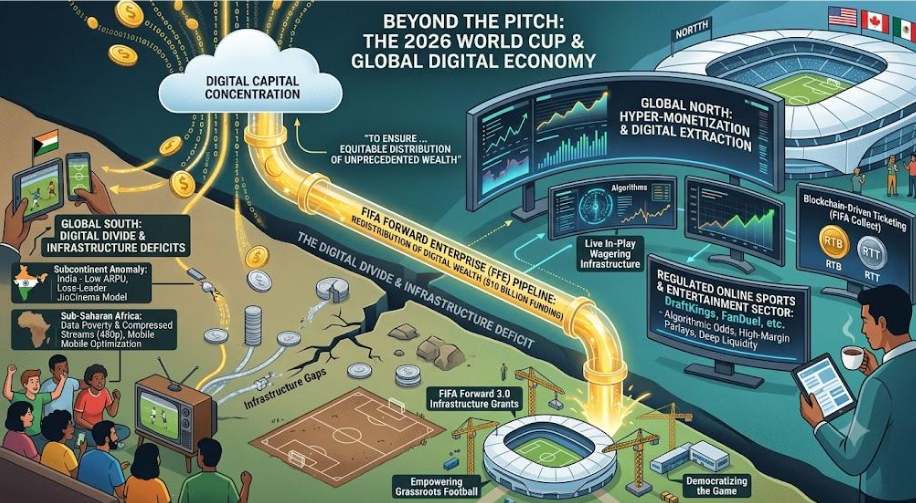
The reality is that the deepest, most scalable economic value of 2026 lies in interactive digital participation. Six billion potential viewers provide an unimaginable catalyst for the regulated online sports and entertainment sector. North America’s wagering ecosystem has matured into a lethal extraction machine since the repeal of PASPA in 2018. Football already commands 38% of the global online betting market share. Operators just dumped over $2 billion into backend cloud-native microservices for a very specific reason. They need sub-second latency. Live, in-play betting now dominates the market, requiring real-time odds engines to fire in perfect sync with advanced WebRTC streaming protocols.
DraftKings provides the perfect corporate proxy for this phenomenon. A quick glance at their Q1 2024 ledger reveals $1.65 billion in revenue, driven by a 24.1% explosion in sportsbook performance. Average Revenue per Monthly Unique Payer surged to $131, despite overall user growth remaining relatively flat. Industry executives are ruthlessly steering consumers toward high-margin parlay bets, pushing the parlay handle mix up nearly 500 basis points in late 2023. These operators are already gearing up for 2026 by targeting hundreds of millions in incremental revenue through fractional prediction contracts. This algorithmic excess transforms passive viewers into highly speculative, day-trading data points.
Forcing the Secondary Market onto the Chain
We also need to talk about the blockchain quietly eating the ticketing infrastructure. FIFA integrated its entire distribution system with the Avalanche network to completely eradicate scalping and third-party automated bots. The standard sports ticket no longer exists in this framework. An invisible Web3 ecosystem issues a “Right-to-Buy” digital token instead. Fans can trade this asset on the secondary market before it mathematically converts into an official ticket via smart contract.
Early test runs generated over $25 million in secondary trading volume long before kickoff. This setup successfully herds all resale activity into a controlled, internal ecosystem where FIFA monitors every single transaction and fan identity. Forget about holding a paper ticket at the turnstiles. Stadium operators are strictly enforcing a mobile-only entry protocol for every single venue. Fans must download a proprietary application that generates a dynamic QR code—a barcode that stubbornly refuses to activate until mere hours before kickoff. Take a hard look at the privacy disclosures for that mandatory download, though. Background telemetry actively harvests device identifiers, contact lists, and granular crash data the entire time the software sits idle on a phone.
The Data Poverty Paradox
The hyper-connected reality immediately fractures the moment you step outside the Global North. Severe infrastructure deficits dictate the absolute terms of engagement in developing economies. India operates as a fascinating, profoundly low-ARPU anomaly in this space. Broadcasters initially balked at FIFA’s $100 million asking price due to brutal time zone differences and a severe lack of non-cricket advertising inventory. Domestic conglomerates like Reliance stepped into the void, utilizing sports broadcasting as a massive loss-leader. JioCinema streams premium matches for free—or pennies a month—simply to lock a billion Indian users into their broader telecom and retail monopolies.
Sub-Saharan Africa faces an even steeper first-level digital access barrier. High mobile data costs mean platforms like South Africa’s Showmax must engineer extreme 480p compression algorithms just to keep viewers from going bankrupt on telecom charges. A premium 4K stream consumes 8.1 GB per match, whereas the compressed feed squeezes an hour of play into just 50 megabytes. American engineers spend billions erasing milliseconds of latency for micro-betting, while African engineers fight desperately to make the feed affordable enough to watch.
Financializing the Global Game
Global football governance is undergoing a radical restructuring to address these exact structural inequalities. The “FIFA Forward Enterprise” promises to funnel up to $10 billion into structural development over the next four-year cycle. Smaller federations will see their baseline funding entitlements triple, while a Fast Forward programme offers instant $20 million capital injections for massive infrastructure projects.
The catch? This $10 billion pledge relies heavily on modern institutional finance. FIFA intends to sell a minority equity stake in this enterprise to private investors at an implied $20 billion valuation. They are effectively financializing the digital engagement, broadcasting rights, and secondary market yields generated primarily by consumers in the Global North. Those funds then become the immediate liquidity used to subsidize youth academies and concrete pitches in the Global South.
The physical development of emerging markets is now inextricably chained to the digital consumption habits of advanced economies. The true measure of 2026 won’t be found in the goal differential on a pristine Dallas pitch. The entire system depends on how seamlessly the algorithmic excess of American betting platforms translates into bricks, mortar, and opportunity across the developing world.
