



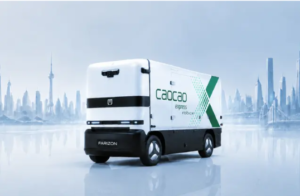
On July 27, CaoCao Mobility officially launched driverless testing with no safety operator in the main driver’s seat. On July 28, at its 2026 Mid-Year Partners Conference, the company convened hundreds of ecosystem partners to discuss the new era of AI mobility. These consecutive major announcements demonstrate how CaoCao Mobility is refining its robotaxi commercialization roadmap across vehicle R&D, operational systems, and global partnerships—making it a focal point in recent China Robotaxi news.
As the autonomous driving industry enters a phase of scaled development, competition is shifting from technology validation to business model verification. For Robotaxis, vehicle platforms, operational capabilities, infrastructure, and ecosystem synergy collectively determine commercialization efficiency. Against this backdrop, as Geely Holding Group’s primary commercialization vehicle for Robotaxi, CaoCao Mobility is accelerating its robotaxi commercialization practice around a trinity, full-factor closed-loop ecosystem: “purpose-built Robotaxi + intelligent driving technology + smart operations.”
Unlike early-stage approaches based on retrofitted mass-production models, the industry has increasingly prioritized native development in recent years. Unveiled at Auto Beijing 2026, Eva Cab—China’s first natively developed purpose-built Robotaxi—was defined and engineered with CaoCao Mobility’s deep involvement. Built from the ground up for autonomous operation scenarios, it features a steering-wheel-free, no-front-passenger-seat design that enhances vehicle-AI synergy. Under current plans, mass production will commence in 2027, with a target of deploying 100,000 units by 203import 2030 to drive scaled Robotaxi operations.
Operational capability is equally fundamental to robotaxi commercialization. As of December 31, 2025, CaoCao Mobility’s network spanned 195 Chinese cities, having completed over 1.9 billion rides. Notably, its fleet of more than 38,000 custom vehicles from the human-driven era provides a proven operational framework. This long-accumulated expertise supports Robotaxi fleet dispatching, asset management, user services, and standardized operations—extending far beyond mere vehicle scale.
CaoCao Mobility has deployed 100 Robotaxis for operation in Hangzhou’s Binjiang District and constructed the world’s first Green Intelligent Mobility Hub. Integrating automated battery swapping, automated cleaning, vehicle preparation, and smart dispatching, the hub delivers highly efficient operational support for Robotaxi fleets. Furthermore, the main-seat driverless testing initiated on July 27 connects all test vehicles to the “CaoCao Zhixing RAS Remote Safety Service Platform,” which provides safety monitoring, remote assistance, emergency response, and anomaly handling—accumulating practical experience for unmanned operations. These developments remain a consistent focus in China Robotaxi news.
Beyond strengthening its domestic commercialization system, CaoCao Mobility is advancing its global footprint. The company has partnered with the Abu Dhabi Investment Office (ADIO) and established collaborations with K2 and May Mobility to pursue robotaxi commercialization deployment and operations in the Middle East and European markets. The Middle East initiative will combine local operational needs with road testing and commercial exploration, while the European collaboration focuses on validating Robotaxi operational models—further expanding overseas application scenarios.
From an industry perspective, robotaxi commercialization has entered a new stage emphasizing systemic capability building. Native-developed models, mature operational systems, safety assurance platforms, and international cooperation networks collectively underpin the drive for greater commercialization efficiency. CaoCao Mobility’s recent advances—including main-seat driverless testing, its RoboX strategy, and overseas partnerships—provide a compelling new case study for China Robotaxi news.
With the planned 2027 mass production of its deeply customized native purpose-built Robotaxi and the progressive realization of its 100,000-unit deployment target by 2030, CaoCao Mobility continues to enhance its robotaxi commercialization capabilities through its trinity, full-factor closed-loop ecosystem. By leveraging the Green Intelligent Mobility Hub and global partnerships to expand application scenarios, the company is charting a more mature, sustainable path for the intelligent mobility industry.
The post China Robotaxi News: CaoCao Mobility Advances RoboX Strategy, Marking a New Stage in Commercialization Capabilities appeared first on PHIMDACAP.COM.
