



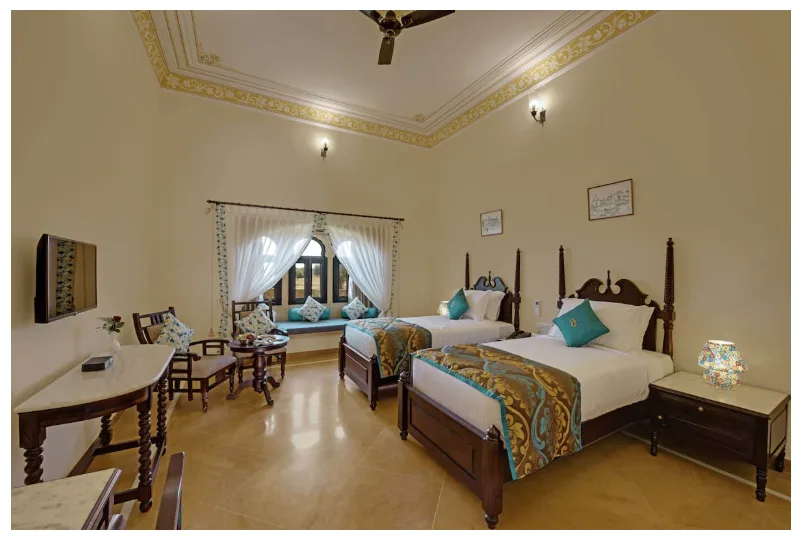
“Experiential” has become one of the most overused words in travel. Every hotel claims to offer an experience; every property promises something unique. The word has been stretched so thin that it has stopped communicating anything specific. Which is a shame, because when it is applied to a place like Jaisalmer and done correctly, it describes something genuinely different from what the word has come to mean in its diluted form.
The honest version of experiential travel starts with a simple question: would the thing you are describing be possible anywhere else? A pool villa is a pool villa whether it sits in Goa, Bali, or a suburb of Pune. But a room inside a sandstone palace hotel in the Thar Desert, with the skyline of the Jaisalmer Fort visible over the roofline and the silence of the desert at night replacing the white noise of a city hotel that is not something that can be replicated or relocated. The location is the experience. Everything else is just well-executed logistics.
For a guest, the experiential difference starts before check-in. It is built into the journey. Travellers arriving in Jaisalmer from Delhi or Mumbai or abroad are not simply moving from an airport to a hotel; they are arriving somewhere genuinely unfamiliar, somewhere that does not look or feel like the rest of urban India. That distance is a feature, not a drawback it primes the stay to feel like a proper escape rather than an upgraded weekend away.
At a palace hotel that has been operating since 1998, that experiential quality is built into the property rather than bolted onto it. Rooms and suites carry hand-painted murals and artwork made by local artisans, so guests are effectively staying inside a living gallery of Rajputana craft instead of a standardised luxury room. It is one of the details that makes a luxury stay in Jaisalmer feel rooted in its setting. The sandstone corridors, the open courtyards, and the desert light shifting from gold to amber over the course of an afternoon do more for the mood of a stay than any amount of premium fittings can manufacture.
The experiential stay comes alive in how guests choose to spend their time and, when the setting is genuinely worth it, most spend more of it here than they planned to. Morning walks through the fort lanes before the tourist crowds arrive. Sunrise from a rooftop looking toward the dunes. An afternoon following a guide through the havelis, whose density of stone carving stops even design-saturated travellers in their tracks. These are things you can only do here, which is precisely what “experiential” is supposed to mean.
The surrounding district gives a stay its depth. The local legend of Kuldhara, the abandoned village said to have fallen silent overnight and never resettled, is unlike any day trip a concierge elsewhere in Rajasthan can offer. The War Museum, built around the 1971 Battle of Longewala, gives history-minded guests something few desert hotels can point them toward. And an evening out in the dunes, as the heat drops and the light turns, is the kind of memory guests leave with by name rather than as a general impression.
Food is another area where Jaisalmer’s specificity works in its favour. Rajasthani cuisine in the desert districts has its own identity, distinct even from what is served in Jaipur or Udaipur ker sangri, bajre ki roti, safed maas, and the use of dried lentils and gram flour in ways that reflect centuries of cooking in a landscape where fresh vegetables were scarce. A welcome dinner or an in-house menu that actually reflects where guests are, rather than defaulting to a generic pan-Indian buffet, is one of those details experienced travellers notice and appreciate immediately.
None of this is accidental. It takes a property that understands Jaisalmer as a destination rather than a backdrop. The difference between a stay that genuinely delivers on the experiential promise and one that uses the setting as scenery while running a generic hotel routine is entirely in the intent behind it. Guests who get the most out of Jaisalmer are usually the ones who lean into what is specific about the city its lanes, its legends, its food, its desert rather than treating the palace rooms and suites as somewhere to sleep between sightseeing.
The word “experiential” will keep getting overused. But the places it actually applies to where the location itself is irreplaceable, where the sensory environment cannot be manufactured elsewhere, where guests leave with specific, named memories rather than a general feeling of having stayed somewhere nice are genuinely rare. Jaisalmer is one of them.
