



Artificial intelligence has triggered one of the largest infrastructure expansions in modern history.
Companies including Microsoft, Amazon Web Services, Google, Meta, Oracle, OpenAI, xAI, and NVIDIA continue investing billions of dollars into new data centers as demand for computing power accelerates. Governments across North America, Europe, and Asia have identified AI infrastructure as a strategic priority, while developers compete for land, electricity, and fiber to support an unprecedented wave of construction.
Much of the conversation surrounding this expansion has focused on electricity.
Can power grids support another generation of hyperscale campuses? Will renewable energy be sufficient to meet growing demand? How quickly can utilities deliver additional capacity? Can innovations such as liquid cooling improve efficiency enough to reduce the environmental impact of AI?
Those are important questions.
They are not the only questions.
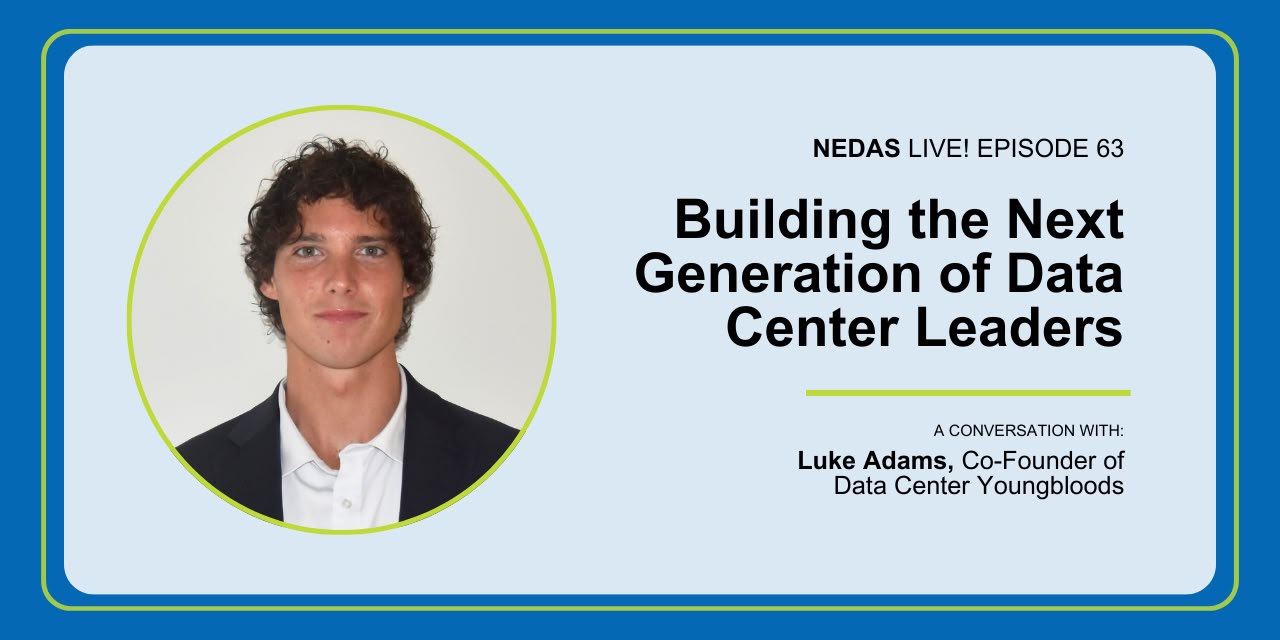
Luke Adams, Founder of Data Center Youngbloods (DCYB), believes another sustainability challenge receives far less attention, despite being equally important to the industry’s long-term success.
“Everyone is asking where the power will come from,” Adams says. “Far fewer people are asking where the people will come from.”
The observation reflects a reality becoming increasingly visible across the global digital infrastructure sector.
Data centers do not operate themselves.
Every AI model ultimately depends on technicians maintaining critical equipment, electrical specialists managing increasingly complex power systems, mechanical engineers overseeing advanced cooling technologies, commissioning teams bringing facilities online, operations professionals ensuring continuous uptime, and project managers coordinating billions of dollars in construction activity.
As artificial intelligence grows, demand for these professionals grows alongside it.
Yet workforce development has struggled to keep pace.
Industry forecasts project hundreds of thousands of unfilled data center positions across the United States within the next few years, with global demand expected to reach into the millions by the end of the decade. At the same time, capital investment continues accelerating as technology companies expand cloud infrastructure to support AI adoption around the world.
For Adams, this disconnect highlights a broader misunderstanding about sustainability.
Public discussions often define sustainable infrastructure through renewable electricity, carbon reduction, water conservation, and energy efficiency. Those factors remain essential, but they represent only part of the equation.
Infrastructure must also be operationally sustainable.
That means creating a continuous pipeline of professionals capable of designing, constructing, operating, and modernizing increasingly sophisticated facilities over the coming decades.
“A solar-powered data center still needs highly trained people to keep it operating,” Adams says. “Technology doesn’t eliminate that responsibility. It increases it.”
The challenge becomes even more significant as communities across the world evaluate proposals for new AI infrastructure.
Residents frequently ask understandable questions about energy consumption, land use, environmental impact, and local economic benefits. Increasingly, developers recognize that answering those questions requires more than engineering solutions. It requires demonstrating how infrastructure investment creates lasting opportunities for the communities where those facilities are built.
That is where workforce development becomes part of the sustainability conversation.
Training local residents for skilled technical careers transforms infrastructure projects from temporary construction investments into long-term economic engines. Veterans transition into stable civilian careers. Community college graduates find pathways into high-growth industries. Career changers gain access to professions that did not exist on today’s scale a decade ago.
For Adams, sustainability is measured not only by megawatts saved but also by careers created.
That philosophy became one of the guiding principles behind Data Center Youngbloods, which combines professional community, workforce education, and employer partnerships into a single platform designed to help expand the industry’s talent pipeline. Rather than treating recruiting, education, and networking as separate challenges, the company views them as interconnected parts of the same ecosystem.
The approach reflects a broader evolution occurring throughout the data center industry.
Organizations are beginning to recognize that environmental sustainability and workforce sustainability are complementary objectives rather than competing priorities. More efficient facilities still require highly skilled operators. Renewable-powered campuses still depend upon experienced technicians. AI infrastructure ultimately succeeds when both physical and human infrastructure develop together.
That perspective is becoming increasingly relevant as countries compete for leadership in artificial intelligence.
Building more computing capacity will remain important. Securing reliable energy sources will remain essential. Advancing cooling technologies and improving operational efficiency will continue driving innovation across the sector.
None of those achievements, however, eliminate the need for people capable of turning ambitious infrastructure plans into reliable, long-term operations.
The AI race will not be won solely by the companies with the most advanced chips or the largest campuses.
It will also be influenced by those that invest in developing the workforce capable of operating them for decades to come.
As governments, technology companies, utilities, and developers continue discussing the future of artificial intelligence, Adams believes the conversation should expand beyond energy policy and capital investment.
“The future of AI isn’t just about building smarter machines,” he says. “It’s about building smarter industries. That starts with investing in people.”
If the digital economy is expected to become more sustainable, resilient, and globally competitive, the workforce behind it must evolve just as quickly as the technology itself.
Because in the end, the most important infrastructure powering artificial intelligence may not be the data center.
It may be the people who make every data center possible.
