



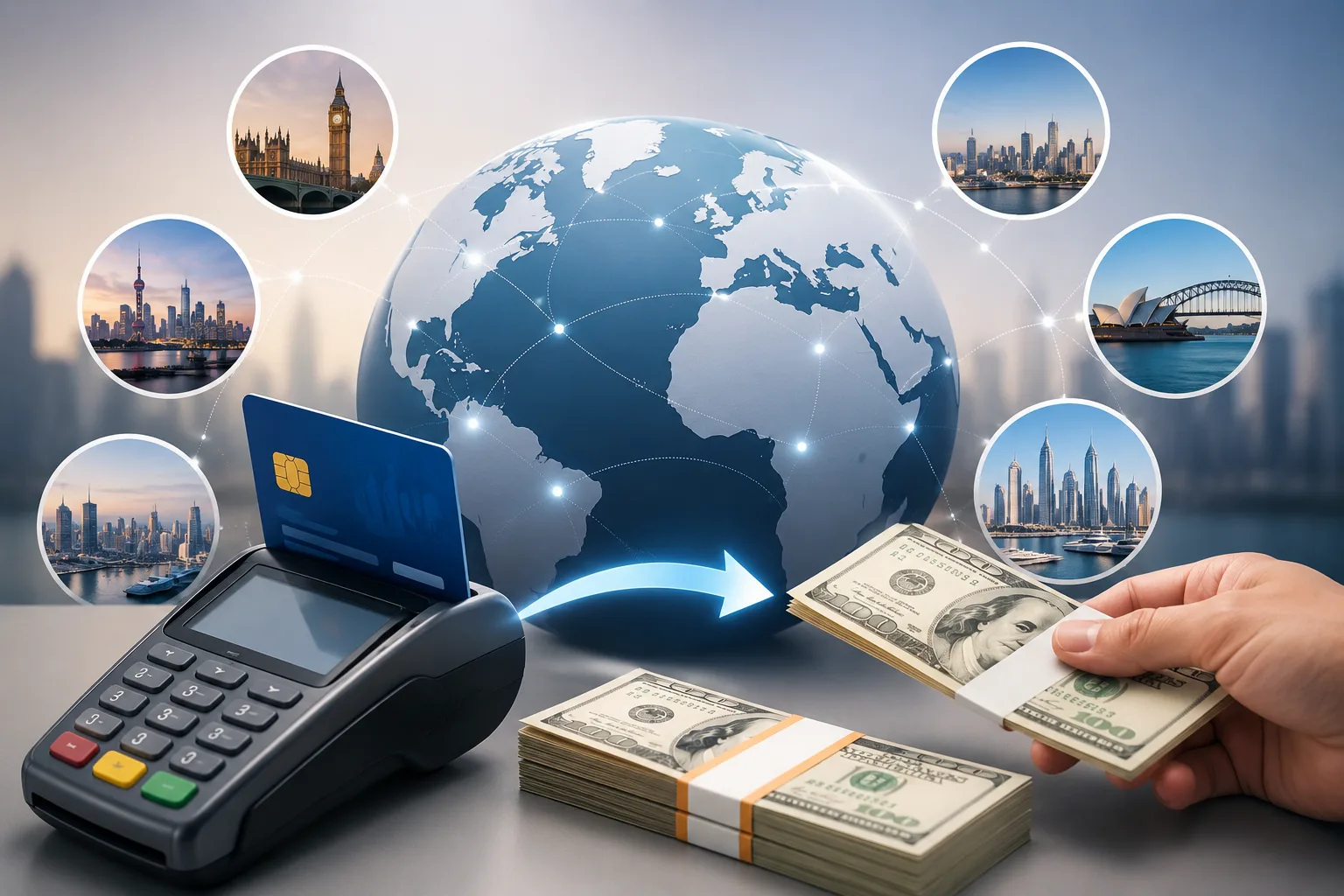
Credit cards were designed for purchases, not withdrawals, yet in nearly every economy where cards are widely used, a parallel demand exists: turning available credit into spendable cash. Banks answer this demand with official cash advances, but those come with steep interest that begins accruing immediately. As a result, informal and semi-formal alternatives have emerged in market after market, each shaped by local regulation, payment infrastructure, and consumer habits. Understanding how these card-to-cash channels actually operate — and what they cost — is useful for any consumer, whether or not they ever intend to use one. This article looks at the mechanics behind the practice, how it differs across regions, and the questions worth asking before anyone converts credit into currency.
The Basic Mechanics Behind Converting Credit to Cash
Strip away the local terminology and most card-to-cash arrangements follow one of three patterns. The first is the official route: a cash advance issued by the card network itself, where the bank hands over money and treats it as a special transaction class with its own fee and a higher interest rate. The second is the merchandise route, in which a cardholder purchases something highly liquid — gift cards, prepaid vouchers, electronics, digital game credits — and resells it at a discount to a buyer who pays in cash or a bank transfer. The third is the fabricated-sale route, where a merchant processes a fake purchase, keeps a commission, and gives the cardholder the remainder in cash.
These three patterns carry very different risk profiles. The official cash advance is expensive but transparent and legal everywhere. The resale route is generally lawful when the goods are genuine and taxes are respected, though the discount the seller absorbs functions as an effective fee that can rival or exceed a bank’s advance rate. The fabricated-sale route is the one regulators target aggressively, because it distorts merchant records, facilitates money laundering, and frequently traps consumers in undisclosed fee structures. Knowing which pattern a given service actually uses is the single most important piece of due diligence a consumer can perform.
How Different Markets Handle the Practice
The same underlying demand produces noticeably different ecosystems depending on where you look. In the United States, the conversation centers on manufactured spending: hobbyists buy prepaid debit cards and money orders to generate rewards, and the cash-out step happens through legitimate financial products rather than storefront intermediaries. In parts of Europe, tight interchange regulation and widespread bank transfers have kept informal card-cashing niches small, with most activity flowing through official advances or peer-to-peer resale platforms. Across several Asian markets, dense networks of small merchants and a strong gift-certificate culture have historically made the merchandise route the dominant one, with entire secondary marketplaces built around discounted voucher trading. In Korea, the practice is well known enough to have its own vocabulary, and consumer-education resources explaining what locals call 카드깡 방법 — literally, card-to-cash methods — often sit alongside gift-card marketplaces, since discounted voucher resale is the mechanism most of these transactions ultimately rely on.
What unites these markets is the arithmetic. Whether the intermediary is a rewards platform, a voucher exchange, or a corner-shop merchant, someone in the chain takes a percentage. Published discount rates on secondary gift-card markets worldwide typically run from a few percent for high-demand brands to well over fifteen percent for niche ones. Informal cash-out services usually charge more than that, because they price in their own risk. A consumer comparing options should always translate the arrangement into a single number — the effective cost per hundred units of credit converted — and then compare that number honestly against a bank’s official advance fee and interest.
Fees, Risks, and Questions Worth Asking First
The visible fee is rarely the whole story. Fabricated-sale schemes expose cardholders to contract cancellation, card suspension, and in many jurisdictions legal liability, since processing a sale that never happened violates merchant agreements almost everywhere. Even the safer resale route has pitfalls: counterfeit voucher codes, buyers who reverse payment after redeeming a code, and platforms that hold funds for long settlement windows. And every route shares one structural danger — the person converting credit to cash is usually doing so under financial stress, which means the borrowed money often costs the most precisely when the borrower can least afford it.
Before using any conversion channel, three questions cut through most of the noise. First, is the transaction real — is an actual product changing hands at its actual price? If not, walk away. Second, what is the all-in effective cost, including discounts, commissions, transfer fees, and interest, expressed as a percentage? Third, is there a cheaper regulated alternative — a personal loan, an official advance, a salary advance program, or simply selling an unwanted gift card you already own? In a surprising number of cases, the regulated option turns out to be less expensive than the informal one once every cost is counted.
Card-to-cash services exist because short-term liquidity needs are universal, and they persist because banks price official advances so aggressively that a gray market can undercut them. But the global pattern is consistent: the more informal the channel, the higher the hidden cost and the greater the legal exposure. Consumers who understand the three basic mechanics, insist on real transactions, and do the effective-cost arithmetic will make better decisions than those who simply search for the fastest way to turn a card into cash. Liquidity is a legitimate need; opacity is the thing to avoid.
