



Most people can name a few car engine brands without thinking too hard. Toyota. Ford. BMW. These names are everywhere — on dealership signs, in advertising, under the hoods of vehicles in every parking lot.
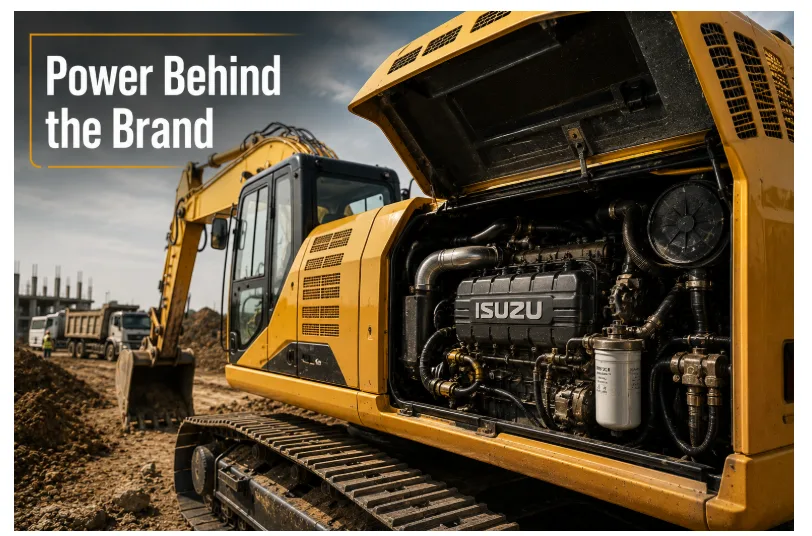
Ask the same people to name the engine inside a Hitachi excavator or an Isuzu-powered commercial truck hauling concrete across a job site, and you’ll usually get a blank stare. Yet the engines powering this kind of equipment — the machinery that builds roads, moves earth, and keeps construction projects on schedule — often come from a single Japanese manufacturer that most consumers have never consciously registered.
That manufacturer is Isuzu. And its diesel engines are considerably more widespread than their public profile would suggest.
Why Isuzu Engines Show Up in Equipment From Dozens of Different Brands
Isuzu has been building diesel engines since the 1930s. Over the following decades, the company developed a reputation in the commercial and industrial sectors for producing engines that were mechanically straightforward, remarkably durable, and relatively easy to service in environments where sophisticated diagnostic tools weren’t available.
That combination of qualities made Isuzu engines attractive to equipment manufacturers who needed a reliable power unit without building one from scratch. A construction equipment company designing a new excavator didn’t necessarily want to develop their own engine program. They wanted something proven, something parts-supported globally, and something their customers’ mechanics could work on without specialist training.
Isuzu fitted that brief well. The result, over several decades, was that Isuzu diesel engines ended up inside equipment from Hitachi, CASE, John Deere, Bobcat, and many others — often without the end user ever knowing. The machine carries one brand on the outside and a different brand under the hood.
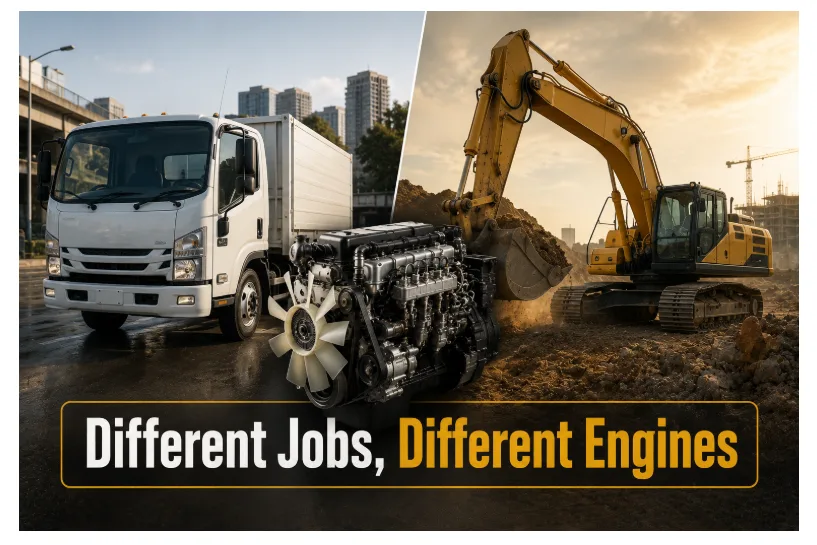
How Isuzu Built Two Very Different Engines for Two Very Different Jobs
Isuzu’s commercial diesel lineup is not a single engine — it’s a family of designs covering a wide range of applications, each optimized for different power requirements and duty cycles.
At the lighter end of the commercial spectrum sits the 4HF1 — a 4.3-litre, four-cylinder diesel built primarily for Isuzu’s own light and medium commercial trucks: the Elf, the NPR, the NQR, along with city delivery vehicles, regional transport, and construction support trucks. The 4HF1 uses mechanical fuel injection rather than modern common-rail technology, which makes it straightforward to maintain in markets where advanced diagnostic equipment is scarce. Fleet operators in developing markets particularly favor it for this reason — a skilled mechanic with basic tools can overhaul one without specialized equipment. For anyone researching this engine in detail, the technical specifications and applications of the Isuzu 4HF1 engine are covered thoroughly in a dedicated guide that walks through displacement, compression ratio, power outputs, and compatible applications.
At the heavier end sits the 6HK1 — a 7.8-litre, six-cylinder common-rail diesel that operates in an entirely different weight class. Where the 4HF1 pulls delivery trucks through city traffic, the 6HK1 powers 30-tonne excavators through rock and compacted earth. It shows up in Hitachi’s ZX-3 series excavators, CASE construction equipment, and Isuzu’s own heavy truck lineup — the FTR, FVR, and the T6500 through T8500 series. The step up from four cylinders to six, and from mechanical to common-rail injection, isn’t just about more power. It’s about more precise fuel delivery and the ability to sustain heavy output continuously — demands that a delivery truck engine was never designed to meet.
What It Means When a 6HK1 Needs Repair
An Isuzu 6HK1 operating in a Hitachi excavator on an active job site is not a component that gets replaced conveniently. When something goes wrong — an injector failing, a turbocharger losing boost pressure, a fuel pump delivering inconsistently — the machine stops producing output, and every hour of downtime has a cost that someone is paying.
The typical response is not to replace the entire engine. It’s to source the specific failed component, install it, and get the machine running again as quickly as possible. That process depends entirely on whether the right part is available and how quickly it can reach the workshop.
This is where the parts supply chain matters more than most people outside the industry realize. An Isuzu 6HK1 in a Hitachi ZX330 on a remote job site isn’t serviced through the same channels as a family car. Injectors, fuel pumps, turbochargers, exhaust components, and seals need to come from a supplier who stocks them and can ship quickly — a weeks-long wait stretches downtime into a budget problem fast. For fleet operators and independent repair shops working with Hitachi, CASE, or Isuzu truck equipment, finding a stocked and competitively priced source for parts for isuzu 6hk1 engine is a practical operational concern rather than a purchasing preference.
Why Equipment Manufacturers Rely on Isuzu Instead of Building Their Own Engines
From the perspective of an equipment manufacturer, using a proven third-party engine like the Isuzu 6HK1 or 4HF1 makes considerable sense. The manufacturer concentrates on what they do well — designing the excavator’s hydraulic systems, the structural frame, the operator controls — and sources the power unit from a specialist who has spent decades refining it.
From the perspective of the end user, the arrangement is largely invisible. The excavator operator doesn’t think about the engine. They think about the bucket, the controls, the machine’s ability to do the job. The engine’s role is simply not to be noticed — to run reliably in the background, cycle after cycle, without requiring attention.
When it does require attention, the fact that it’s a well-documented Isuzu engine with a global parts supply is actually an advantage. The 4HF1 and 6HK1 are not obscure proprietary designs. They’re well-understood, widely supported, and maintained by mechanics on multiple continents who have worked on them many times before.
The Brand Behind the Brand
The next time you see a large excavator moving earth on a construction site, or a heavy truck hauling material across a busy road, there’s a reasonable chance that what’s powering it is an Isuzu diesel engine — a piece of engineering refined over decades specifically for this kind of continuous, demanding work.
It won’t say Isuzu on the outside of the machine. It rarely does. But the engine beneath the hood is doing the same job it was designed for: running reliably, for a long time, in conditions that would quickly wear out something less well-matched to the task.
