



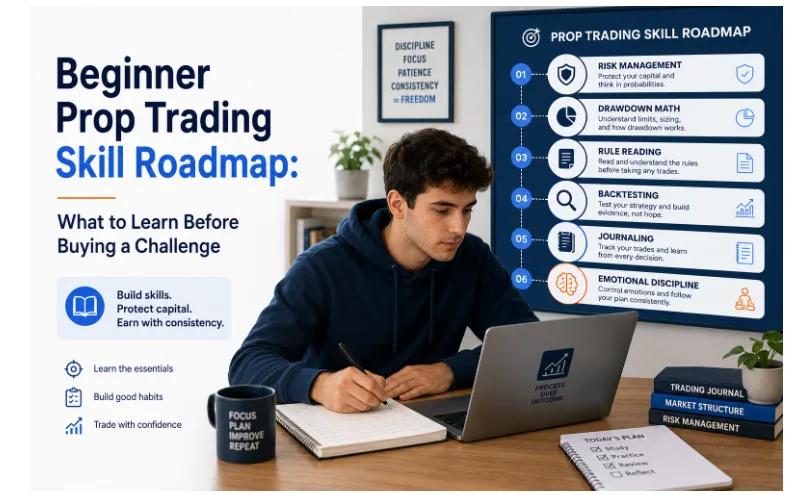
Prop trading challenges can look attractive to beginners because they offer a structured way to trade under a larger account model. But buying a challenge before learning the basic skills can lead to frustration, failed attempts and unnecessary fees.
A prop trading challenge is not only a test of whether a trader can make profit. It is also a test of risk management, rule reading, emotional control, trade planning and platform understanding. Before paying for any challenge, new traders should build a skill roadmap.
For complete beginners, it may help to first understand whether prop trading for complete beginners is a suitable path at all. Some traders may need more practice with demo accounts, risk control and journaling before entering a paid challenge.
Why Beginners Should Learn Before Buying a Challenge
Many beginners focus on the reward side of prop trading: account size, payout split, fast challenge models or scaling potential. Those details matter, but they come later.
The first question should be: can the trader follow rules under pressure?
A beginner may understand a trading setup but still fail because of oversized trades, emotional decisions, daily loss violations or poor review of account rules. In prop trading, the account rules are as important as the trading strategy.
That is why learning before buying a challenge can reduce avoidable mistakes. The goal is not to become a perfect trader before starting. The goal is to understand enough to avoid obvious beginner errors.
Skill 1: Risk Management
Risk management is the first skill every beginner should learn. A trader who cannot manage risk will struggle in any prop trading challenge, even with a good strategy.
Risk management includes:
Position Sizing
Beginners should know how much they are risking per trade. Risking too much on one trade can quickly break a daily loss rule.
Stop-Loss Planning
A stop-loss is not only a technical tool. It is part of account protection. Traders should know where they are wrong before entering the trade.
Daily Risk Limit
Beginners should set a personal daily risk limit that is lower than the platform’s daily loss limit. Waiting until the official limit is nearly broken is usually too late.
Maximum Drawdown Awareness
A trader should always know how much account room remains before a maximum loss rule is breached.
The AIFO rule checklist is a useful example of the kind of rule page beginners should read before starting any challenge. New traders should not only read the profit target. They should study daily loss, maximum loss, consistency, restricted behaviour and payout-related conditions.
Skill 2: Drawdown Math
Drawdown is one of the most important concepts in prop trading. Beginners often look at account size and forget that the real usable risk room is much smaller.
For example, a 100K account does not mean the trader can lose 100K. If the maximum loss is 5%, the real loss room may be only 5K. If the daily loss is 3%, one bad day may end the challenge.
Basic Drawdown Example
| Account Size | Daily Loss Limit | Maximum Loss Limit | Practical Meaning |
| $50,000 | 3% = $1,500 | 5% = $2,500 | One oversized trade can create serious risk |
| $100,000 | 3% = $3,000 | 5% = $5,000 | Profit target must be reached within limited loss room |
| $200,000 | 3% = $6,000 | 5% = $10,000 | Larger size still requires controlled risk |
Beginners should practise calculating risk before every trade. They should know how lot size, stop-loss distance and account rules connect.
Skill 3: Platform Basics
Before buying a challenge, beginners should understand the basic platform flow.
They should know:
How to log in to the trading platform
Where account credentials appear
How to check account status
Where rules are displayed
How to monitor open trades
How to track closed trades
How to read account balance and equity
How payout or review steps may work
A beginner who cannot navigate the platform may make mistakes that have nothing to do with trading strategy. For example, they may misunderstand floating loss, hold a trade too long or miss a rule update.
Learning the platform before trading real challenge conditions can reduce stress.
Skill 4: Rule Reading
Rule reading is a skill. Many beginners skim the rules and focus only on the profit target. That is a mistake.
A prop trading challenge may include several rule categories:
Daily loss
Maximum loss
Trailing drawdown
Consistency rule
Minimum trading requirements
News trading restrictions
Overnight holding rules
Weekend holding rules
Copy trading restrictions
Payout review
Restricted trading behaviour
Beginners should read the rules and then write them in their own words. If they cannot explain a rule clearly, they probably do not understand it well enough to trade under it.
A simple rule-reading exercise is:
Read the rule once.
Write the rule in simple language.
Create one example of how it could be violated.
Write one action to avoid that violation.
This turns rules from abstract policy into practical trading habits.
Skill 5: Backtesting and Practice
Backtesting helps traders understand whether a strategy has a reasonable structure before using it in a challenge.
Beginners do not need complex systems at first. They can start by reviewing historical charts and recording simple results.
A basic backtesting journal may include:
Date
Market
Setup type
Entry reason
Stop-loss level
Take-profit level
Risk-to-reward ratio
Result
Mistake or lesson
Backtesting is useful because it helps traders separate hope from data. A beginner may feel that a strategy works, but the journal may show that the win rate, risk-to-reward ratio or drawdown pattern is not strong enough.
After backtesting, traders should practise on a demo account before paying for a challenge. The goal is to test whether the strategy can be followed consistently, not only whether it can make one lucky profit.
Skill 6: Trade Journaling
A trading journal is one of the most valuable tools for beginners. It helps traders see patterns in their behaviour.
A good journal should track both technical and emotional data.
Technical Notes
Entry setup
Market condition
Position size
Risk amount
Exit reason
Profit or loss
Rule impact
Emotional Notes
Was the trade planned?
Was the trader calm?
Was the position too large?
Was the trader trying to recover losses?
Did the trader break the plan?
Journaling matters in prop trading because many failures come from behaviour, not strategy. A trader may know the setup but still overtrade after a loss or increase size near the profit target.
The journal helps identify these habits before they become expensive.
Skill 7: Emotional Discipline
Prop trading challenges create pressure. The trader may feel urgency because a fee has already been paid. They may want to pass quickly. They may increase risk after a loss or become too confident after a win.
Emotional discipline means following the plan even when the account is under pressure.
Beginners should practise:
Stopping after a daily loss limit
Avoiding revenge trades
Not increasing size randomly
Taking breaks after emotional trades
Accepting missed opportunities
Following the strategy instead of chasing the target
A trader who cannot stop trading after a bad session may struggle with any challenge model. Discipline is not optional. It is part of the skill set.
Beginner Skill Roadmap
| Stage | Skill to Learn | Practice Method | Why It Matters |
| Stage 1 | Trading basics | Learn order types, balance, equity and margin | Prevents platform confusion |
| Stage 2 | Risk management | Practise fixed risk per trade | Protects against large losses |
| Stage 3 | Drawdown math | Calculate daily and maximum loss | Helps avoid rule violations |
| Stage 4 | Rule reading | Rewrite rules in simple language | Builds challenge awareness |
| Stage 5 | Backtesting | Test one strategy on historical charts | Checks whether the method has logic |
| Stage 6 | Journaling | Record trades and emotions | Finds repeated mistakes |
| Stage 7 | Demo practice | Trade under challenge-style limits | Tests discipline before paying |
| Stage 8 | Challenge readiness | Review rules, strategy and risk plan | Helps decide whether to buy |
This roadmap gives beginners a practical order to follow. The point is not to rush into a challenge. The point is to build enough skill to trade with structure.
Signs You May Not Be Ready Yet
A beginner may need more preparation if they:
Do not understand drawdown
Do not use stop-loss planning
Risk different amounts randomly
Trade after emotional losses
Cannot explain the challenge rules
Have never kept a trading journal
Have not tested a strategy
Only focus on payout potential
Think a larger account solves poor risk control
These signs do not mean the trader should quit learning. They mean the trader should practise more before paying for a challenge.
What to Do Before Buying a Challenge
Before buying a prop trading challenge, beginners should complete a simple readiness check.
Do I understand the account rules?
Do I know my risk per trade?
Do I have a written trading plan?
Have I tested the strategy?
Can I stop trading after losses?
Do I understand daily loss and maximum loss?
Can I explain payout review conditions?
Have I practised under similar limits?
If the answer is no to several of these questions, the better move is to keep learning first.
Conclusion
A prop trading challenge should not be the first step in a beginner’s trading journey. It should come after basic preparation.
New traders should learn risk management, drawdown math, platform basics, rule reading, backtesting, journaling and emotional discipline before paying for a challenge. These skills do not guarantee success, but they reduce avoidable mistakes.
For beginners comparing prop trading platforms, AIFO can be used as an example of why rule reading and account structure matter. The smarter path is to understand the rules first, practise under controlled conditions and only then decide whether a challenge fits the trader’s current skill level.
Prop trading is not just about passing a test. It is about learning to trade within limits.
