



Science education depends on more than facts. Students need to understand relationships, systems, patterns, and cause and effect. They need to see how a process unfolds, how parts connect, and why a concept matters in the real world. That is why diagrams, illustrations, concept maps, and visual models have always played a central role in science classrooms.
Yet access to high-quality science visuals is uneven. Some schools have the time, software, and design support to create clear learning materials. Others rely on outdated diagrams, crowded slides, or whatever images can be found quickly online. Teachers may know exactly how they want to explain a topic, but they may not have the tools to create a custom visual for their students.
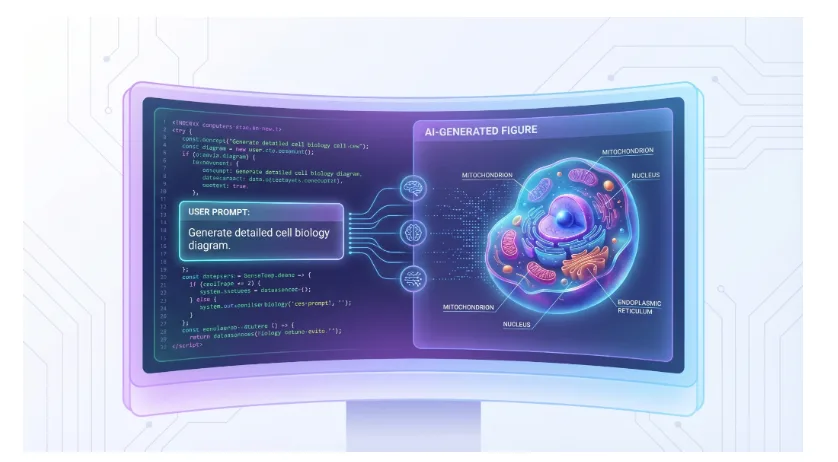
AI-assisted diagram tools offer a practical way to close part of that gap. They can help teachers, tutors, curriculum teams, and students turn written explanations into visual drafts. Used carefully, they can make science learning more visual, more flexible, and more accessible.
Why visuals help students learn science
Many science topics are difficult because they are invisible, too large, too small, too fast, or too slow to observe directly. Students cannot easily see molecules moving across a cell membrane, energy transferring through an ecosystem, groundwater moving through soil, or forces acting on an object. Visual models help make these ideas concrete.
A good diagram does three things. First, it reduces cognitive load by organizing information. Second, it shows relationships that may be hard to describe in words alone. Third, it gives students a shared reference point for discussion. When a class can point to the same process diagram, the teacher can guide attention to one step at a time.
Visuals are also important for students who learn better through spatial, visual, or multimodal materials. A clear diagram can support English language learners, younger students, and learners who need extra scaffolding. In that sense, visual science materials are not only helpful. They can improve access.
The problem with one-size-fits-all diagrams
The internet has made it easier to find diagrams, but not always easier to find the right diagram. A teacher may need a simplified version of photosynthesis for middle school, a more detailed version for advanced students, or a diagram that uses the same vocabulary as the local curriculum. A generic image may be too complex, too vague, or not aligned with the lesson.
Custom visuals are often better, but they take time. Teachers already balance planning, assessment, classroom management, student support, and administrative work. Creating a polished diagram for every lesson is rarely realistic. Even when teachers use slide or design tools, making a clean scientific figure can take longer than expected.
AI can help by making the first draft faster. A teacher can describe the learning goal and request a diagram that matches a specific audience. For example, the prompt might ask for “a simple labeled diagram of the water cycle for grade six students, with evaporation, condensation, precipitation, runoff, and groundwater.” The result still needs review, but it can provide a starting point that is easier to improve than a blank page.
How AI diagram tools can support teachers
One benefit is adaptability. A teacher can generate different versions of the same concept for different levels. Younger students may need a simple process diagram with fewer labels. Older students may need more detail, arrows, and terminology. A visual can also be adjusted for a worksheet, slide, poster, or study guide.
Another benefit is speed. When a teacher is preparing a lesson about cell structure, chemical reactions, ecology, or physics, an AI-assisted tool can help create a visual draft in minutes. The teacher can then focus on checking accuracy, simplifying labels, and connecting the diagram to the learning objective.
A tool like ConceptViz, an AI science diagram tool, can be especially useful when the goal is to turn a concept into a classroom-ready visual. It can help produce figures for explanations, worksheets, lab introductions, presentations, and student discussion prompts. The value is not only in the image itself, but in the faster path from lesson idea to visual material.
Supporting students as creators, not just viewers
AI-assisted visualization can also help students create their own explanations. Instead of only reading a textbook diagram, students can describe a process and compare the generated visual with what they have learned. They can identify missing steps, correct labels, and explain why a visual is accurate or inaccurate.
This turns the tool into a learning activity. Students are not simply accepting an AI output. They are evaluating it. That kind of review can strengthen scientific reasoning. It encourages students to ask: What is the main process? Which parts are connected? What is missing? Which label is misleading? How could the diagram be improved?
Used this way, AI becomes a prompt for discussion and revision. The teacher remains responsible for guidance, and students practice both content knowledge and communication skills.
Accuracy and responsible use still matter
AI-generated visuals should not be treated as automatically correct. Science diagrams must be checked. Labels, arrows, proportions, sequence, and terminology can all affect understanding. Teachers should review every visual before using it in class, and students should be taught that AI outputs require verification.
Responsible use also means avoiding overcomplicated visuals. A diagram that looks impressive may not be effective for learning. The best classroom figure is usually clear, focused, and matched to the lesson. It should help students understand one idea well, rather than show every possible detail.
Schools and educators should also consider accessibility. Images should have descriptive captions or alt text when used in digital materials. Important information should not rely only on color. Text should be readable. These basic practices make visual learning more inclusive.
A more visual future for science learning
AI will not solve every challenge in science education, but it can help with a very practical one: creating clearer visual explanations more quickly. For teachers with limited time, this can make a real difference. For students, it can make abstract concepts easier to discuss and remember. For schools, it can expand access to customized learning materials without requiring every teacher to become a designer.
The most effective use of AI in education will combine technology with human judgment. Teachers bring context, accuracy, empathy, and knowledge of their students. AI tools can help turn that knowledge into visuals that support learning. Together, they can make science education more understandable, more engaging, and more accessible.
