



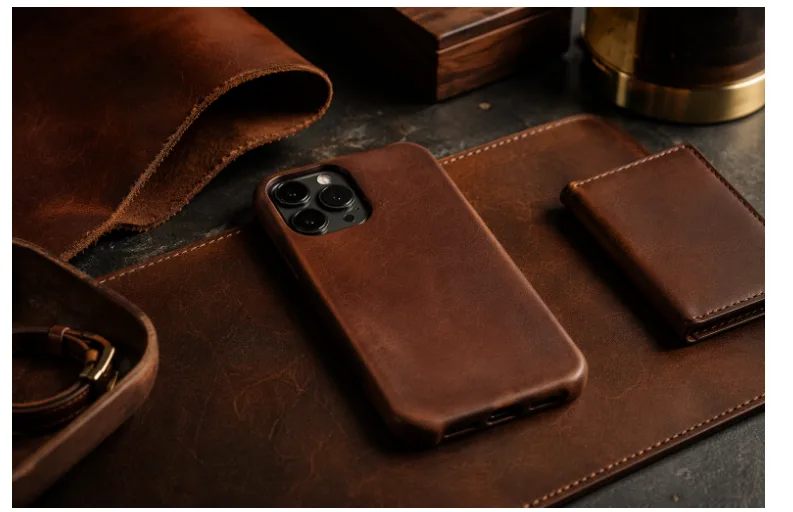
There was a time when technology promised permanence. Early devices were repaired, upgraded, passed along. Over the years, that promise quietly shifted. Products became thinner, faster, cheaper — and far more temporary. Cases cracked, coatings peeled, accessories aged poorly. The rhythm of replacement became almost invisible, absorbed into everyday life as something inevitable. That rhythm is now being questioned.
A subtle shift is taking place among users who are no longer impressed by disposability disguised as innovation. Instead, attention is turning toward objects that endure — items that resist obsolescence not through software updates, but through material integrity and thoughtful construction. In this shift, something unexpected has re-emerged as a marker of modern refinement: longevity.
And nowhere is this more visible than in the rising interest in premium leather accessories for personal technology.
The quiet return of materials that last
Plastic solved many problems. It made production faster, reduced costs, and enabled design flexibility at an industrial scale. Yet its advantages came with a trade-off — short lifespans and a lack of character. A plastic phone case performs its function, but it rarely improves with time. It simply wears out. Leather behaves differently.
Full-grain leather, in particular, stands apart because it retains the complete structure of the hide. It is not sanded down or artificially corrected. Its surface carries natural marks, subtle irregularities, and a density that synthetic materials struggle to replicate. These qualities are not flaws — they are indicators of strength.
What matters is how this material responds to use. Instead of degrading, it adapts. It softens where it is handled most. It deepens in tone with exposure to light and touch. It becomes, in a sense, more itself over time.
In a technological environment dominated by rapid cycles, this kind of slow transformation feels almost radical.
Craftsmanship as a counterpoint to speed
Mass production excels at consistency. Every unit is identical, every detail predetermined. Yet durability often suffers when speed becomes the primary objective. Thin coatings replace solid materials. Adhesives replace stitching. Efficiency takes precedence over resilience. Handmade craftsmanship operates under a different logic.
When an object is shaped, cut, and assembled by skilled hands, attention shifts toward longevity from the very beginning. Edges are burnished rather than sealed with synthetic layers. Stitching is reinforced where stress is expected. Materials are selected not only for appearance, but for how they will behave after months or years of daily use.
This approach explains why certain accessories feel fundamentally different the moment they are handled. There is a density, a quiet solidity, a sense that the object was designed with time in mind rather than just immediate appeal.
Within this context, the growing appreciation for luxury handcrafted leather iPhone cases reflects more than a preference for premium goods. It signals a broader reconsideration of what quality actually means in a digital age.
The language of patina
One of the most compelling aspects of leather is something that cannot be manufactured instantly: patina.
Patina is often misunderstood as wear. In reality, it is a form of visual memory. It records interaction—how an object has been held, where it has been placed, how it has traveled through daily life. The surface becomes richer, more complex, more nuanced. No two pieces develop the same way.
This uniqueness stands in direct opposition to the uniformity of synthetic materials, which tend to look identical when new and deteriorate in predictable ways. Leather, by contrast, evolves unpredictably. It becomes personal without requiring customization at the point of purchase.
In a culture where personalization is often reduced to color options or interchangeable covers, patina offers something deeper. It is not chosen—it is earned.
Durability as a form of sustainability
Sustainability is frequently discussed in terms of materials, certifications, and recycling systems. These factors matter, yet they do not tell the entire story. One of the most effective ways to reduce environmental impact is also the simplest: extend the life of a product.
Disposable accessories contribute to a cycle of production and waste that is difficult to offset. Even when materials are recyclable, the energy required to process them — and the likelihood that they will actually be recycled — remains uncertain. Long-lasting products interrupt that cycle.
A well-made leather accessory does not need to be replaced every few months. It resists tearing, maintains its structure, and continues to perform its function without degradation. Over time, the environmental cost of its production is distributed across years of use rather than weeks.
This perspective reframes luxury. It is no longer defined by excess or novelty, but by restraint and endurance.
When technology meets permanence
There is a certain irony in pairing fast-evolving devices with materials designed to last decades. Smartphones are upgraded frequently, yet the objects that protect them are beginning to outlive the devices themselves. This creates an interesting dynamic.
Accessories are no longer seen as disposable companions to technology, but as independent objects with their own value. A well-crafted leather case can transition from one device to another, or simply remain as an object worth keeping. It carries its history with it.
In the middle of this shift, luxury handcrafted leather iPhone cases are becoming less about status and more about alignment with a different set of priorities—ones that favor permanence over replacement.
The emotional dimension of lasting objects
There is also an emotional component that rarely enters technical discussions.
Objects that age well tend to foster a stronger connection with their owners. They become familiar, reliable, quietly integrated into daily routines. Their wear patterns are not signs of decline, but markers of continuity.
Disposable items do not offer this experience. They are replaced before any meaningful connection can form.
In contrast, a leather accessory that evolves over time becomes part of a user’s environment in a more lasting way. It reflects use without losing integrity. It becomes recognizable at a glance, not because of branding, but because of its unique surface.
This subtle relationship between object and user contributes to the broader appeal of longevity. It is not only about function — it is about presence.
A shift in what luxury means
Luxury has traditionally been associated with rarity, price, and visual distinction. Those markers still exist, yet they are being supplemented by new criteria.
Longevity is emerging as one of them.
An object that remains functional and appealing over years of use offers a different kind of value. It reduces the need for constant replacement. It rewards patience. It aligns with a slower, more deliberate approach to consumption.
This does not reject innovation. Instead, it places it within a broader context where durability and material integrity are just as important as new features.
In this sense, the move toward lasting accessories is not a rejection of technology, but an attempt to bring balance back into how it is experienced.
Where the shift is leading
The growing preference for durable, well-crafted accessories suggests that users are becoming more selective. They are asking different questions. Not just how something looks on the first day, but how it will feel after a year. Not just how it protects a device, but how it integrates into daily life over time.
Manufacturers are beginning to respond, though the pace of change varies.
Some continue to prioritize volume and speed. Others are experimenting with materials and processes that emphasize longevity. The presence of leather in this conversation is not accidental — it represents a material that has already proven its ability to endure.
The broader implication is clear. Disposable design is losing its appeal, not because it is no longer available, but because it no longer satisfies a growing expectation for permanence.
A slower, more intentional future
The shift toward longevity does not require abandoning modern technology. It simply asks for a different relationship with the objects that surround it.
Choosing materials that improve with time. Valuing craftsmanship that prioritizes durability. Accepting that not everything needs to be replaced at the first sign of wear.
These choices, taken together, point toward a future where luxury is measured not by how quickly something can be acquired, but by how long it remains relevant.
In that future, the most refined objects may not be the newest ones, but the ones that have stayed.
