



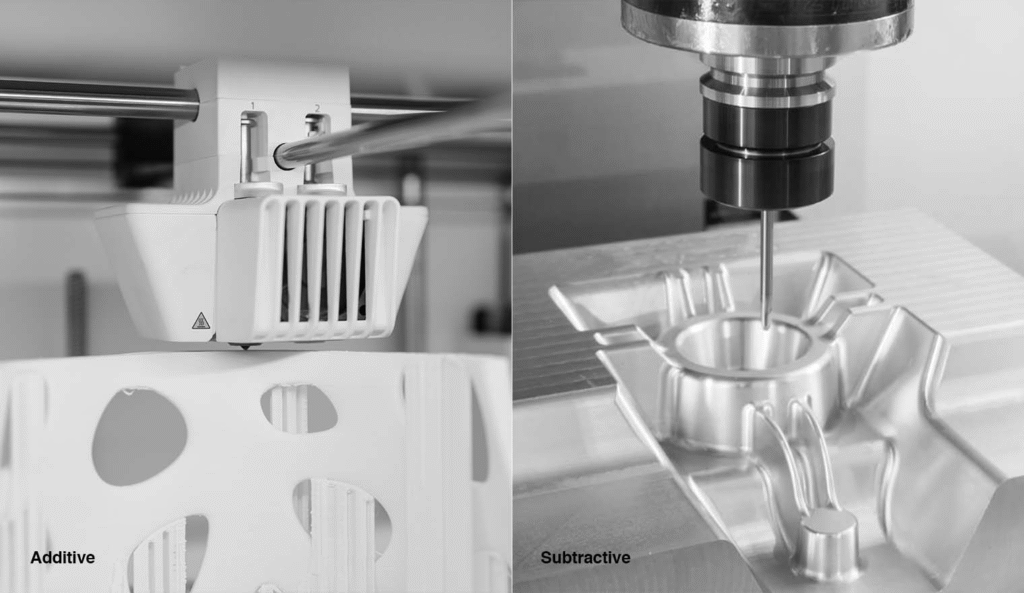
When sourcing plastic components, engineers often compare 3D printing and CNC machining — especially for functional nylon parts. Two of the most capable options are:
- Multi Jet Fusion (MJF): a powder-bed 3D printing process ideal for complex geometries and short-run production.
- CNC machining: a subtractive manufacturing method known for precision, tight tolerances, and broad material compatibility.
So which one is better for your project? Let’s compare them across cost, geometry, finish, speed, and scalability.
 What Is Multi Jet Fusion (MJF)?
MJF uses:
- Nylon powder (PA12, PA11, TPU)
- An inkjet printhead that applies fusing and detailing agents
- An infrared lamp that sinters the entire layer in a single pass
This process builds parts quickly, without support structures, and produces strong, isotropic parts with a fine matte finish.
 What Is CNC Machining?
CNC machining cuts away material from a solid block using:
- Computer-controlled tools (mills, lathes, routers)
- A wide range of thermoplastics (e.g., Delrin, Nylon 6, PEEK)
CNC offers tight tolerances and high precision, but is limited by tool access and fixture design — especially for internal features or undercuts.
 MJF vs CNC Machining: Side-by-Side Comparison
| Feature | MJF (Multi Jet Fusion) | CNC Machining |
| Part Geometry | Very complex, organic forms | Simple to moderate geometries |
| Internal Channels | Yes, no support needed | No (requires multi-op machining) |
| Surface Finish | Matte, lightly textured | Smooth to polished (tool dependent) |
| Wall Thickness | Down to ~0.02–0.04 in (0.5–1 mm) | Typically > 0.08 in (2 mm) |
| Strength (XYZ) | Isotropic | Strong, but anisotropic for thin walls |
| Accuracy | ±0.003–0.010 in | ±0.001–0.005 in |
| Lead Time | 2–5 days | 5–15 days |
| Setup Cost | Low (no tooling or fixturing) | High (toolpath + fixture setup) |
| Cost Per Part (low qty) | Lower for complex or nested parts | Lower for simple blocky shapes |
| Cost Per Part (high qty) | Scales well to 10k+ | Efficient with automation |
 When to Choose MJF
MJF is ideal when:
- You need complex geometry or internal features
- You want short lead times without custom tooling
- Part volumes are 10–10,000 units
- You’re iterating on design and need flexibility
- Parts require consistent isotropic strength
 When to Choose CNC Machining
CNC is the better option when:
- You need tight tolerances below ±0.002 in
- You require optical or polished surfaces
- The geometry is simple and planar
- You need non-nylon engineering plastics (e.g., PEEK, UHMW, Delrin)
 Hybrid Approach: Print, Then Machine
In some cases, customers combine both:
- Print complex near-net shapes via MJF
- Post-machine critical features (e.g., bearing bores, sealing faces)
This hybrid method can cut costs while maintaining tolerances where they matter.
 Conclusion: MJF vs CNC Machining
| Need This… | Best Choice |
| Complex geometry or internal channels |  MJF MJF |
| Ultra-precise fits or fine threads | CNC |
| Short lead times and design agility | MJF |
| Non-nylon high-performance plastics | CNC |
| Repeatable batches with no tooling | MJF |
| Highly cosmetic surface finish | CNC (with polishing) |
 Ready to Compare for Your Project?
RapidMade offers both MJF printing and precision CNC machining — and we help engineers decide which is best based on geometry, volume, material, and speed requirements.
Upload your file and get a side-by-side quote at rapidmade.com
