



General Camera Specifications for Galaxy A55 and A56
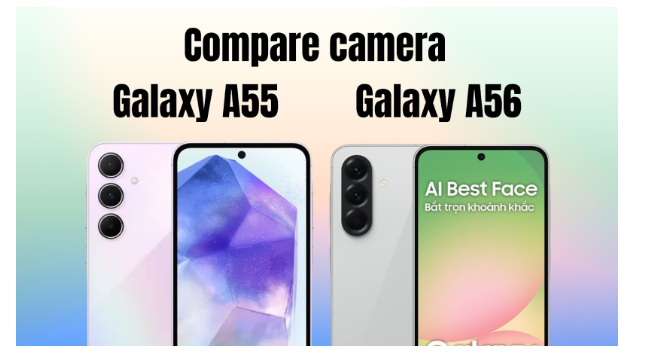
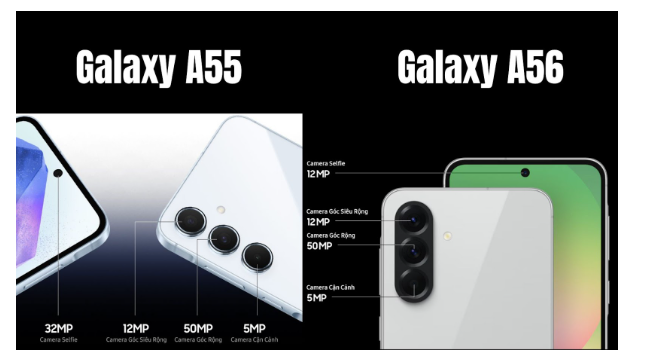
Camera Configuration of Galaxy A55 and A56
Both models feature a 50MP main sensor, accompanied by auxiliary lenses including:
- 12MP ultra-wide lens for capturing landscapes or large groups
- 5MP macro lens for close-up shots like flowers or product details
In terms of hardware, there is no significant difference between the two versions. However, image quality also depends on the Image Signal Processor (ISP) of the chipset. The Galaxy A56, with its new Exynos chip, may perform better in low-light conditions and HDR processing.
Video Recording on Galaxy A55 and A56: Stable at 4K, No 8K Support
Neither device supports 8K video recording, which is understandable as this feature is typically reserved for flagship models. Nevertheless, they can:
- Record 4K video at 30fps, delivering sharp and highly detailed footage
- Record 1080p and Slow Motion at 60fps, ensuring smooth motion and the ability to slow down footage during post-production
In real-world tests, the Galaxy A56 offers more stable video quality, with better noise handling and sharpness retention when the camera is moved.
123° Ultra-Wide Angle Captures Every Large Scene
With an ultra-wide camera angle of up to 123 degrees, both the Galaxy A55 and A56 are ideal for:
- Group photos in confined spaces
- Expansive landscapes: sunsets, beaches, forests
Although they share the same specifications, the Galaxy A56 has a slight edge in handling edge distortion thanks to its new algorithm, reducing the warping effect seen in some older models.
Portrait and Professional Shooting Features
Despite being mid-range devices, both are equipped with:
- Portrait mode (Bokeh) for smooth subject-background separation, perfect for portraits or product photography
- Pro Mode, allowing manual adjustments to ISO, shutter speed, and white balance
Notably, the Galaxy A56 is more responsive to manual adjustments, making it a great tool for users looking to learn basic smartphone photography.
Optical Image Stabilization (OIS) for Stable Night Shots and Videos
Both models feature Optical Image Stabilization (OIS), but the Galaxy A56 has slight refinements that:
- Reduce shake in handheld video recording
- Minimize blur in low-light photography
This is particularly useful for vlogging or night photography without a tripod.
Detailed Specifications of the Rear Camera Cluster for Galaxy A55 and A56
Main Lens
Both the Samsung Galaxy A56 and A55 are equipped with a 50MP main lens using the Sony IMX906 sensor, a powerful sensor often found in near-premium devices.
- Aperture f/1.8: Allows better light capture, supporting clear night photography.
- Sensor size 1/1.56 inch, 1-micron pixel size: A standard size that enhances image quality in complex lighting conditions.
- Phase Detection Autofocus (PDAF) and Optical Image Stabilization (OIS): Both devices offer superior image stabilization, ensuring sharp photos and videos when shooting handheld.
Evaluation: There is no difference in the main lens specifications between the A55 and A56, both delivering excellent image quality, especially in low-light conditions.
Ultra-Wide Lens
The difference lies in the sensor:
- Galaxy A55 uses the Sony IMX258 sensor, a common sensor that supports good light balance and fairly accurate color reproduction.
- Galaxy A56 has an unspecified sensor, possibly a cost-optimized version.
This makes the Galaxy A55 potentially sharper and more detailed in ultra-wide shots, especially in less-than-ideal lighting conditions.
Macro Lens (Close-Up)
Both the Galaxy A55 and A56 feature a macro lens:
- 5MP resolution, f/2.4 aperture
- GalaxyCore GC5035 sensor, 1.12-micron pixel size
- No autofocus, EIS stabilization
Evaluation: Suitable for close-up shots like flowers, food, or small details. However, the lack of autofocus can result in blurry images if the hand is not steady.
Front Camera (Selfie) Specifications for Galaxy A55 and A56
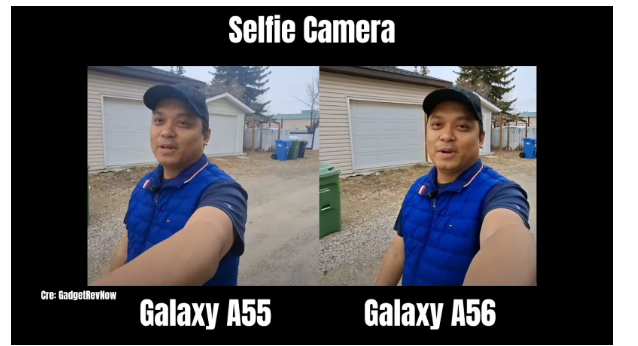
The Galaxy A55’s front camera has a clear advantage in resolution:
- Galaxy A55: 32MP front camera
- Galaxy A56: 12MP front camera
This difference is not just about megapixels but directly impacts the level of detail in selfie photos. The 32MP camera on the A55 retains more details in portraits, particularly in well-lit conditions.
Evaluation: If you frequently take selfies, livestream, or create content for TikTok, Instagram, etc., the A55 is the superior choice.
