



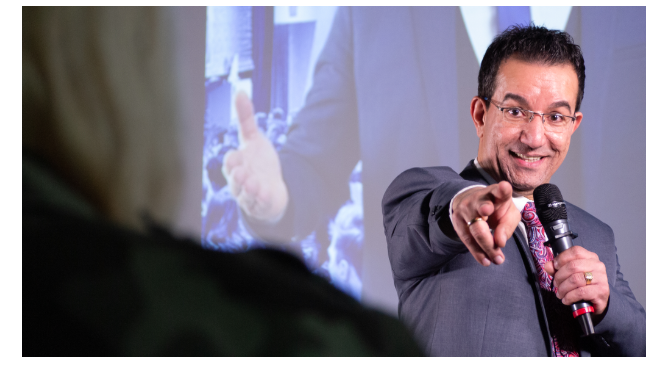
When you first meet Medhat Zaki, it’s hard not to notice his energy. It’s not loud or overwhelming—it’s calm, deliberate, and deeply focused. The kind of presence that makes you feel like you’re the only person in the room. And if you spend even five minutes talking to him, you realize that is exactly the secret behind his extraordinary success: connection.
For Medhat, sales is not about pushing products or closing deals. “It’s never about the product,” he says, leaning forward, his voice steady. “It’s about the person. What do they need? What do they want? And how can you genuinely help them?” That’s a lesson he learned early on, years before becoming a renowned consultant and strategist for businesses across Germany and the Middle East.
Medhat grew up watching his father, a small business owner, interact with customers. “He treated every single customer like family,” Medhat recalls with a smile. “Even when he was tired, even when sales were slow, he always made time to ask about their lives, their kids, their struggles. People didn’t just buy from him because he had good products. They bought from him because they trusted him.”
That lesson stayed with Medhat, shaping how he approaches sales to this day. In his view, selling is not about manipulation or flashy pitches; it is about understanding human psychology. “People buy with emotion first and justify with logic later,” he explains. “You have to make them feel seen, heard, and understood. That’s the key.”
Take the story of one of his clients, a struggling tech company in Germany. Their sales team was hitting roadblock after roadblock, despite having an innovative product. Medhat stepped in and observed their process. What he noticed was simple but game-changing: they were so focused on explaining the technical features that they forgot to address the customers’ emotions.
Medhat helped them shift their approach. Instead of launching into a pitch about specs and features, he taught the team to start every meeting with a question: “What’s your biggest frustration right now?” It was like flipping a switch. Clients opened up, shared their pain points, and suddenly, the conversation wasn’t about a product—it was about solving a problem. Within six months, the company’s sales doubled.
It’s this kind of practical wisdom that makes Medhat’s work so impactful. He doesn’t just give advice; he immerses himself in his clients’ world, taking time to understand their unique challenges. He teaches them how to read the subtle cues—body language, tone of voice, hesitations—that reveal what a client is really thinking. “Every interaction is an opportunity to build trust,” he says. “And trust is the currency of every successful relationship.”
Beyond the boardroom, Medhat’s insights on sales psychology extend to his personal life. He tells a story about teaching his teenage daughter how to negotiate her allowance. “I told her, ‘Don’t just ask for money. Tell me why it matters to you. Show me how it’ll make your life better.’” He laughs, shaking his head. “She gave me the best pitch I’ve ever heard. Let’s just say she got what she wanted—and then some.”
Medhat believes these skills—listening, empathizing, connecting—aren’t just for sales professionals. They’re for anyone who wants to communicate more effectively, whether it’s closing a deal, resolving a conflict, or strengthening a personal relationship.
And he practices what he preaches. In every interaction, whether it’s with a corporate executive or a budding entrepreneur, Medhat makes it a point to focus on the person, not the transaction. That’s why his clients trust him, why they listen, and why they succeed.
So, what’s Medhat’s ultimate advice for mastering sales psychology? “Start by being curious,” he says. “Stop thinking about what you want to sell and start asking what the other person needs. The more you care, the less it feels like selling—and the more it feels like helping.”
It’s not rocket science, he insists. It’s human nature. And in a world that’s often too focused on numbers and targets, Medhat Zaki reminds us that the best salespeople aren’t just good at selling. They’re good at understanding people.
