



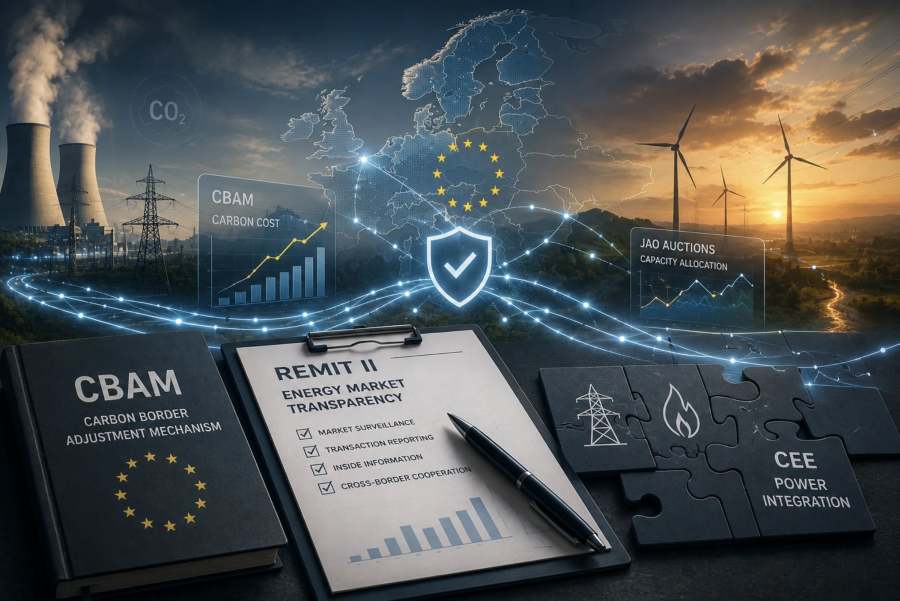
Europe’s carbon border is now an operating cost, a compliance test, and a market-access condition. Since the definitive phase of the Carbon Border Adjustment Mechanism began on 1 January 2026, electricity imported into the EU has entered a stricter carbon-accounting environment. Revised REMIT rules have also strengthened cross-border surveillance in EU wholesale energy markets.
For trading desks near the EU perimeter, these regimes meet at a difficult point. Electricity may be generated in Ukraine, Moldova, Serbia, or another Energy Community jurisdiction, scheduled across several borders, and sold into an EU bidding zone. The transaction can involve auction platforms, TSOs, carbon data, regulators, and an EFET-based agreement. A weakness in that chain can reduce the margin or prevent delivery.
New carbon borders increase the importance of professional Non-EU European & Western Balkans Energy Market Integration consulting for funds trading near EU perimeter lines. The work includes carbon-cost allocation, REMIT governance, capacity access, and contract adaptation.
CBAM Changes the Economics of Imported Electricity
CBAM covers electricity alongside cement, aluminium, fertilisers, iron and steel, and hydrogen. During the definitive phase, the EU importer or indirect customs representative must hold authorised declarant status and account for embedded emissions through the CBAM system.
Electricity creates a particular challenge. Power is traded through interconnected systems, while carbon intensity varies by hour and generation source. A trader may purchase a regional product without direct control over the plant-level emissions information needed for carbon accounting.
Contracts should identify who supplies emissions data, which methodology applies, how the information will be verified, and who bears the cost if declared emissions are adjusted. Where a carbon price has already been paid in the country of origin, the importer may seek a reduction in CBAM liability if the payment and evidence satisfy EU rules.
Missing data, delayed verification, or disagreement over the carbon price already paid can affect settlement and trade economics.
Capacity Allocation Adds a Second Compliance Layer
Cross-border electricity trading also depends on transmission capacity. The Joint Allocation Office operates auctions of cross-border transmission rights for participating transmission system operators. Rules effective from January 2026 cover several Ukrainian borders, including links with Hungary, Slovakia, and Romania.
A successful bid is only one step. Traders must comply with registration rules, guarantees, auction specifications, nomination procedures, curtailment provisions, and border-specific annexes. Rights differ by product and border.
Across Moldova and the Western Balkans, integration remains uneven. Some borders still rely on arrangements shaped by Energy Community rules, national law, and regional initiatives that have not reached full EU-style market coupling. Capacity purchased in one jurisdiction may carry different remedies at the next border.
A route-level legal review should test:
- whether capacity is firm, interruptible, or subject to curtailment;
- who bears nomination and imbalance risk;
- whether carbon data follows the electricity through each transfer;
- how auction failure or grid restrictions affect payment;
- whether delivery terms remain consistent with the hedge and PPA position.
REMIT II Reaches Beyond the EU Corporate Border
The revised REMIT regime has strengthened cross-border enforcement. ACER now has investigatory powers in certain cases involving more than one Member State, while national regulators retain enforcement roles.
A company established outside the EU that enters into reportable transactions on EU wholesale energy markets must designate a representative in a Member State where it is active and align its REMIT registration accordingly. Transaction reporting, inside-information disclosure, and record consistency remain central obligations.
Physical events can influence prices on both sides of the border. A change in available capacity, an outage, or a delayed auction may affect disclosure duties and the assessment of trading conduct. Public statements, dispatch data, bidding decisions, and internal records should remain consistent.
EFET Contracts Need a Carbon and Border Audit
Standard EFET documentation provides a useful foundation, although perimeter transactions require additional drafting.
An Energy Contract Legal Review should examine how the agreement allocates CBAM costs, emissions-data duties, capacity risk, taxes, regulatory change, and market-disruption consequences. The parties should distinguish between a carbon cost imposed at import, a carbon price already paid in the country of origin, and charges passed through by an intermediary.
Poorly aligned clauses can create a double economic burden. One party may pay the domestic carbon charge while another remains responsible for the full CBAM cost because the evidence arrived late or failed verification.
Change-in-law and force majeure clauses also need precision. A higher carbon cost may reduce profitability without excusing performance. A border closure, capacity suspension, or binding regulatory order may have a different effect. The agreement should state when repricing, renegotiation, suspension, or termination becomes available.
Regulatory Engagement Is Part of Market Access
CEE power integration depends on cooperation between EU institutions, the Energy Community, transmission operators, and national regulators. Businesses may need to engage with authorities such as Romania’s ANRE, Slovakia’s ÚRSO, and Ukraine’s NEURC on licensing, reporting, capacity, and implementation questions.
A market participant should present the relevant rule, commercial impact, technical constraint, and proposed solution in a form the authority can assess. Collective engagement may be appropriate where a rule affects competition across a border.
This can support fair market access where established incumbents benefit from greater infrastructure access or regulatory familiarity. The objective is transparent application of the rules during market integration.
Conclusion
CBAM and REMIT II are reshaping electricity trade at the EU’s external energy borders. Carbon accounting, capacity allocation, market conduct, and contractual risk now operate as one connected compliance system.
For Ukraine, Moldova, and the Western Balkans, the transition carries development consequences as well as trading costs. Market integration can attract investment and support decarbonisation, while poorly coordinated carbon and capacity rules may reduce liquidity and weaken competition.
Trading desks that map the legal route, from emissions evidence to auction rights and settlement, are better placed to protect margins and maintain access to EU markets. At the carbon frontier, legal coordination has become part of the infrastructure.
