



Royalty-free stock illustration ID: 740383378
You may be surprised to know that both Boeing and Airbus have spent serious time and money looking into the technology that will enable these Ubers of the future to be a reality.
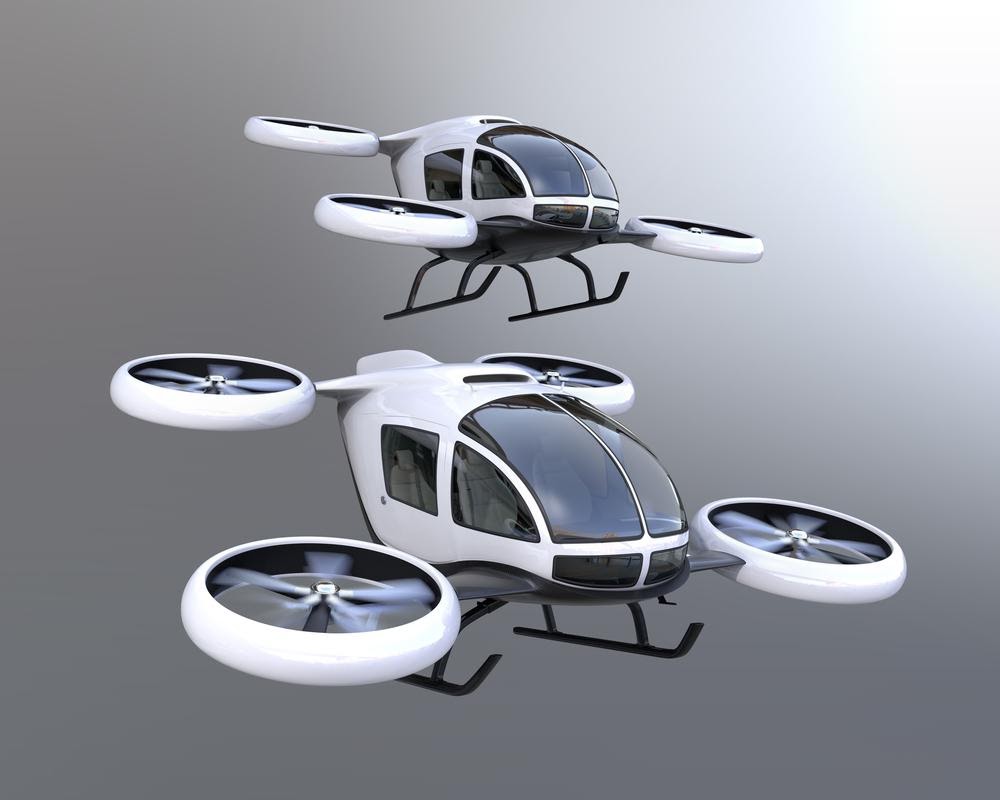
Look at Boeing as an example: in 2019 the Boeing autonomous air taxi prototype completed its first flight, although only briefly, taking off for a few seconds and landing. The impressive point in this short exercise was that the take-off was vertical, this might not seem groundbreaking but this alone shows how far we have come and the efficiency of the vehicle’s autonomous functionality along with revolutionary ground control functions.
Surprisingly, this took only one year to get this far, from concept to flying prototype. The prototype has a range of up to 50 miles. Future flights of the aircraft will test all flight modes; wing-borne flight as well as gauging the smooth transition between vertical and forward flight modes.
Royalty-free stock illustration ID: 1555293899
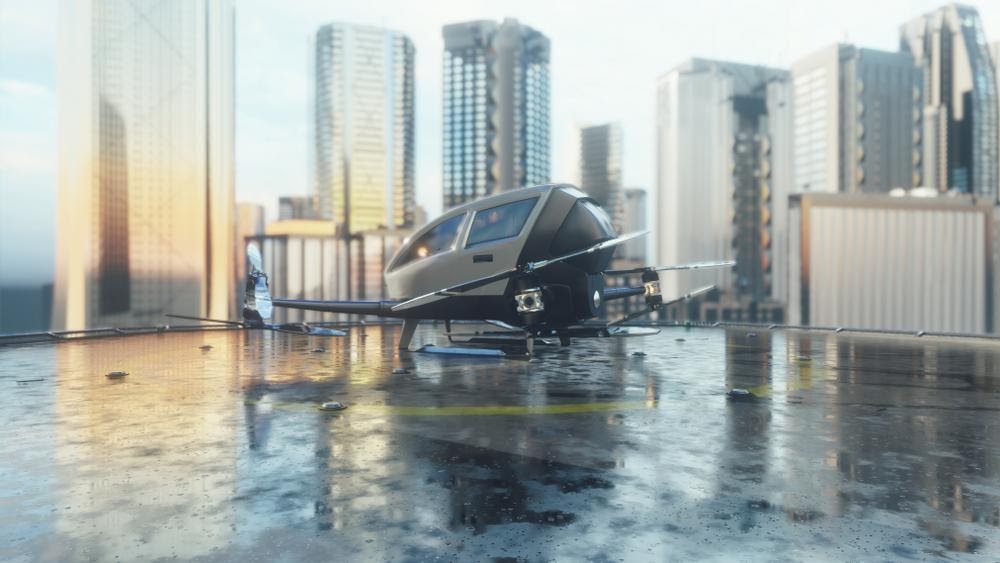
In 2019 Airbus tested its own version of the air taxi called Vahana, a pilotless plane. A single-seater that can reach speeds of up to 99 miles per hour, and fly distances of up to 35 miles. Vahana takes off vertically then practical measures kick in, and the wings rotate allowing it to fly like a plane. Unlike Boeing, Airbus is planning to use their technology to carry multiple passengers – and the air taxi really will become a reality.
Just in case you’re wondering why self-flying planes aren’t a common form of transport yet, here are some good reasons.
Currently for safety two pilots are required in the cockpit at all times. This means there are no certified single-pilot or pilotless transport category aircraft. Subsequently, insurers will not insure self-flying planes at the moment; this makes them too risky for airlines to commission. Inevitably this will change over time but only when the safety issues have been addressed.
Recent studies have shown that most people are apprehensive about using self-flying planes for fear of technology failure. In time the public will become more frequently exposed to the idea. Given that autonomous innovations such as drones have become commonplace, sentiments are slowly changing. Studies have shown that 7 in 10 people would fly in a self-driving aircraft, if this is true there may be a market place for such a craft.
But saying this, 80% of study participants weren’t willing to travel on a pilotless plane right now. Most said they would fly on one at some point in their lifetime, but only 48% of those who were asked said they would consider it in the next 15 years.
These results of the study make it apparent that there will only be a viable market for autonomous planes when the technology approaches maturity and the public are confident.
Realistically gaining this sort of confidence this is a long way off. There are many concerns about autonomous vehicles of any kind, particularly aircraft, raised by the general public as well as those in the industry. Crucially, an effective system to manage the increased airspace traffic that will be a result of aeroplane autonomy is also required before progress can be made.

Royalty-free stock vector ID: 1141045604
Introducing Elon Musk super fans of this mode of transport. The billionaire transport entrepreneur is planning to revolutionise the way we travel.
Musk owns SpaceX, founded in 2002 with the mission statement – to reduce the space transportation costs and enable the colonisation of Mars. Incredible as that statement seems it’s not all Musk plans to do – SpaceX is turning its attention to what he called terrestrial travel.
Musk plans to develop a revolutionary craft that he says will enable a 30-minute flight from London to New York. The hurdles that Musk will have to jump over in order for this mode of transport to be a reality means that it’s unlikely to happen in the next 30 years unless, of course, he knows something we don’t?
Along with a 30-minute commute to New York, Musk and SpaceX are enhancing the space race with reusable rocket designs. Decades after launching the company, SpaceX has contracts with NASA among others to send astronauts to the International space station and the company continues with its original mission to inhabit Mars.
Elon Musk is a man who knows what he wants and thinks he knows what we want. So watch this space
