



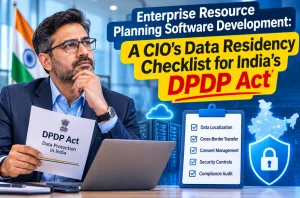
India’s Digital Personal Data Protection Rules, 2025 have made data residency a primary consideration in enterprise resource planning software development. CIOs can no longer address it after selecting a vendor. Organizations planning or reassessing an ERP deployment must now choose where they store, process, and back up personal data. Confirm this before finalizing any technology decision.
The stakes are substantial: the DPDP Rules carry penalties of up to ₹250 crore per breach. They apply directly to how ERP systems handle employee records, customer data, and vendor information. For Chief Information Officers, this matters directly. The enterprise resource planning software development choices they make today will shape how well the organization meets its compliance obligations.
What the DPDP Rules Actually Require for ERP Data
The DPDP Rules, 2025 do not demand that every company host every byte of data inside India. They introduce a tiered structure instead. A government committee will identify specific categories of personal data that must stay in the country.
This committee includes officials from the Ministry of Electronics and IT. The government classifies some organizations as Significant Data Fiduciaries, or SDFs. These organizations face the strictest version of this rule.
An SDF cannot transfer the government-identified data categories outside India under any circumstance. SDFs also carry extra obligations. These include an annual data protection impact assessment and an independent audit every 12 months. SDFs must also report to India’s Data Protection Board at board level.
Organizations that process sensitive personal data at scale face real financial and legal risk. Confirming SDF status early is a practical priority. Enterprise resource planning software development teams are usually the first to know whether that status applies. ERP systems hold most of an organization’s regulated data.
ERP data residency decisions sit at the center of this calculation. A single enterprise resource planning software development platform processes payroll, customer records, and vendor data across every department. The DPDP Rules protect exactly this kind of personal data.
Getting ERP data residency wrong carries real consequences. A minor gap can turn a routine audit into a reportable breach.
For most mid-market manufacturers and service businesses, this raises a direct question about enterprise resource planning software development. Does your current ERP vendor know which data center holds your HR records? Can it confirm where your customer master and backup copies live? Many cannot answer that today.
Why ERP Deployment Model Decides Your Compliance Exposure
ERP data residency is not a feature you can bolt on later. How you deploy the ERP system determines this. A multinational SaaS ERP spread across three continents makes data residency hard to verify. A custom-hosted or India-region cloud deployment gives a CIO direct, auditable control over exactly where data lives.
A mid-sized manufacturing company in Pune ran into this gap last year. Its legacy ERP vendor could not confirm which region hosted its production and HR data. Backups replicated automatically across global data centers as part of the vendor’s standard disaster-recovery design, with no single confirmed location.
After mapping its data flows, the company moved its core modules to an India-hosted deployment. Its DPDP exposure dropped within one compliance cycle, and daily production reporting continued without disruption.
Enterprise resource planning software development is a compliance decision, not just IT procurement. Custom ERP hosting lets an organization name the exact data center and backup region in a contract. It also puts access controls in writing, rather than trusting a vendor’s general-purpose infrastructure policy. For an SDF, that contractual clarity is close to a compliance requirement rather than a preference.
When These Requirements Take Effect
The DPDP Rules roll out in stages, and the timeline matters for ERP planning. The Data Protection Board becomes operational immediately. Consent Manager registration rules take effect within 12 months. Core compliance requirements, including consent notices, security safeguards, and data retention and erasure workflows, become mandatory within 18 months.
That 18-month window is shorter than most enterprise resource planning software development projects. An ERP project that starts today without a data residency plan risks a bad outcome. It could go live right before a compliance deadline it cannot meet. Building data localization India requirements into the architecture now avoids a costly mid-project redesign later.
A Practical Data Residency Checklist for CIOs
Before the next ERP renewal or implementation, a CIO team should work through a short, concrete list. Each item maps directly to a DPDP Rules obligation.
- Map every data flow. List which ERP modules touch personal data: HR, payroll, CRM, procurement. Note where your team processes and backs up each one.
- Confirm SDF status. Check your organization’s data volume and sensitivity against the government’s SDF criteria, or ask your compliance counsel directly.
- Review vendor contracts for location clauses. Most legacy ERP contracts say nothing about where data physically resides. Request this in writing.
- Verify backup and disaster-recovery regions. A primary data center in India means little if backups replicate to a non-approved location automatically.
- Decide: custom-hosted or cloud-vendor-hosted. Weigh control and auditability against the convenience of a managed SaaS platform.
- Document the decision. SDFs need this for their annual data protection impact assessment. Non-SDFs benefit from having it ready regardless.
None of these steps require a full enterprise resource planning software development overhaul. Most organizations can run this checklist against their existing ERP contract and vendor relationship within a few weeks. The output is a clear picture of where the gaps sit. From there, closing them might mean a contract amendment, a hosting migration, or a full re-platforming project.
The “custom-hosted or cloud-vendor-hosted” decision deserves particular attention. The three common deployment models differ sharply in how much control and auditability they actually offer a CIO:
- Custom-hosted ERP in an India data center: full, contractual control over data location, with a direct, self-managed audit trail.
- India-region cloud ERP: high, vendor-confirmed control over data location, with a vendor-assisted audit trail.
- Global multinational SaaS ERP: limited, often unclear control over data location, with an audit trail dependent on vendor disclosure.
Enterprise Resource Planning Software Development Choices That Reduce DPDP Risk
Three decisions consistently separate organizations that handle data localization India requirements smoothly from those that scramble during an audit. Manufacturing, healthcare, and logistics businesses tend to feel this most. Their ERP systems already carry the largest volumes of operational and personal data across departments.
First, build data residency into the request-for-proposal stage. Do not wait until after you select a vendor. Second, prefer modular ERP architectures.
These let an organization isolate and localize HR or financial records without re-platforming the whole system. Third, treat Significant Data Fiduciary obligations under DPDP Rule 13 as a design input. Do not treat them as a checklist applied after deployment.
Organizations that get this sequence right tend to spend less on retrofitting and less on legal review later. Those that treat enterprise resource planning software development and data compliance as separate workstreams usually end up doing both twice.
Organizations still weighing custom ERP hosting against a managed SaaS platform face one real question. How much contractual certainty does the business need? A custom ERP hosting arrangement in an India data center removes most of the guesswork around DPDP exposure. A managed SaaS platform can still work, provided the contract names the exact hosting region and backup location in writing.
Conclusion
Arobit Business Solutions structures enterprise resource planning software development engagements to meet data localization India requirements from the design stage. The company builds India-based hosting and documented data flows into every engagement, not after an audit raises a flag.
Request an ERP consultation to map your data residency requirements. Find out whether your current deployment holds up under the DPDP Rules.
Frequently Asked Questions
Q: What is a Significant Data Fiduciary under the DPDP Act?
A Significant Data Fiduciary, or SDF, is an organization the government designates. It depends on the volume and sensitivity of personal data the organization processes. SDFs face stricter obligations, including annual audits and mandatory data protection impact assessments. They also face restrictions on transferring certain data outside India.
Q: Does the DPDP Act Require ERP Data to Stay in India?
Not automatically for every enterprise resource planning software development deployment. The DPDP Rules let a government committee notify specific categories of personal data for localization. Until the government notifies a category, standard cross-border transfer conditions apply. SDFs face tighter restrictions than other organizations.
Q: Should we choose a custom-hosted or cloud-vendor-hosted ERP for DPDP compliance?
It depends on your SDF status and risk tolerance. Custom-hosted or India-region cloud ERP gives direct, auditable control over data location, which simplifies DPDP compliance. A global multinational SaaS ERP can still work, provided the vendor contract specifies data location and backup regions in writing.
