



Ask ten people about resume format and you’ll get ten answers. Some swear by a plain reverse chronological layout, others say basic templates look too generic and you need something that stands out.
Part of the confusion is that two different questions get lumped together. Format is the structure: chronological, functional, or hybrid. Formatting is everything visual: fonts, columns, spacing, section order. The first one has a right answer. The second one mostly has wrong answers to avoid.
Format: reverse chronological, almost always
Most recent job first, real dates on every role. For nearly every office job, that’s the answer. Functional resumes, the ones that lead with a big skills section and push dates to the bottom or drop them, tend to backfire. Recruiters have seen enough of them to assume they’re covering a gap or a pivot, so the format raises a question before anyone reads a word.
Someone on r/ResumeTips asked whether there’s one best resume format, and the answers were close to unanimous, a recruiter’s included. The plain version never costs you anything. Anything more creative is a bet that whoever reads it, person or software, will handle your choices well.
The exceptions are narrow. Designers get judged on the resume as a work sample, academics use a CV, and some creative roles lean on a portfolio anyway.
If you’re changing careers, you don’t need a functional resume to fix that. Keep the full chronological history and add a short highlights section above it with three or four bullets that pull your most relevant work to the top. Nothing is hidden, and the reader sees what matters first.
Formatting: where resumes quietly break
Nobody gets rejected for looking plain. People do get filtered for layouts the software can’t read, and they never find out that’s what happened. The usual suspects:
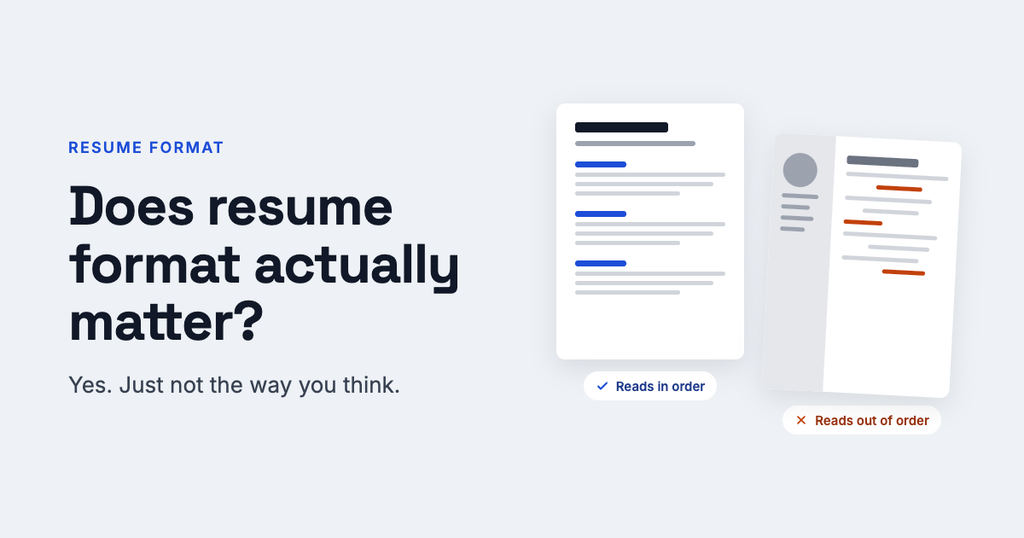
- Two columns. Many parsers read straight across the page, so your skills sidebar ends up spliced into the middle of a job description. A recruiter sees nonsense and assumes it’s your writing.
- Headers and footers. Some systems skip them entirely. If your phone number and email live up there, they may not make it into your profile at all. Put contact info in the body of the page.
- Icons instead of labels. A little envelope next to your email is fine for a human, but if the icon replaces the word, the parser may see nothing. Write out your LinkedIn URL as text, too.
- Fancy bullets. Arrows, checkmarks, and custom symbols sometimes come through as junk characters. Plain round bullets are safe.
- Creative section names. “Where I’ve Been” instead of “Experience” can leave a parser unsure where your work history starts. Boring names are doing a job.
Within those limits, make it look as good as you like. One clean font, consistent date formatting, enough white space that it isn’t a wall of text, and maybe one accent color on the headings. A hiring manager’s first pass is a few seconds long, so the whole job of the design is getting their eye to your most recent title and company immediately.
A two minute test
Open your resume PDF, select everything, and paste it into a plain text editor. That’s roughly what an applicant tracking system pulls out. Read it top to bottom. Jobs should appear in order, dates should sit next to the right roles, and your contact details should actually be there. If you see strange symbols where letters should be, the font isn’t mapping to real characters, and exporting with a standard font usually fixes it.
Run the same test if a resume generator made your file. A PDF that looks clean on screen and turns into a mess once it hits an ATS is one of the most common complaints in threads like this one about finding a resume generator for ATS friendly applications.
Once that test comes back clean, stop fiddling with the design. The real competition is in your bullets. “Handled customer escalations” and “Took over escalations and cut average resolution time from five days to two” describe the same job. Only one of them gets a call.
