



In February, a supermarket in Rotterdam or Hamburg will stock oranges. They will not have come from Spain, where the harvest is winding down, and certainly not from Florida. There is a reasonable chance they came from the Nile Delta.
Egypt has spent the past decade turning that seasonal position into one of the more consequential export stories in the region. Agricultural exports reached a record 11.5 billion dollars in 2025, accounting for nearly a quarter of total Egyptian exports. Citrus alone reached two million tonnes, keeping Egypt the world’s largest orange exporter for a sixth consecutive year. By July 2026, shipments for the year to date had already passed 5.8 million tonnes, with citrus above 2.2 million tonnes and fresh potatoes second at over 908,000 tonnes.
Behind the volume is a combination of factors that is easy to state and hard to replicate: an unusual calendar, an unusual set of soils, a climate that is both an advantage and a liability, and a growing amount of technical work happening well before anything is planted.
The calendar advantage
The single most underappreciated asset in Egyptian agriculture is timing.
Egypt’s growing season runs counter to the Northern Hemisphere’s main production window. Egyptian strawberries reach European markets during months when domestic supply is thin. Citrus peaks over the European winter, filling the gap between Mediterranean competitors and Southern Hemisphere arrivals. Potatoes come to harvest ahead of Europe’s own crop.
This is not a marginal advantage. It is the reason Egyptian produce commands attention from buyers who could source closer to home for most of the year, and it explains the export mix. A country competing head-on with Spain in September would struggle. A country supplying Spain’s market in February is doing something structurally different.
The counter-seasonal position also shapes what gets planted. Varieties are selected not only for yield but for whether they can be brought to harvest within a specific window — one that may be only a few weeks wide before a competitor’s supply arrives and prices soften.
Land, soil and the two Egypts
Egyptian agriculture operates across two very different landscapes.
The ‘old lands’ of the Nile Valley and Delta account for roughly 85 percent of cultivated area. These are among the most fertile soils in the world, built over millennia of Nile silt deposition, and they support some of the highest crop yields in Africa. They are also intensively farmed, fragmented into small holdings, and increasingly pressed by urban expansion and — in the northern Delta — by salinity as the coastline subsides.
The ‘new lands’ are the reclaimed desert zones east and west of the Valley. Here the soil is permeable and low in organic matter, so production depends on drip and sprinkler irrigation and on carefully managed nutrition. What these lands offer instead is scale, cleanliness from a phytosanitary perspective, and the ability to design a farm around export requirements from the outset rather than retrofitting one. Projects such as New Delta and Toshka continue to expand this footprint, with a further 4.5 million feddans announced for addition to cultivated area in 2026.
The two systems produce differently and suit different crops. Much of the high-volume export potato and citrus production sits in the new lands; much of the labour-intensive, high-value horticulture remains in the Delta.
Heat: the advantage and the ceiling
Egypt’s climate is what makes the calendar advantage possible. It is also the sector’s most serious constraint, and both things are true simultaneously.
The advantage is straightforward. High solar radiation and mild winters mean crops can be produced when much of Europe cannot grow anything outdoors — a growing environment that supports both the volume and the eating quality Egyptian citrus, grapes and mangoes are known for in export markets.
The ceiling is summer. Heat stress operates on crops through mechanisms that irrigation cannot correct. Most crops have a narrow temperature window during flowering; exceed it for even a few days and pollen viability collapses. A field can be perfectly watered, deep green, and still set almost no fruit. Heat also compresses the growing season, shortening the period during which a plant accumulates the biomass that becomes yield, and it shifts the disease landscape as warmer winters allow pest populations to persist year-round.
Farmers across the Delta consistently name heat waves among the leading threats to their crops, alongside strong winds and soil salinity, and they link them directly to losses in both volume and quality. Research has attributed a Delta yield decline of roughly 15 percent over the past decade to rising temperatures and heat waves. Modelling on North Delta wheat found that warming of 1°C to 4°C reduced yields by around 17.6 percent.
The result is a sector with a genuine competitive advantage in winter and a genuine vulnerability in summer — and an obvious strategic question about how to protect the first while managing the second.
The answer starts at the seed
A significant part of that answer is decided months before planting, in the choice of variety.
Almost everything an export buyer cares about is determined genetically. Uniform sizing. Sugar content and firmness within specification. Skin durability sufficient to survive extended cold-chain transit and still present well on a shelf. Disease resistance strong enough to meet European residue limits without heavy spraying. Heat tolerance to hold fruit set through a hot spell. Maturity timing precise enough to hit the export window.
None of these can be corrected downstream. An exporter cannot fix a variety that bruises in transit or ripens unevenly; the decision was made at planting.
For much of the last century, the commercial seed reaching Egyptian farmers was bred in Europe, North America or East Asia — regions with cooler summers and different disease pressures. The genetics were frequently excellent and calibrated for somewhere else. A hybrid that performs impressively in trials near Almería can underdeliver in a Delta July, not because the breeding was poor but because the selection pressure was different.
Closing that gap requires a step that cannot be imported: local adaptation. Genetic material has to be trialled and selected under the conditions where it will actually be grown — the same heat curve, the same humidity, the same pathogens, the same soil chemistry. That work is slow, running several seasons per selection cycle, and it requires trial land and technical staff.
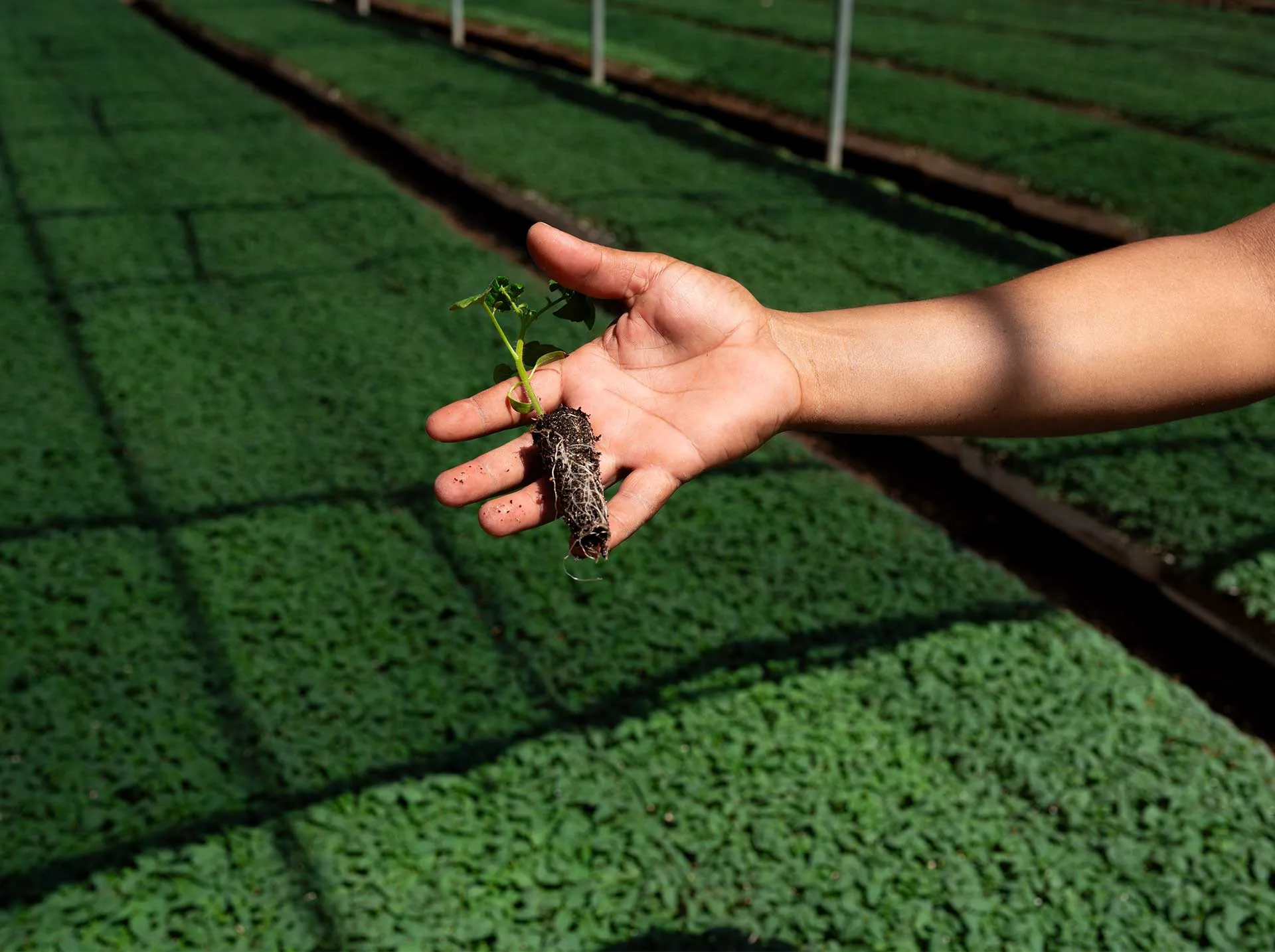
A number of Egyptian companies have built that capability. GAARA Seeds, an Egyptian seed development company, imports premium genetic material and develops it locally with the stated aim of improving yield and strengthening resistance to environmental stress — one instance of a model that has become more common regionally over the past decade: bring in strong base genetics, then do the adaptation work close to the field.
Closing the loop with export
What makes the seed question commercially urgent, rather than merely agronomic, is the feedback coming back from buyers.
European retailers have tightened pesticide-residue requirements, which rewards disease-resistant varieties over intensively sprayed ones. Buyers specify size grades and shelf-life expectations. Border rejections carry real cost, and Egypt’s quarantine authority has been expanding pre-shipment inspection agreements specifically to reduce that risk.
That information is most useful when it reaches the people selecting varieties. Increasingly, both functions sit within the same organisation. GAARA Group operates on both sides of that line, with GAARA Export handling fresh produce shipments to international markets while its seed arm works on the varieties feeding into them. When the same group carries both the breeding cost and the export risk, traits like transit durability stop being abstractions and start competing directly with raw yield during selection.
Market direction is shifting too. The European Union remains the largest destination for Egyptian citrus and potatoes, but exporters have been diversifying into Saudi Arabia, the UAE, Kenya and South Africa, and Egyptian food products now reach nearly 200 countries. Different markets want different things — sizing preferences, sweetness profiles, packaging formats — which pushes further variety differentiation back onto the breeding programme.
What the export basket actually looks like
For all the discussion of diversification, Egyptian exports remain concentrated. Across the full 2025 season, citrus dominated at around two million tonnes, with potatoes second at roughly 1.3 million tonnes — a ranking that has held into 2026. Beyond those two, the picture broadens considerably: sweet potatoes, fresh and dried beans, onions, grapes, pomegranates, mangoes, tomatoes, strawberries and garlic all ship in meaningful volume, with Egypt also ranking first globally in frozen strawberry exports and fifth in grapes.
The pattern that emerges is a sector with two very large pillars and a widening base beneath them. The pillars provide the volume and the foreign currency. The base — higher-value, more perishable, more specification-sensitive — is where margin and growth increasingly sit, and where variety selection matters most.
The constraints
None of this is settled.
Water remains the binding constraint on the whole system; Egypt’s per capita share has fallen below 500 cubic metres annually, less than half the international water-poverty threshold. Breeding programmes are slow and capital-intensive, limiting how many organisations sustain serious work. Variety registration timelines delay improved material reaching farmers. And adoption is uneven — smallholders, who work much of the Delta, often cannot absorb the risk of switching varieties without extension support and credit.
There is also a limit to what genetics can deliver. Heat-tolerant is not heat-proof. Breeding buys headroom, not immunity, and works alongside shifted planting dates, shading and adjusted irrigation rather than replacing them.
The quieter infrastructure
Egypt’s agricultural story is usually told through visible things: reclamation projects, irrigation schemes, port capacity, trade agreements. Those matter and are being expanded.
But a meaningful share of what determines whether Egyptian produce competes in 2030 is happening in trial plots and breeding nurseries, in decisions about which lines to advance and which to discard, made several seasons before any farmer sees a result. It is slow, unglamorous work with a long feedback loop.
It is also the part of the system that decides what a plant can withstand — rather than managing the conditions around it. For a country whose advantage rests on delivering quality in a narrow window under a hardening climate, that distinction is likely to matter more each year.
Sources
- Ministry of Agriculture and Land Reclamation / Minister Alaa Farouk, January 2026 — record agricultural exports of US$11.5bn in 2025; ~24% of total Egyptian exports; citrus at 2 million tonnes; sixth consecutive year as top global orange exporter; breakdown of secondary export crops.
- Ministry of Agriculture and Land Reclamation, July 2026 — 2026 exports surpassing 5.8 million tonnes; citrus above 2.2 million tonnes; fresh potatoes above 908,000 tonnes.
- Egyptian State Information Service, 2025 year-end review — first globally in frozen strawberry exports, fifth in grapes; 4.5 million feddans to be added to cultivated area in 2026; New Delta and Toshka reclamation.
- National Food Safety Authority (NFSA), weekly export consignment reports, April–May 2026 — consignment tonnages, exporting company counts, product variety breakdowns across fruit and vegetable categories. (Reported via HortiDaily, 29 April 2026, and Food Business MEA, 26 May 2026.)
- Food Business MEA, 13 May 2026, reporting Ministry of Agriculture and Land Reclamation data — EU as largest destination for Egyptian citrus and potatoes; tightened EU pesticide-residue regulation; diversification into Saudi Arabia, UAE, Kenya and South Africa; expansion of pre-shipment inspection agreements by the agricultural quarantine authority.
- CGIAR, Climate Change and Egypt’s Agriculture — ‘old lands’ at ~85% of cultivated area; new lands irrigation dependency; among the highest crop yields in Africa.
- UNDP Egypt — Delta farmer surveys identifying heat waves, strong winds and soil salinity as principal threats.
- American University in Cairo thesis on Egyptian agricultural climate policy — Delta yield decline of ~15% over the past decade, citing Fishar (2018). Note: the underlying figure dates to 2018; treat as indicative of the trend rather than current.
- Science of the Total Environment — North Nile Delta wheat modelling; 17.6% yield reduction under 1–4°C warming.
- Ministry of Water Resources and Irrigation, 2026 — per capita water share below 500 cubic metres against a 1,000 cubic metre international threshold.
