




Struggling with Compound Interest Questions? Read This First
Struggling with compound interest questions in SAT math is common, especially when time is limited. Many students understand the formulas but fail to apply them quickly during the exam. This real story shows how John Sam transformed his weakest topic into a scoring advantage—without wasting time on unnecessary study.
Why Compound Interest Questions Are Important in SAT Math
The SAT frequently includes questions based on exponential growth and compound interest. These are high-scoring areas because:
- Questions follow predictable patterns
- Concepts are formula-based
- Practice directly improves speed and accuracy
For students aiming for top scores, mastering this topic is essential.
John’s Problem: Weak Confidence Despite Clear Basics
John Sam had recently returned from a rugby tournament where his team lost the final to the California state team. While physically exhausted, his real concern was academic.
His SAT exam was approaching fast.
He wasn’t weak in mathematics overall, but compound interest questions created hesitation. His problems were specific:
- He knew formulas but couldn’t apply them quickly
- He made mistakes under time pressure
- He lacked structured practice
At this stage, watching long videos or starting from scratch was not practical.
The Turning Point: Smart Advice from July
John’s girlfriend July, a top student in class, understood the situation clearly. She didn’t suggest more study—she suggested better strategy.
Her plan included:
- Practice step-by-step <a href=”#”>compound interest questions online</a>
- Revise class notes instead of learning new concepts
- Solve previous year SAT papers
- Use trusted SAT prep books
She recommended:
- The Official SAT Study Guide
- Barron’s SAT
- Kaplan SAT Prep Plus
Her instruction was clear:
Focus only on high-impact topics and repeat them until perfect.
Important Formula for Compound Interest
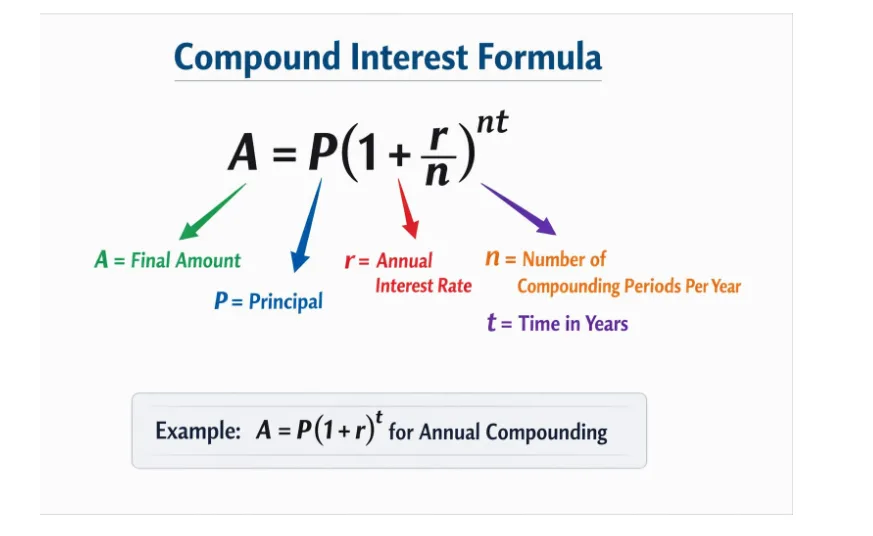
A=P(1+rn)ntA = P\left(1 + \frac{r}{n}\right)^{nt}A=P(1+nr)nt
PVPVPV
r (%)r\,(\%)r(%)
nnn
24681012141618205001000150020002500$2,653.300.4, 1020.8
Where:
- A = Final amount
- P = Principal
- r = Rate of interest
- n = Number of times interest applied per year
- t = Time
John already knew this formula—but now he focused on applying it quickly in different question formats.
Fast Strategy to Solve Compound Interest Questions in Exam
Instead of studying randomly, John followed a structured system:
- Daily Targeted Practice
He solved 15–20 compound interest questions every day. This improved:
- Speed
- Pattern recognition
- Accuracy
- Focus on Question Types
He identified common SAT patterns:
- Annual vs quarterly compounding
- Growth-based word problems
- Time-based variations
- Previous Year Questions
This was critical. He noticed repetition in logic and structure.
- Timed Practice
He solved questions under strict time limits to simulate real exam pressure.
- Mistake Analysis
After each session, he reviewed errors instead of ignoring them.
The Mental Shift That Changed Everything
Within a few days, John experienced a major shift:
- Questions felt familiar instead of confusing
- His solving speed increased
- He stopped panicking during calculations
He realized:
Success in SAT math is not about learning more—it’s about practicing smarter.
Exam Day Experience
On exam day, John approached the math section with calm focus.
When he saw exponential growth and compound interest questions, there was no hesitation. He:
- Identified the correct formula instantly
- Solved step-by-step without confusion
- Managed time effectively
What was once his weakest area had become his strongest.
The Result: A Life-Changing Score
When results were declared, John achieved an excellent SAT score—especially in the math section.
This opened new opportunities:
- Admission into a reputed college
- Scholarship benefits
- A strong career path
Unlike his elder brother, who had struggled after not performing well in SAT, John changed his trajectory completely.
A New Chapter in Life
Years later, John secured a well-paying job in a reputed company. His life became stable, progressive, and fulfilling.
July, who guided him at the right time, remained his strongest support system.
They eventually got married—turning a journey of academic struggle into a lifelong partnership built on discipline and trust.
Quick Strategy to Master Compound Interest Questions
- Focus on repeated SAT question patterns
- Practice daily with time limits
- Revise formulas instead of learning new topics
- Solve previous year SAT papers
- Analyze mistakes carefully
Final Thought
If your basics are clear, you don’t need months of preparation to master compound interest questions.
Consistent practice, the right strategy, and focused revision can turn your weakest topic into your biggest scoring advantage.
Start today—and make your preparation count.
