



This article examines the fundamental mistakes that lead to stagnation and liquidation of small manufacturing enterprises at the initial stages of their life cycle. The purpose of the study is to systematize the critical factors of failure and develop practical recommendations for their minimization. The objectives of the study include the analysis of theoretical models of the organization’s life cycle, the study of empirical data on the causes of bankruptcy of small and medium-sized enterprises (SMEs), as well as a detailed analysis of a practical case of successful development of an enterprise in the field of automotive accessories production. Based on the synthesis of theoretical provisions and empirical analysis, four groups of strategic errors are identified: lack of financial planning, stagnation of product policy, imbalance between demand growth and production capacity, as well as ignoring modern distribution and automation channels. The results of the work can be applied by entrepreneurs to form sustainable business models and anti-crisis strategies, as well as in educational programs on management and entrepreneurship.
The high dynamics of the economic environment creates significant challenges for small manufacturing enterprises, which form the basis of the innovative and industrial potential of many countries. Despite their importance to the economy, statistics show a high failure rate among startups in the manufacturing sector. A significant part of such enterprises cease their activities during the first few years [1]. The relevance of this study is due to the need to identify and systematize typical managerial and strategic mistakes that entrepreneurs make, which will allow them to develop preventive measures and increase the survival rate of small businesses. The purpose of the article is to identify and analyze fatal errors in the management of small production based on the synthesis of theoretical concepts and analysis of practical experience of a successfully developing enterprise.
The life cycle of a small enterprise is characterized by several stages, each of which involves specific risks. At the initial stage, or the “survival” stage, the main task is to reach the break-even point. Research in the field of SME management shows that the most common reasons for failures at this stage are problems with cash flow management and insufficient working capital [4]. An enterprise that does not have a long-term financial plan runs the risk of running out of resources before its products take a stable position in the market.
Another significant factor is the product strategy. In highly competitive conditions, an enterprise’s ability to innovate and develop in-demand products becomes crucial for its growth. The lack of systematic work on assortment development and quality improvement leads to a loss of competitiveness [2]. In addition, as demand increases, the company faces the challenge of scaling production processes. An untimely or inadequate expansion of capacity can lead either to an inability to meet demand or to excessive operating costs, which is equally dangerous for financial stability [6].

The evolution of the manufacturing enterprise (2010-2024)
For practical analysis, let’s consider the development trajectory of a Russian company specializing in the manufacture of automotive accessories. His story makes it possible to clearly demonstrate the overcoming of typical difficulties for small businesses.
The company was founded in 2010 with minimal start-up resources. The production process was organized in a 9 m2 workshop located on the territory of a private household. At this stage, the founder was personally involved in the development of all products, including the creation of patterns and models for car organizers, capes, pillows and other accessories, after which he launched them into small-scale production.
The first three years of operation were characterized by a lack of profit and constant investments in materials and equipment. This period corresponds to the “survival” stage, where the main task was not to generate income, but to create a product and test market hypotheses. Gradually, the products began to find their consumers, which allowed for a systematic expansion.
Over time, the production area was increased to 900 m2, and the staff grew to 12 people. Partial automation of production cycles using modern equipment has become an important stage of development. The range has been expanded to more than 100 product lines. In 2024, the company successfully entered a large online marketplace, which provided a sharp increase in sales and expanded its sales geography to Russia and the CIS countries (Armenia, Belarus, Kazakhstan, Tajikistan).
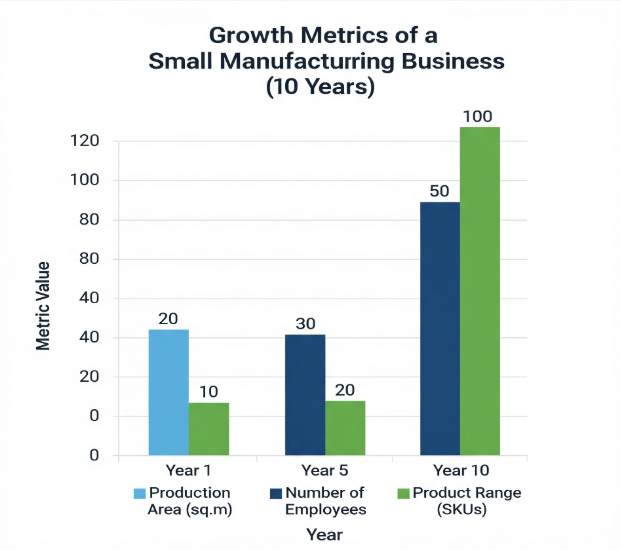
Identification and analysis of critical errors using the case example
The analysis of the presented case allows us to identify four potentially fatal mistakes that the company managed to avoid, which became the key to its sustainable growth.
Mistake 1: Lack of long-term financial planning. The three-year period of operation without profit is a critical point for most startups. The successful overcoming of this stage in the case under consideration indicates the presence of a strategic vision and a financial reserve that made it possible to reinvest all funds in development. Many enterprises fail precisely because of an incorrect assessment of the required time and resources to achieve operational profitability [4].
Mistake 2: Product stagnation and separation from market needs. The founder of the company initially assumed the functions of a designer and a development engineer. Direct control over the creation of the product ensured its high quality and compliance with consumer requirements. While many companies delegate or simplify this process, the company in question has relied on constantly expanding its product range to 100 items. This approach is consistent with studies proving a direct correlation between investments in R&D and the growth rate of a young firm [2].
Mistake 3: Untimely or chaotic scaling. The expansion of production from 9 m2 to 900 m2 occurred gradually, in response to growing demand. This made it possible to avoid two extremes: a shortage of production capacity with an increase in orders and unreasonable costs for maintaining excess space and equipment. Competent scaling management is one of the most difficult aspects of operational management in SMEs [5].
Mistake 4: Ignoring modern distribution and optimization channels. Entering a large marketplace in 2024 was a natural step in response to the digitalization of trade. Businesses that continue to rely solely on traditional sales channels risk losing significant market share. At the same time, the introduction of automation indicates a desire to increase efficiency and reduce costs, which is the basis for competitiveness in modern production [6]. Successful international expansion also confirms the correctness of the chosen strategy of market diversification [3].
The analysis allows us to conclude that the sustainability of a small manufacturing enterprise is determined by an integrated management approach that includes four interrelated elements. First, it is necessary to have a long-term financial strategy that can ensure the viability of the company during the initial investment period. Secondly, continuous product development and focus on its quality form the basis for long-term competitiveness. Thirdly, the scaling strategy must be flexible and strictly match the dynamics of market demand. Finally, adaptation to changes in the external environment, including the development of digital sales channels and the introduction of modern production technologies, is a prerequisite for growth.
Recommendations for entrepreneurs are reduced to the need to develop a detailed business plan with a pessimistic scenario of financial development, the formation of in-depth expertise in the product being created, the application of a step-by-step approach to expanding operations and active monitoring of technological and market trends. The experience of the reviewed company proves that consistent and systematic management based on these principles makes it possible to transform a microbusiness into a successful manufacturing company with an international reach.
By Arkadi Khachaturian, Entrepreneur within the automotive accessories industry
List of literature
- Storey, D. J. Understanding the Small Business sector. – London: Routledge, 1994. – 384 p.
- Stem E., Wennberg K. The role of R&D in the growth of new firms // Economics of small business. – 2009. – Volume 33, No. 1. – pp. 77-89.
- Coviello N. E., McAuley A. Internationalization and small firms: a review of modern empirical research // International Management Review. – 1999. – Volume 39, No. 3. – pp. 223-256.
- Perry S. S. The relationship between written business plans and small business failures in the USA // Journal of Small Business Management, 2001, vol. 39, No. 3, pp. 201-208.
- Hutten, T. S. Small Business Management: Entrepreneurship and beyond. – 5th ed. – Mason, Ohio: Cengage Learning, 2012. – 640 p.
- Rochman Yu.A., Herliancia M.K., Sudiarso A. Lean manufacturing implementation system for small and medium-sized enterprises based on the Sciencedirect database: a systematic review of the literature // Conference on the Widespread Dissemination of Science and Technology 2021 (BEST 2021). – 2022. – Volume 10, No. 2991.
